 |
| Posthouse |
Working as an editor on his brother’s films and others Nikolas Red has been involved in this industry for a long time now, but the arrival of his directorial début, Posthouse, at Halloween Frightfest, marks the first time he has done anything in Europe, so he’s pretty excited. He should be – in a strong line-up, it’s one of the standouts.
Following an estranged father and daughter who start rebuilding their relationship so that they can work together on film editing, it’s set in a context he knows well, but it covers much more besides, from the history of Philippine cinema to colonialism, the challenges of growing up in a famous family, and the country’s rich and complex folklore. He was disappointed not to be able to make it to the Frightfest screening, but happy to connect to talk about his work. We began by discussing his editing work.
“That's basically my bread and butter,” he says, trying to work out how long he’s been doing it for – something like eight years, at least in terms of the professional stuff. “It's just through editing films and watching films that I got the hang of the bare bone basics on how to make a film. Most of the films I've edited were also, very conveniently, directed by my brother [Mikhail Red]. We usually work in tandem in most of these films. So the creative process is not that new to me. Of course, for the first time I was the director, but still we worked a lot in the editing room in the post production process. So yeah, it's not exactly my first rodeo, but of course there's also a lot of challenges came my way being a first time director.
“In terms of treatment, that's where I guess my editing shone through by the use of different visual treatments. Of course you have the silent film effect, but to complement that, I added kind of a mixed media effect, so I also used many modern techniques and visuals. There was a VHS portion as well and even social media visuals that I used. So there was that kind of experimenting going on.
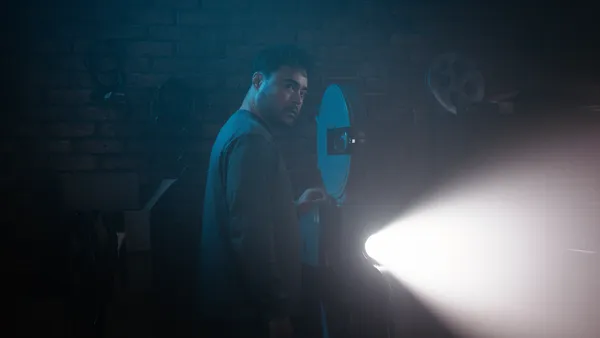
“You can say it's also an editor's film since that also pertains to the setting, I guess. It happens mostly just in one location in one night. It kind of mirrors my own experiences working as an editor late in the night, alone in a posthouse. In fact, that's where I actually got the idea to make a film like this. It was during this one time I was editing and, very long story short, I saw a ghost in part of the raw footage. And that just gave me the idea, you know – why not make a film about something like this? Because I don't think I've watched many films focusing on an editor, per se.”
Was it a real post house that he shot it in?
“No, but funnily enough, it used to be a media place, more for broadcast. It was an old studio. It's now actually a seminary for Catholic priests. So they repurposed it. But it was very convenient because most of the rooms there, they contain this very old equipment and also these recording sound stages and studios where. It complemented the film. But, yeah, I picked it mostly because of the way it looked. There are silent film portions in the film. It looked like one of those old set pieces you see in really old silent films. So that actually gave me that idea to shoot there, basically. We were very lucky”.
I tell him that I find it really interesting because there are three generations of a family that the film talks about, and each one of them is using very different film techniques. Was he interested in using it to talk about the history of film?
“Yeah, definitely,” he says. “It kind of ties into the treatment of using mixed media. Because I wanted to represent those layers of these three generations that went through this same entity, this thing that was haunting them.
“The creature appears in the silent film form and also in the more modern form, and kind of mirrors these three generations. And of course, this is kind of based on my own experiences as well. I am a second generation filmmaker as well. My dad [Raymond Red] is also a filmmaker and I have these fond memories of him still editing on this very old equipment. Kind of like in the film, he was editing using a Steinbeck analogue editing machine. There was this image of him – I saw him working with a lot of film strips and he looked like a mummy because the strips were all over his body.
“I've never worked with actual film and I'm working digitally using Premiere Pro. I think that those are the things that I take for granted in a way. The editing process today is a lot easier than it was before. So I also wanted to highlight how raw and very manual the editing process was before. It also added that element of film meeting digital format in present day.”
In the film, protagonist Cyril inherits some film from his father. There's the sense of the Philippines inheriting film traditions and that changing through time. Was that also something that he wanted to touch on?
“Yes – our cinematic heritage and history in general. In the film, of course, there's also that element of an American expat, basically his grandfather. And that ties in our history with how cinema was introduced. The pioneers here who made the first silent films were Europeans and Americans. It ties in also with our colonial past because they were our colonisers before, and even though they gifted the machinery to make our first films, unfortunately it came with a cost. They were also our colonisers.
“Of course it ties in with the subject that this whole film revolves around, which is our silent films. And in fact, all of our silent films are virtually lost. We've never recovered a single one of them. So it’s a sad message or a sad love letter to these films or the cinematic characters that we've lost. And there's also that horror aspect to it where, you know, it's somewhere still out there waiting to be recovered. What would we see and find out when we do recover these artefacts from the past?”
We talk about the creature itself – the mananaggal – which has been around in the Philippines, in folklore, for far longer than Europeans or Americans.
“It's been part of our myth even since before the Spanish came to the Philippines,” he observes. “That was our first colonial experience. But I can only imagine how this creature or the depictions of it gradually changed or evolved through time. And in fact, maybe some influences of Americans came into play where it borrowed aspects from the modern vampire. I think it gradually became an amalgamated thing. You know, it's just pieces from different cultures blended together as well as, I guess. Well, another trivia, of course, was the very first horror film made in the Philippines was about the Mananaggal. It's an actual film that was lost.”
We discuss one of my favourite scenes in the film, in which the young Cyril, disturbed by a noise in the night, goes downstairs holding out what Nikolas explains is a Voltes 5 sword from an anime that was a big hit there [until President Marcos banned it for supposedly being a dangerous influence]. Because he's so young, the boy he thinks he can defend himself with it – he's taking something out of a fictional environment to defend himself against something that he perceives as coming from a different fictional environment. There’s an overlap of fiction and real life and fiction and memory all the way through the film – and, Nikolas admits, a bit of inspiration from The Empire Strikes Back as well. Cyril has a difficult legacy to deal with.
“He inherits the same machismo abuse aspect from his great grandfather and also his grandfather. But depending on the times, it manifests in different ways. So maybe now it's more about him being disappointed. Disappointed about his career and lashing out against his daughter. It’s basically a story about passing on generational trauma to your next in line. And there's a hope that maybe the next generation would cut off this vicious cycle by ending it. That, of course, is up to Rea, the daughter, the next generation.”
She seems very different, I note, but I think that’s partly technological. She's different because she doesn't have to deal with the world in the same kind of complicated physical way that the previous generations did. Everything's so simple for her.
Nikolas nods. “There's also sense that the generation today, in some ways they're more practical than the previous generation. I dare say smarter.” He shrugs. “Maybe not smarter, but these older generations, they have these traditions or things that aren't necessarily practical, but they still do it their own way. And what Rea represents here is the newer generation.”
There are also some things that she doesn't really understand because of that, I suggest.
“Yeah, of course. She's also oblivious to the whole abuse. She didn't really bond well with her father. She's smart but she's not really aware of the history behind film. And that's where I guess Cyril comes in to play, to enlighten her on these artefacts from the past and how we used to do films traditionally.”
We move on to talk about the practical process of making the film..
“First there was the pressure because it's still a studio film in some ways,” he says. “You could consider it, you know, mainstream because, well, it’s maybe not a luxury, but I'm one of the lucky ones to have actual studio backing to make my début feature. But with that said, there was also the challenge because we worked with a very modest budget. We actually shot it in nine days.”
I make an involuntary sound. That’s tight, even by indie standards.
“I can't believe that we did it in nine days, but there was that challenge,” he says. “But I was also happy to embark on it because many first time filmmakers here in the Philippines, that's what they usually go through. They work with a very modest budget. I was actually quite surprised how the film turned out. You know, going to your first feature, you expect all these problems that might come up. I don't know if I was just really, really lucky with the crew that I had, and of course, the backing of my brother by my side and my producer Iana [Bernardez].
“It was a pretty much happy experience. I enjoyed every step of the way and I'm actually looking forward to making my sophomore feature. But you know, for now I'm happy with how Posthouse turned out. I guess maybe the biggest step coming from being an editor to actually making the film was finally you're working with actors because, you know, spending being alone in an editor's office is way different from actually having to be a people person and all of a sudden interact with these people. Even the lead was a veteran actor, so I was kind of intimidated working with him. But he loved the script and we got to jam pretty well, so it turned out a good experience as well.”
I point out that the advantage of working with veteran actors is that they know exactly what they're doing and what's expected of them. Did he have a chance to rehearse with the actors, or did they just have to go straight for it?
“We didn't really have time to rehearse but we had maybe a couple of days talking about the backstory of the characters and what a good approach would be to portraying these characters,” he says. “To be honest, you know, like, we had a script, but being my first time making a film, there were also many times where we were pretty much going with the flow, and there were many impromptu moments. Maybe just in the day itself we would decide to go another route with the script. And the actors, they had to be very versatile in in adapting to any situation, because sometimes we would change a certain direction in the story. There was that, but it wasn't a very physically taxing shoot, I guess. I mean, there were a few jump scares. Rea had to have blood effects on her, but we didn't really have to spend much time. Also in coordination, it was really more on mounting the jump scares with the prosthetics and the creature itself, the camera movements, which was challenging, but thankfully, it didn't require much of the actors’ time.”
Is he able to reveal anything about the film that he’s planning to do next?
“All I can say is, you know, me and my brother, we work in a studio where most of our films have been horror films. And of course we do want to branch out eventually into other genres. I was thinking of not entirely leaving horror, but I want to dabble more into romance. So I thought, why not make a romantic thriller or romantic horror film, which, if you think about it, it's basically a Hitchcock film like Vertigo, where there's a romantic couple but they go through something thrilling or something horrifying. So, yeah, I want to go that route for my next film.”
In the meantime, I assure him, Posthouse has what it takes to be an international hit.