 |
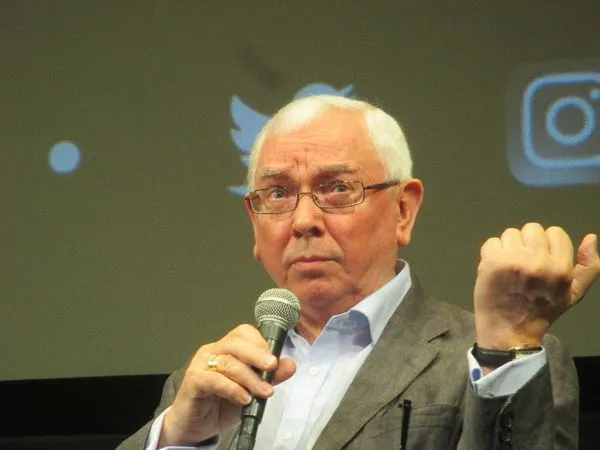
| Terence Davies in New York to talk about A Quiet Passion Photo: Anne-Katrin Titze |
Writer and director Terence Davies has died at the age of 77.
The Liverpudlian director, whose films included Distant Voices, Still Lives and Benediction died peacefully at home after a short illness, it was announced on his Instagram page.
He may not have been Britain's most prolific director - with just nine full-length features across his 50-year career - but the films he made were beautifully crafted and emotionally resonant, often featuring autobiographical elements about growing up in working-class Liverpool. They also frequently had an elegiac element.
In his best known early work Distant Voices, Still Lives, he crafts an evocative portrait of family life in his home city that drew heavily on his own, which is as much about the nature of memory as the events that occur in a household run by the volatile hand of its patriarch, played by Pete Postlethwaite.
He also drew on his own life and his Catholicism for his trilogy of short films Children, Madonna And Child and Death And Transfiguration.
Beyond his own life he was also known for handsome adaptions, including Terence Rattigan's The Deep Blue Sea, Edith Wharton's The House Of Mirth and Lewis Grassic Gibbon's Sunset Song, which took 15 years to get off the ground. He also turned his hand to full-blown documentary with his portrait of Liverpool, Of Time And The City.
With his poetic approach to filmmaking, it's little surprise that he was at his finest when tackling the lives of poets themselves. A Quiet Passion, starring Cynthia Nixon, looked at the life of Emily Dickinson, and he found his perfect match with Benediction, the story of poet Siegfried Sassoon - played in the flush of rebellious youth by Jack Lowden and in the bitterness of old age by Peter Capaldi.
There's a pervasive sense of melancholy about Sassoon's inability to reconcile his own feelings and faith - something Davies, who said he was "terribly devout" in terms of Catholocism as a youngster, doubtless relates to, as he once told The Guardian: “I have hated being gay, and I’ve been celibate for most of my life."
When it came to directing, Davies once told us: "What I've always said to the actors in every film: I don't want you to act, I want you to feel it. Because then it's true. Once it's acted it becomes a collection of mannerisms."
The Instagram post about his death ended with a quote from Horace: "Pulvis et Umbra Sumus (We are but dust and shadows" and a second from Christina Rossetti: “And if thou wilt, remember, And if thou wilt, forget.”
Davies' work - so rooted in the real, yet so imbued with the spiritual and the poetic - only blooms more in the memory with time.