 |
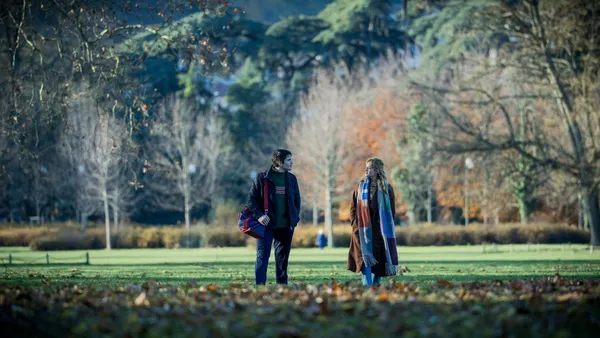
| Two Pianos Photo: Emanuelle Firman, courtesy of Why Not Productions |
French filmmaker Arnaud Desplechin’s Two Pianos tells the story of Mathias (François Civil), who ends his self-imposed exile in Japan, and returns home to Lyon, France. He’s lured back by his former mentor, Eléna (Charlotte Rampling), who has invited him to perform alongside her at a series of concerts. However, an unexpected encounter with a young boy, who has a startling likeness to him, leaves Mathias bewildered. Then he crosses paths with Claude (Nadia Tereszkiewicz), a woman he had an affair with some years ago. After she chose his best friend Pierre (Jeremy Lewin), her future husband, over him, Mathias did the only thing that felt right. He left his hometown and made a new life teaching and performing in Japan.
Desplechin began his career with the 55-minute film The Life Of The Dead (La Vie Des Morts), about a family that seemingly cannot escape death’s shadow. He followed this with the espionage thriller The Sentinel (La Sentinelle), a 19th century set drama about the allure of the stage for a starry-eyed Jewish girl in Esther Khan, and the black comedy, A Christmas Tale (Un Conte De Noël). He directed Benicio del Toro in Jimmy P, an adaptation of anthropologist George Devereux’s 1951 book Reality And Dream: Psychotherapy Of A Plains Indian. Also starring Desplechin regular Mathieu Amalric, it’s the story of the relationship between a Native American veteran and his French psychoanalyst at a hospital in Topeka, Kansas. Meanwhile, Two Pianos shares something in common with Ismael’s Ghosts, which is also about former lovers crossing paths again.
In conversation with Eye for Film, Desplechin discussed clumsy choices, the appeal of darker stories, and shouldering guilt. He also spoke about his appreciation for melodrama, being haunted by the past, and the significance of the figure two.
The following has been edited for clarity.
Paul Risker: Can you remember the moment when you first became entranced by cinema, or any early memories that have stayed with you?
Arnaud Desplechin: I remember watching my mother listening to a film programme on the radio one Sunday evening. I also remember there was a polemic in the newspaper about the Walt Disney movie, The Jungle Book. I only read the headlines, but what the French critic was saying about the film, and I knew this from my parents, was that Walt Disney was a racist and was on the extreme right. Belonging to a leftist family, I thought I wouldn’t be allowed to go see the film, but my mother said, “Yes, you will be allowed to go.”
I loved it, and I still think it's a good film — ambiguous, but still a good film. I thought about how wonderful it is that, in entertainment, you can say it's leftist or rightist, or you can say it has this philosophical issue, but these films have an unpredictable depth. The Jungle Book was made for me because I was a child, but I loved that there was a political message — I wanted to be part of it and to write those little hidden messages in the film.
When I was nine years old, we didn’t have a TV at home, but my grandparents had one. I saw Alfred Hitchcock’s Marnie on a Sunday afternoon in black and white. And I was shocked. The adult world depicted in the film was cruel and brutal, but I found darker types of stories like these interesting. The connection between dreams, fairy tales and reality in cinema is mesmerising, and the fact that films are all three, offering you the dream and the harshness of real life in the same space is their beauty.
PR: Were there any moments that led you to choose a career in filmmaking?
AD: Oh, I was much clumsier than that, because my family knew no one in the business — no one in the theatre, no actors, no technicians, nothing. So, when I told my father I was interested in working in film, he was devastated. He thought I would just be employed and poor, that I would have a cheap life and that would be it.
I knew there was one cinema school in Paris, which I learned how to spell: IDHEC [Institut des hautes études cinématographiques]. In France, when you are nine-years-old, your teacher will ask you what you want to do when you grow up. I wrote IDHEC, but my teacher didn't know what it was, and I told them it was the cinema school.
I had no idea what it meant to be a director until I arrived in Paris. I was still young, only seventeen, and over the coming years, I discovered what directing was about. But I have to say, it's still a mystery — I have no idea.
The director is the only one who doesn't have to do a thing on a film. It's a waste of time, right? The sound recorder is recording the sound, the DOP is working the lights, the grip man is laying the tracks, and the writer is writing the script. What use is a director? And so, last year, my son, who didn’t know if he wanted to be a DOP or a director, asked me what a director is. I said, "In cinema, he’s the guilty one.” I then told him, “You can be a director if you’re willing to be guilty,” because if the actors are no good, then it's your fault. It’ll be because it was miscast, or you didn't write the proper lines, or you were not able to help them. If the lighting is silly, it's because of your lack of dialogue with the DOP. If you can't park the trucks, it's because you didn't scout properly. So, it's always your fault. I told him if you can deal with that, then you can be a film director.
PR: You’ve been doing this for a while now.
AD: I was lucky, because I didn't start that young. I made my first film, The Life Of The Dead, when I was 29. I’d already spent a lot of time being an editor, DOP, and scriptwriter, and so, I was just happy to direct a film at last.
I love to compare my work to an actor who is given a text and tries to find its meaning, because that's what I'm trying to do — it’s an interpretation.
PR: What was the genesis of the idea for Two Pianos?
AD: I had wanted to work with Kamen Velkovsky, the co-writer, for a long time. The two of us had met on Jimmy P. He doesn't speak French, but he wanted us to write together.
One summer, three years ago, we were on Skype, and he asked, “Okay, what do you have?” I told him that I had this idea of a young Christian widow telling an obscene Jewish joke at a funeral. She’s too young to be a widow and the death of her husband was brutally sudden, leaving her in a blur. Then, I asked Kamen what he had, and he told me about this pianist returning to his hometown to perform at a concert. Meanwhile, in the park, he sees a child that looks like him. It sounded like a fairy tale, and I asked, “But whose child is it?” He said, “It’s the child of your widow.”
So, we had our film in two sections. One was about Eléna and Mathias, who returns home to perform a series of concertos with his former mentor, but is haunted by the child he encounters. And when Claude’s husband Pierre dies, we have the film’s second section. She becomes Eléna’s rival when hers and Mathias’ and paths cross again.
The idea was to have a melodrama with a mystery, where ghosts are everywhere in the melodrama, and the mystery with its emotions has a purpose and a soul. So, that’s how the film started.
PR: Mathias and Claude are characters reckoning with their own pasts. This makes them relatable because it’s not uncommon to feel haunted by the roads one travels in life.
AD: Yes, we are trapped in our past, and we never stop trying to escape it. There’s also guilt in our past. I'm thinking about Claude, who was too young to be pregnant and who suddenly wound up making guilty choices. It was a mess, but she couldn’t do anything other than accept it. And it's the same for Mathias, who was a young piano player who was too brutal and a bit too dangerous for Claude, whereas Pierre was more comforting. So, Mathias escaped from this broken love affair, but all of the characters are full of despair.
I love the final image before the film’s epilogue. After having sex with Mathias in the hotel, Claude leaves, and she’s barefooted as she waits for the elevator. In this moment, she is in contact with the world, and she’s no longer trapped in the past, trying to escape to another life. She’s without the man she loves, but she’s free now and can finally become herself. And the following scene is Mathias going to the piano performance. Sat at the piano, the first thing he does is take off his shoes. Like Claude, he’s in contact with the world. It’s about escaping the burden of the past, or at least, that’s how I see it.
PR: There’s a powerful moment when Claude tells Mathias, “I loved you both back then.” He says, “And you cheated.” She murmurs a tearful “No.” We habitually seek to simplify everything, including emotions and feelings. It’s also common that love and affection are shrouded in the possessive, and it’s perceived that emotions are easily governed by ethics. This exchange in Two Pianos is an example of how the story tries to understand its characters and the human experience in a deeper way.
AD: Falling in love has to do with knowledge, and so, by falling in love, you better understand the world. I don't like the idea that feelings are simple. They are awfully complex and that’s why they are appealing, because they can conflict with one another. You can hate and love someone at the same time, and it’s this complexity that makes emotions interesting. And that's why I love emotionally driven films.
When Kamen and I began working on this film, it was originally called An Affair to Remember, like the Leo MCarey movie. These melodramatic films were despised when they were made in the 30s and 40s. They were referred to as “women's films” or “women’s pictures,” as if it were something you had to despise. But I'm proud to be making a melodrama, a genre that was once looked down upon, because you learn a lot from the genre’s range of complex emotions. And this is what makes these films beautiful.
PR: In what way does the energy and the intricacy of the piano playing, alongside the space of the stage itself, tie into communicating the film’s themes, ideas, and metaphors?
AD: My thought was that when Mathias and Eléna are playing face-to-face, these huge black pianos are menacing and beautiful at the same time. The beauty of it is the intricacy of the pianos, which are a link between a mentor and her student, as well as their absolute friendship.
Thinking about these two pianos, the film’s title and this metaphor, Claude is trapped between two men, and Mathias is trapped between two loves. He's dedicated to both Eléna and Claude. And by going back to the piano at the end of the film, strangely enough, Eléna wins and Claude loses.
The story is also about the little boy, Simon, who has two fathers. He will have to choose one or the other. And Lyon has two rivers, the Rhône and the Saône. Everything suddenly made sense in a beautiful way: two pianos, two rivers, two lovers, and two fathers. This figure of the double worked perfectly for the film.
Two Pianos screened at the 69th San Francisco International Film Festival, and is released in US cinemas from Friday 1st May by Kino Lorber.