




 |
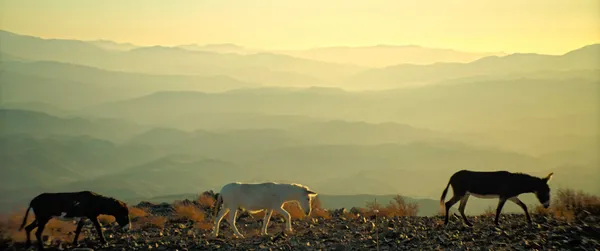
| Palaye, Palomo and Ruperto in Perfectly A Strangeness Photo: Nicolas Cannocionni |
Three donkeys go wandering in the desert. Climbing a hill, they discover an observatory where everything is still and quiet and seems frozen in time. Then, as darkness falls, a mysterious transformation takes place. This is Perfectly A Strangeness, and it’s a distinctly unusual film to find among the documentary short Oscar nominees. It’s a breathtakingly beautiful piece of work which says a good deal without words, but there’s plenty more to say about it.
It reminded me of Patrizio Guzmán’s Nostlagia For The Light, I tell director Alison McAlpine when we meet. She’s surprised at the comparison, not because she can’t see what I mean about theme and imagery, but because the most important thing for her about her film is its very different structure. Taking that as a jumping-off point, and noting that it’s particularly rare in the context of the Academy Awards, I ask what it was that drew her to that form of storytelling.
“I did a film called Cielo in the same area, and I had to deliver a short,” she explains. “I wanted to do something that felt really different, even though I had to do it in that region. I wanted to tell this tall tale that had happened in 24 hours.
“My first film was made in Scotland and I've always been influenced by oral traditions. I really wanted to go back to that. How could I tell an uncontrived, simple story in the best sense of that word, you know, like a great storyteller or a great actor would do it, and do that without text, without dialogue?
“I love trying to create something that really feels sensorial. When we shot my film Cielo, there were often donkeys around the observatory, which I loved, so I thought, well, how do they see this world? And then began an exploration in terms of how do you replicate their near-panoramic vision? We used anamorphic lenses. We were speaking with scientists and then putting a light on a donkey's eyes and sometimes seeing, in certain eyes, these amazing shapes and colours, even though they look dark to our eyes.
“I had many questions about donkeys and how to create something that felt non-anthropomorphic. I'm not so keen on the documentaries, which feel a little cute for me, about animals. Obviously it's a human perspective, but we tried to create a more visceral feeling.
“My first experience in the observatory was when I arrived just after noon – well, it must have been the afternoon, a little later – and everybody was asleep, everybody being scientists and staff in the observatory. I walked around because it's so beautiful and fascinating, and I felt that these domes were somehow alive because you could hear little sounds.
“It reminded me of this experience I had in Orkney, Scotland. I did a bit of teaching in the UK before I did my first film. There’s a local legend about the Ring of Brodgar, that at midnight the stones begin to dance, and they dance all night until dawn. After my first day and night in the observatory, that felt like what happens there. These metallic domes that feel like giants open up to the sky and they chase the stars and dance. And then when the dawn comes again, they fold up their eyes to the universe and sleep again. So those were a couple of sources of inspiration for this film.”
I loved that idea of the observatory coming to life, I tell her. The film is full of cycles like that. It also made me wonder if visiting that place might be part of the donkeys’ daily routine.
“It's a lovely thought,” she says. “They're certainly around. Sometimes scientists, because they know I have a weakness for donkeys, they send me little clips, like ‘There are this many donkeys here.’ And of course, they do hang out. I think also in the kitchen, there's other people who love the donkeys, so they give them some food, which encourages them to hang out. But I like the image that they're looking there too.”
There’s a point at which one of the donkeys seems to be trying to work a water pump, I note.
“Interesting,” she says. “I don't know. They certainly were scratching on things. There is not a lot of water in that desert, but they are given water by the staff. You always feel very conscious around it anyways, being in that observatory, because, you know, you could have a shower for hours if you wanted, but there's very little water in that area.”
Did she direct the donkeys much, or simply follow them to see what emerged?
“I directed them in a sense,” she says. “We rented donkeys. We didn't try to use the wild ones. That would have been impossible. The donkeys that you see there are a combination of domestic donkeys, because there's farmers just below the observatory gates, and there are also a lot of wild donkeys in that area. We rented donkeys from farmers.
“I had written a treatment about where I wanted them. We started them below the observatory because I wanted them in this unnamed desert, and so we had to get them up the hill. Sometimes that was quite difficult and challenging. We simply had to be patient and do a number of takes and give them food and not give them too much food, etc. And then I wanted us to be with the donkeys, whatever they did. They're exploring, we're just following them.
“It's such a magical place. Any excuse to go back there, I go back. But you're going with the pace of the donkey, right? It's playing on the title of the film – Perfectly A Strangeness, that everything's rediscovering the world as if for the first time. So going at that donkeys’ pace and being willing to seek to film, to be 100% present, when the donkey decides to do that thing with his ears, like antennas. It slows you down. It helped me appreciate in different ways this experience in this extraordinary environment.”
Then there’s Ben Grossman's music, which is a very powerful element in the film.
“It was such an extraordinary gift to work with Ben,” Alison recalls. “He's a hurdy gurdy improviser – that’s what he’s known most for. He's just such a lovely human being. I gave him the challenge, which he says was for him a very exciting challenge, which was I wanted music that felt improvised. So there was this subtlety which, you know, you don't know at first what's music and what's observational sound, and it gradually builds until it becomes more symphonic, as the observatory comes to life.
“The process was just a lot of talking with Ben and going back and forth and sharing and asking. I wanted him to give this palette of sound, which is not easy to do, which feels fresh – without associations, you know? It feels like we haven't heard these sounds before. And so we're not thinking that something scary is going to happen to the donkeys or something. It has that openness and transports because there's no dialogue.
“Obviously the instruments he chose, like the hurdy gurdy, the tuba, the pianet from the Seventies, are not instruments you normally hear. And he didn't use one observatory sound. The only observatory sound is at the end when the observatory is closed.
“One more thing that I wanted, and he agreed, is that the sound of the hooves are part of the score. He was just beautifully open to creating that subtlety. He’s a composer who doesn't need to put their stamp on it that says ‘I'm composing this.’”
The film has done extraordinarily well at festivals. Was she expecting that or was it a surprise to her when it took off the way it did?
“The whole thing has been a surprise,” she says. “It's just been such a gift. It's arts council funded, mostly, and so many companies helped and so many creatives gave so much. We really were just playing, trying to create a beautiful film. We applied to Cannes because I was with my Chilean editor and we noticed the film was 15 minutes. And somebody said ‘Oh, official selection. It's free and it's 15 minutes.’ And we just thought ‘Why not?’
“I didn't expect it. They never accept documentaries. So it was out of the box, I think maybe you could say, in Cannes too. It's been this out of the box film that somehow keeps traveling – and the fact that it's been nominated for an Oscar, it's wild and wonderful.”
Whatever happens at the Oscars, she says, it won’t change her approach to making films.
“I really want to create cinema. I just want to push myself. I've been so lucky to work with incredible creative teams. I want to explore, you know, whether I ‘succeed’ or not. Of course, one wants to create a beautiful film, but you're just jumping in there, right? And I just want to stretch myself. It's such a mad journey to make an independent film. We're the only independent, I think, in our competition. But that's what I want to do. I want to work with that spirit as long as I can.”