 |
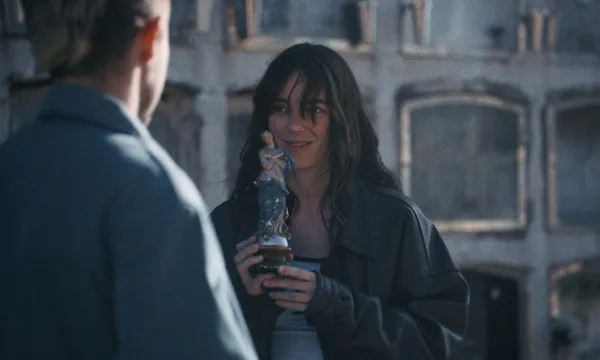
| Victoria Luengo in Saints. Mikel Gurrea: 'She was very important to the building of the character' Photo: Courtesy of San Sebastian Film Festival |
A mother/daughter relationship drama is married to a heist film in Mikel Gurrea’s second feature Saints, which sees him reteam with Victoria Luengo, whose career has really hit its stride with films including Bitter Christmas and The Beloved since she starred in his debut Cork (Suro).
She plays Lali (Victoria Luengo), a petty thief and drifter whose life is upturned by a phone call from her mother (Ariadna Gil), who is terminally ill. Returning home to care for her, she is tempted into a spot of theft in the hospital chapel, making off with its carving of a saint. Trying to fence it she encounters a gang run by Rosario (Eulalia Ramón), a former nun, who becomes a second matriarch in her life.
Saints – which also refers to the Barcelona neighbourhood where the film is set – had its premiere in competition at San Sebastian Film Festival, where we sat down with Gurrea to talk about it.
It seems he was the only one who was surprised when Luengo ended up as the lead.
“I was deliberately not thinking of her or anybody. So I started writing, trying not to think of any actresses because you never know if they're going to be available and all of these things. But then, very quickly, it was very obvious that I was thinking of her. I remember when I opened that discussion with my producers and collaborators, they told me, we knew all along. From that point until we actually finished the script and started shooting the film we opened our collaboration with Victoria for a year. We would workshop some ideas that I would then revise with my little camera, and then watch the footage and some of those ideas I would take to the script. So she was very important to the building of the character.”
“We took a trip to the Badlands where the film starts, so we kind of gave the character a routine. Then she had this idea of the teeth, because she had broken her tooth in the theatre years ago, so she has like a composite cap, and she said, ‘I think I should remove it for the character’.
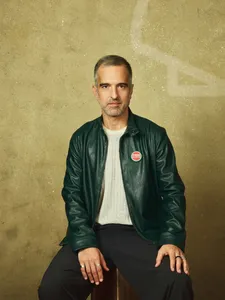 |
| Mikel Gurrea in San Sebastian Photo: Courtesy of San Sebastian Film Festival/Jorge Fuembuena |
Although Gurrea is Basque, this film, like Cork, features Catalan. He explained: “I live over there in Barcelona and this film started out with me speculating on the name of the district where I live, which is Sants. It is not a particularly religious or Catholic district. I love it there. It's quite working class and it has a lot of anarchist background. Then I started interrogating this name, and I found out that there was a church that gave the name to the district. So I thought, okay, I should go there, and every time that I went, I found it locked. That's when I kind of had this idea of a locked Temple. A locked church is a bit like a vault with things that could be stolen. I started reading a lot about religious living in Spain, which has a long, long tradition and is well documented. And that's how the film started.
“So, it was always going to be Catalan because it's kind of rooted in that district.”
One of the most striking elements of the film is the production design because Lali and her gang steal a number of religious artefacts, big and small. Gurrea says that they had a three-pronged approach when it came to creating props that looked authentic.
“We do have the real icons of the cathedral at some point, which we were allowed to touch but not remove. Then we would have real icons that we would purchase at auction and things like that, so that took a bit of research and budgeting. Then the third layer was 3D printing and craftsman painting. So we would scan real models and then we would recreate those with 3D printing and then a real religious statue painter would paint them with the pigments.”
With all that preparation, it was one of the first areas that Gurrea and his team tackled.
“I think maybe that was the very first discussion that we had with the production designer. Knowing that we would have to be very determined about which ones. It wasn’t so much me saying, ‘I want this icon and that icon’, it was, ‘What’s in the market, what makes sense to the locations we’re going to be allowed to shoot in because it was also a big thing to be allowed into these chapels and churches. So it was quite a bit of work and preparation, but we managed.”
Although Gurrea says he is “culturally Catholic”, it was really through the research for the film that he learned a lot more about the iconography.
“Looking at these things as potential objects to be stolen, which is also a kind of devotion in itself towards the piece of art and reading about religious art thieves, I bumped very quickly into the real character of Erik the Belgian. He was a very famous religious art thief in Spain and in Europe, and he left his Memoirs.
“He said these very ambivalent things that almost felt like a holy appreciation towards his icons, but also with this ambivalence about things that are stolen and the meaning of them and how the meaning is given when he used to bring those objects to the buyers and the buyers would cry in front of them.
So, I thought, how interesting that this very same object depending on how you look at it has different meanings, so I kind of wanted to play with that and see where the viewer stands in that and also where the main character stands.”
Ambivalence is something that runs through the film, with Rosario’s character also being partly a mother figure, partly religious given her background as a former nun, but also having a harder side in terms of running the thefts.
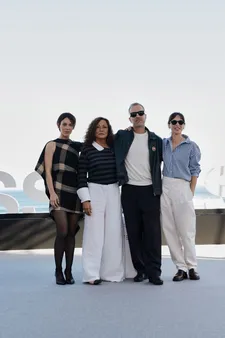 |
| Victoria Luengo, Eulàlia Ramon, Mikel Gurrea and Ariadna Gil in San Sebastian Photo: Courtesy of San Sebastian Film Festival/Jorge Fuembuena |
“She's a bit of a mother, she can be a bit of a mafia boss leader but at the same time,s he never quite lies. We were very careful with the actor Eulàlia and co-writer Francisco Kosterlitz to never have her say bullshit.
“Also I think there’s a kind of recognition between Lali and her. I think they see each other. Lali, if she made certain decisions, could be a version of Rosario. So, I think it was. It was fun to play with that.
Both Gurrea’s features have strong women at their heart and a female-focused story. He says: “I made a short film quite a while ago and it was very linked to my biography, and I couldn't crack it. Then, one day, I decided to change the character to a teenage girl and that freed me up a lot.
I think even if you write about something far from your experience, like this religious art trafficking, you are kind of playing with your own sensitive materials, so I've I've always thought that it was freeing just not to think, ‘OK it’s a bloke with my experience.’ Then the character allows me to follow her a bit more.”
The heist element of the film is particularly strong and it’s something Gurrea says he had a lot of fun with as it took him back “to the cinema I love”.
He adds: “I always talk about the old Jules Dassin films Rififi and Topkapi. I love those films because they are so playful and there is some almost balletic element of the heist itself. The elevated ballet choreographic thing very quickly became linked to the ritual itself – the religious ritual, if you want, because we are thieving from temples in this movie, but at the same time, perhaps the ritual of caring.
“Going back to your previous question, it was important that it was daughters and mothers in this sense, because the burden is more intense there, the caring is imposed on women in a much stronger way. I wanted to start with a character who was very carefree and see if, in this sense of guilt and duty, which is very Catholic, she could find a sense of wanting to be there just for that period, which is not going to last very long.”
One of the notable elements of the heist is the size of some of the saints that the thieves go off with and Gurrea says he wanted to do everything with practical effects.
He adds: “We wanted this very delicate element so that it almost felt like shadows stealing – another film I could reference is Irma Vep, because it has this thing of almost looking unreal but it’s very physical. So that took me to surrounding Rosario and Lali with some people from the circus and some people who are trained and have a lot of control of physical language. So that all those sequences could have that element.
“And, when they are on the roof, we were always going to be on the roof. There was no question that we would use CGI or a drone shot.
“Surprisingly, the locations were very kind to us. I remember the first meeting that I had with the people that managed the cathedral. I had written these things – they go through the roof and then they go through a catacomb-style of basement – but I wasn’t sure that existed in that place. And when I said, ‘This is what we want to do’. They said, ‘We’ve got it’. Of course, it took a lot of planning so that we could make it safe but it was quite smooth.”
The heist scenes, like much in the film, are helped enormously by Valentina Magaletti’s distinctive percussive score.
Gurrea says: “Valentina is an Italian based in London. When I’m writing I do these things like workshopping with Victoria and, like many directors, I make scrapbooks. I take images and play with those and play music. I was trying to discover music and somehow drums were something that I was feeling. So I started looking for drummers, but as you said, because we have three women at the centre, I thought of female drummers. I started researching and very quickly Valentina appeared and I started playing her music. One day I recorded some images with my phone and sent them to Victoria with this music. She said, ‘Well, that’s fantastic’. So her music kind of got stuck with the film. Then, like a fan, I went to her website and wrote her an email. I said, ‘Look,I just can’t get your music out of my head with this film. So would you be interested in creating new music?’ She was really excited and kind. We had some meetings and then she started making the music, and it was always her taking the lead and me kind of then graduating the tonality or the intensity, but she's a true musician. It was a really joyful collaboration.”
Gurrea also became a dad during the process of writing and making the film and he says that the birth of his daughter has changed his perspective.
“She was born just a few months prior to the shoot and that did change me a little bit. I was very adamant that the ending of this film was going to be a bit of a luminous one, perhaps as opposed to my previous film. That is not to say that my next film is not going to go into the dark, because it’s fun and it’s also human.”