 |
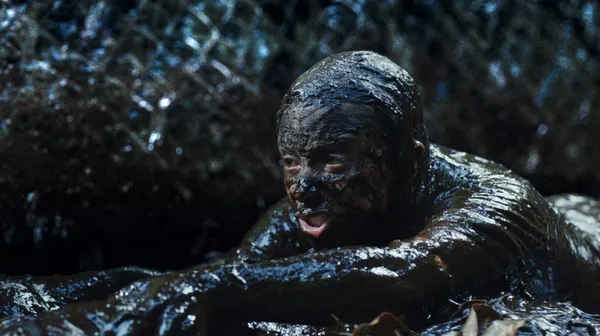
| Beware Boiúna Photo: Fantastic Fest |
The opening film at the recent Fantastic Fest, and now screening at BeyondFest, Mike P Nelson’s Beware Boiúna is a film whose success depends on the audience developing a sense of awe. It’s set in the vast expanse of the Amazon Basin and concerns a legendary creature, a monster to some but a god to others, whom locals believe has the power to decide who lives and who dies. A film like this is heavily dependent on having the right score, so it was great to get the opportunity to speak with composer Stephen Lukach about his work on it.
“Mike and I have worked on a couple other projects before this,” he says. “We first met actually working on his first feature film, The Domestics. I was an assistant of the composer, Nathan Barr, and Nathan let me do a little bit of additional music on that one, so I got to know Mike well through that process. Then his second feature film, Wrong Turn, the reboot, came about and yeah, Nate wasn't able to do it, so he put my name in the hat for it and I end up doing it. Mike and I had a lot of fun doing it. After that was V/H/S/85, the couple segments that Mike directed for that.”
I tell him that I think that’s the best of the V/H/S/ anthologies.
“Oh, yeah, it was a good one. And then this was the next thing, so I was super happy he asked me to be involved in this one. It was a lot of fun.
“Having worked with Mike before a bit, I'm familiar with some of the weird kind of crazy sounds that he likes. In particular, he likes his big, low bass growls, you know? So for this one, it was like, how can we achieve that kind of effect? Get a similar sound but a different sound that we haven't used before?
“I found this woman named Miako Klein. She's a musician based in Berlin and she plays a contrabass recorder, which is like a six foot tall version of the little recorder that you learn in grade school. It's made out of wood actually, at that size, and she can get these really cool, deep, airy growl sounds. In particular, she has a very cool style where she will run that sound through a bunch of guitar pedals and get these really cool, gnarly sounds. We wanted to achieve these growls with something that originated from like an air source. And so, yeah, this contrabass recorder ended up being the ticket.”
I noticed when we first go into the film and we're looking at trees from above and moving across the water, there are long, low sounds that sounded a bit like horns, I say. Was that that instrument? “That's it, yeah. So it starts off with the very first thing you hear. I think it starts over the Lionsgate logo. It’s a high, kind of whispery tone. That's also Miako doing some kind of harmonic cool effects. Then you get this big low. It's kind of brassy at that level, but yeah, that was the contrabass recorder.”
And then we go into drums for the action sequence, I note. Did he choose local sources of inspiration for that?
“Not necessarily the rhythms, but the sounds, definitely,” he says. “I used a lot of indigenous-style shakers and different things like that just to keep the tempo, especially during that opening bit. The drums are some various frame drums and ethnic drums I had lying around, but I didn't get too heavy into trying to be indigenous or specifically of that region. Just something that felt like the jungle and woods and raw.”
There are two different kinds of threat in the film: one from Boiúna herself and one from other humans. The latter is introduced in a bar scene. I mention that I thought I heard a bit of his music in there, around the songs that are playing.
“Yeah,” he says. “You’ve got a good ear. That’s totally there. We start to introduce some of the sounds that will become Brennan Malloy's – I don't want to say theme, because it's not really very musical, but his sort of thematic sounds. You know, like tonal signatures, sonic signatures, if you will.”
Did he work with the sound team on the film to get that balance of elements to work?
“A little bit, yeah. A little bit here and there. But there's a couple parts that get really loud. There's a lot of explosions and all of that, and it was sort of like, ‘Do you want to hit this with some big crazy boom or do you want me to do it?’ More often than not, we would just both hit moments and do big loud noises, and then at the final mix, they could decide, if it was too much, which ones they wanted to use.
“An overall theme of this whole film is Mike wanted it to be really loud and intense, even to the point of distorting in some moments. He thought that was kind of fun. So there's probably a lot of moments where they used my sounds and the sound designer’s sounds. Just more. More is more.”
Often, just due to time constraints, composers end up getting the film after it's pretty much finished, and they take it away and they work on it then, separately from everyone else. But with the kind of immersive experience that Mike's trying to create, it works better to have sound and music interrelated, I suggest.
“Yeah, for sure. And thankfully, with this one, I was able to get on board pretty early. Mike sent me the script and everything before they had shot, and I had several months while they were shooting to start messing with ideas and coming up with some crazy sounds that I could send Mike, to see what he latched on to. He gave me all sorts of wild references, from some really avant garde Vangelis stuff to the soundtrack for Sorcerer. All sorts of weird, cool, fun things. As a composer, it’s really exciting when your director is giving you those types of things as references. It means you can be weird.”
I ask if there’s an established musical language for snakes in film which he tapped into, but he shakes his head.
“While I love it and I've seen it, maybe a few years ago, I intentionally didn't go back and rewatch Anaconda or anything like that. I was going in blind to not be too influenced by anything, just to see what spoke to me, what spoke to Mike, what everybody latched onto in terms of the sonic world. Even the editor, Tom Elkins, was a huge help. When I would create a lot of sounds and send them to Mike, he was able to help patch things in, put the puzzle pieces together. If maybe I made a sound that Mike really liked but wasn't exactly sure where it could go, Tom could help. It's just a big puzzle, putting all the little pieces together.”
What's it like for him when he’s been designing it in that way and then he finally gets to see the film and have all the sound come together?
“It's really cool.” He grins. “I just saw it at Fantastic Fest and it was really nice. I hadn't seen it since the final mix, which was about a year ago. It's fun to see it with an audience. You're removed from it. You forget all of the little micro details you were nitpicking and concerned about and you're able to just sit back and enjoy it and be more objective about it and enjoy it closer to an audience member.”
Did it help to see other people enjoying the bits that he wasn't 100% confident about?
“Totally. Yeah. I was with my girlfriend. Every time she was squeezing my hand really tight during some tense moment I was like, ‘Alright, that worked.’ And even myself, I got a few goosebumps in some places. I obviously knew what was happening, but, yeah. It was fun.”
It is the kind of film he would choose to go and see if he wasn’t working on it, he says.
“I think there hasn't been a great creature feature in a while, and it's something that's not trying to be funny or too campy or anything. Mike's going for this gnarly, hardcore, gruesome creature feature, and it's a lot of fun.”
He has a couple of projects currently in the works.
“There's one that I can't talk about that I'm pretty excited about, and there's a video game called Skull And Bones that I've been working on the music for, for a couple years, and that continues going with additional seasons of content. That's always fun, to keep reinventing, some of themes and the vibes of that game.
“I'm definitely drawn to darker things, but that can range from thrillers to dark comedies, heist things, you know, I'm a huge fan of Martin McDonough. His film In Bruges is a classic and one of my favourites. I haven't done anything in that world. That kind of dark comedy vibe would be fun, but apart from that, I just love thrillers. Like, you know, Fincher type stuff would be a dream. I mean, him, obviously a dream, but anything in that world that allows you to be dark and sound designy, but still a little bit melodic at the same time, it's always fun. So I guess less traditional, sonically, is where my heart's at.”