





Eye For Film >> Movies >> Death Of A Yellow Bird (2026) Film Review



Whenever and however we confront mortality, one of the hardest things to do is work out how to live in the meantime. The unknown man (Ari Millen) at the centre of this story has taken the first step. Diagnosed with a terminal illness when still in what people call the prime of life, he has made up his mind that he doesn’t want to die in a hospital bed. Instead he has arranged with its new owners to go out into the wilderness and stay at the cabin he loved as a child. it’s a place of which he has many fond memories, a place where he hopes to be able to find peace. But out there alone in the chill of winter, he finds that his struggle to face the future is compounded by disturbing shadows from the past.
There is a distinct perspective, and a language of sorts, associated with facing illness like this, especially if it happens before one has had time to taste old age. Most films on the subject are made by outsiders and fail to capture it. Death Of A Yellow Bird is different. Premièred at Fantastic Fest, it was first conceived when Millen told his longstanding friend, director Cody Calahan, that he had received a similar diagnosis and did not expect to be around for much longer. The two decided that they wanted to spend their remaining time making a film, and Millen has since credited that experience with his own continued survival. Not only is the experience he portrays a familiar one in this regard, but he throws himself into the role as few actors ever do, because at the time of shooting he expected it to be his last act of communication with the world.
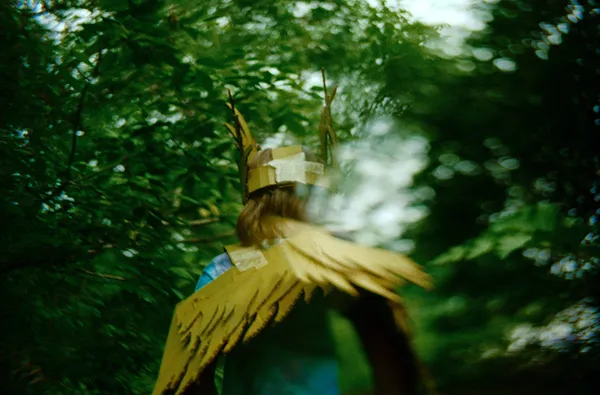
The result is compelling. Though the film is laden with tragedy, it speaks to the growing awareness of the self as part of a larger whole, and of all time as precious, no matter how difficult it may be. The protagonist’s journey is a lonely one – ironically, his mother, with whom he frequently speaks on the phone, is also seriously ill, but as her condition affects her mind, she has no awareness of it. He explains to her repeatedly that his father is dead and likewise his little brother, whom we glimpse from time to time in flashback, often running through the trees dressed as a yellow bird. But how well does he understand the time he had with them? The discovery of a VHS player and tape hidden under the floor leads him into a strange form of dialogue with the past and, piece by piece, the uncovering of a family secret that has haunted him all this time.
Cutting between the frozen present and the bright past, a seemingly perpetual spring in which sunlight splashes down through dappling leaves and the river sparkles, the film speaks to a life interrupted long before illness entered the picture – a life which has always been held back by an inability to put all the pieces together. This is addressed in part through the devices of a traditional ghost story, and it achieves some real scares; there is also that investigative element common to such tales as they were popularly told a century ago. Struggling to untangle his own memories to find out what happened to his brother, the protagonist unexpectedly recovers his drive, and it becomes apparent that there may be something in the future – not his own life, but life nonetheless – that is worth fighting for.
A superior piece of genre fiction and a testament to the reality of life in such precarious circumstances, this is a tough film to watch, but well worth it.
Reviewed on: 20 Sep 2026


Director: Cody Calahan
Writer: Cody Calahan
Starring: Ari Millen, Peter Outerbridge, Kassandra Santos
Year: 2026
Runtime: 93 minutes
Country: Canada
Search database:
