





Eye For Film >> Movies >> Death Has No Master (2026) Film Review



Sometimes a location is almost a complete story in itself. The sprawling house with its surrounding walls and gates must have looked imposing when it was new, a monument to the imperial authority of Europe there to oversee the plantations in the new World, to remind the locals why they were looked upon as primitive. Elegant, high-ceilinged rooms with tall windows. Great, curving staircases and polished floors. Glittering chandeliers. Now, after a century of neglect, it is being reclaimed by the forest, like everything here. Damp peels away its one spotless façade. The vines along the porticos mock the supposed power of colonial Spain. There is rot everywhere. The same paintings hang from the walls, the same books line the shelves, but the cruel history that they depict is now laden with shame.
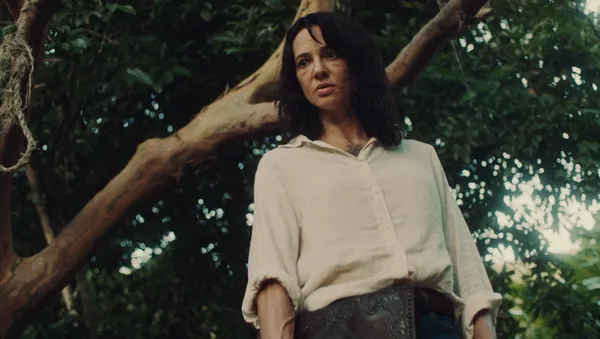
Caro (Asia Argento) has come, following the death of her father, to claim this place. She has been warned that, in the current economic climate, she will probably only be able to realise about half its value, but she still wants to sell; she will take her millions and go and live somewhere that lives up to her idea of civilisation. But in Venezuela, nothing is as simple as it seems. She is pleased to find housekeeper Sonia (Dogreika Tovar), whom she remembers from childhood, still looking after the place, but is rather less enthused to learn that she thinks of it as her own home – and that the law might agree with her.
Sonia’s little boy, Maiko (Yermain Sequera) has to move his things out of the master bedroom to make way for Caro. Trying to make peace, she offers to pay for him to go to school, saying that it will give him a better life. She tells him that his name is Michael, as if he were struggling with a speech impediment. Looking through her father’s old things, she finds a copy of Dante’s inferno with its illustration of tormented souls in a pit. Observed from above by the two gentleman visitors, they resembled the enslaved indigenous people who worked on Venezuela’s plantations and in its mines. Caro thinks of herself as a modern woman, part of a society which has left that sort of barbarism behind, but she casually gives orders and expects the world to bend to her will. When it fails to, she becomes prone to sudden, violent bursts of anger. In a bar in the city, blood red light illuminates a tiny stage. A middle-aged crooner sings a melancholy song about jealousy poisoning his soul.
This is not entirely new territory, but it is rare to see a woman in the central role. This variation achieves two things. Firstly, it make us more alert to her vulnerability, increasingly isolated in a big house far from the world she understands. Secondly, it provides an opportunity to reflect on the specific monstrous characteristics of white femininity in racially segregated societies and their descendents. Deprived of the protection of her father, whose later life decisions she mighteven see as a betrayal, Caro is quick to look to lawyer Roque (Jorge Thielen Hedderich) as a substitute of sorts, presenting herself to him as an aggrieved party and confident that he will take her side no matter how ugly the things she asks of him.
This is a new type of character for Argento and she handles it well. Her Caro is tougher than she pretends, yet brittle; capable of empathy yet unwilling to take that extra step to imagine what life might be like for someone who lacks her privilege. Her ill-considered sense of grievance is genuine, and consequently one can sometimes feel sympathy for her, or at least pity, as the situation gets more and more out of control. Up against her, Tovar has less room to develop a complex character, but matches her charisma – no small feat for a newcomer – and convinces as a woman whose initial situation may divide viewers, but who has secrets which complicate precisely the notions of legacy and right upon which Caro is depending.
That sense of human frailty – in mind as well as body – which haunts much of European colonial literature is strongly in evidence here, and it’s interesting to see it from the perspective of a Venezuelan director. Luis Armando Arteago’s lush cinematography, full of deep shadows and decaying surfaces, combines with Vittorio Giampietro’s resonant score to suggest a place where to remain is to be consumed, where reason itself crumbles before the power of the forest. A descent into violence feels inevitable, yet still shocks when it comes. Streaks of red splashed across all that green. The wages of centuries-old sin, a deadly inheritance.
Reviewed on: 20 Sep 2026


