 |
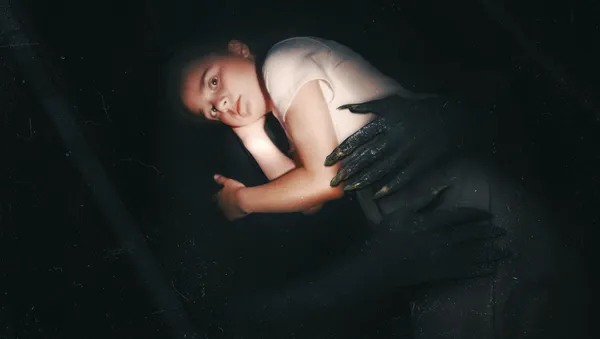
| Dracula: The Night Around Us Photo: Frightfest |
A pared-down adaptation of Bram Stoker’s novel which transplants the action to a present day US city whilst focusing on the frequently neglected character of Dr. John Seward (played by Eric Toms), Chris Schwab’s Dracula: The Night Around Us is relatively light on action but big on atmosphere. It sees the doctor working at a psychiatric clinic where Renfield is an inmate, and also developing a friendship with Mina and Lucy (her daughter in this version) when they move into an apartment beside his. It’s screening as part of Frightfest 2026, and a couple of days before the festival began, I met Chris to discuss it. We began by talking about Seward, whom I feel has a lot of potential which tends to be overlooked.
“I agree with you,” Chris says. “Also, when reading the book, he's a point of view character. I always connected with the way that the story's happening to him, and everything about that. So I always found him to be an interesting character and, yeah, wanted to make him the main character in my adaptation.”
The book is interesting as an early work of medical fiction, showcasing a lot of the latest innovations of the period when it was written. Was that something that he felt it was important to bring through?
“I definitely wanted to have a sense of mystery around what was going on with Lucy and what they could do to potentially help her,” he says, referring to the character’s mysterious anaemia and sleepwalking.
Lucy is younger than most people realise in the novel, but here she’s a prepubescent child (played by Raelan Mackiewicz).
“That was one of the first things that came to me, in a dream, actually. I remember thinking ‘Oh, this is a really great way to break into the story,’ and to kind of streamline the adaptation that I wanted to do. And I like the idea of a child with pure innocence being one of the first victims of Dracula.”
She’s heavily sexualised in a lot of adaptations, and in this version, there's a sense of her potentially being preyed on like that. Even Seward feels like he might present a risk, because we hear that he's lucky to have a job, which suggests that he's done something uncertain but problematic in the past. Was that intended to make people wonder like that?
“Oh, of course. Yeah, definitely. I had a bit more of a backstory with Seward, but then I decided it's better to leave it more of a mystery of what happened. But I'm so glad that you picked up on that. It was definitely intentional on my part.”
How did he seek to balance the chemistry of the relationships between Seward and Lucy and Seward and Mina (Marlene Mc’Cohen)?
“I figured for Seward, this is really what he needed in his life. He needed a balance. Everything in his life has been going terribly; the world around him just seems to be awful, and I wanted this ray of sunshine coming into his life, which we see in Mina, and this hopefulness that maybe things could get better. And then obviously, that all gets ripped away from him.”
There's another character who is mostly missing from the story, but we do get little hints of Jonathan in that there's a photograph that Mina reacts badly to, and there's a hint that maybe Mina and Lucy are running from something when they first turn up. How intentional was that?
“That was definitely very intentional,” he says. “They are sort of on the run, trying to start a new life. And just like with Dr. Seward, how he needed this sort of in his life, I felt like they needed Dr. Seward just as much. As far as Jonathan goes, I obviously took a lot of the aspects of Jonathan's character and melded that in with Dr. Seward. But yeah, I knew I wasn't going to do a travelling to the castle sort of thing that most adaptations do, so it became easier to write him off and make him kind of a weird villain. She's worried, you know? She does not want Jonathan to know where she's at.”
How did he go about developing his own Dracula? We’ve all become used to the suave Christopher Lee style Dracula, but he's quite monstrous in the book. “Yes, definitely. More of my inspiration was the second half of the book and how he's really just a fiend, running around in the shadows and preying upon Lucy and Mina. And so I always wanted him to be very monstrous, very disgusting, in a way, and I wanted him to remain mostly in the shadows and to be something super mysterious for the audience. More of a deep, demonic sort of look is what I was going for.”
Then there’s Renfield.
“I did not want Renfield to be just a stark raving lunatic. I wanted him to be creepy and unsettling as a character, and those were conversations I had from the very beginning when I cast Spencer Weitzel to play him. I think he did a fantastic job. And yeah, obviously it’s the same thing you were saying about with Dracula being a side of Seward that he doesn't want to be. So is Renfield.”
We talk about the setting and his choice of locations, both temporal and spatial.
“Obviously a modern day adaptation was about a budgetary limitation I had. I wasn't going to be able to film it in a late 1800s style. But one of the things I thought of was these giant overpasses that we have. I live, and the giant sprawling concrete and everything. From the base of it could look like an imposing castle. So that was sort of the visual language I was going for, to try to tie it back to some of the other elements of the novel.”
The domestic locations are also quite creepy.
“Oh, yeah. That’s mostly just lighting. Lighting and framing. Especially the dinner scene. It's really just one overhead lamp that's coming down. And it's funny, when were filming, that was the first scene that we filmed with Raelan. Her whole family had come. Her little brother was over there. He goes, ‘Who eats dinner like this, in the dark?’”
He’s full of praise for Raelan.
“She was amazing. She was really easy to work with. Took direction very well, came very prepared and took it very seriously. This was her first acting role actually, and I really appreciated the dedication that she gave to it. She made sure that she was giving it her all.
“I'm very blessed to be able to work with and call these people my friends. And when I'm writing it, I'll usually have the people in mind as I'm writing it, so that makes it a little bit more of an easier transition because I know exactly how they would play it themselves and so I can write to their strengths.”
Frightfest is the icing on the cake.
“I'm so excited. This is really a dream come true and I’m just very excited for the opportunity to show it in front of the wonderful big Frightfest audience.”