 |
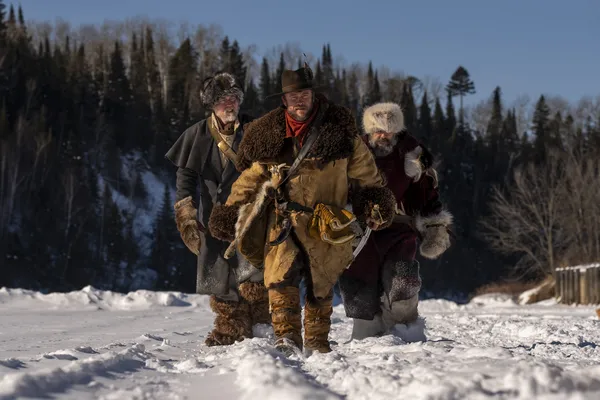
| Ithaqua Photo: courtesy of the Warrior Agency |
There are three reasons why I’m excited to be doing this interview, I tell Casey Walker when we meet shortly before Frightfest to discuss Ithaqua. First of all, because it's Hammer, and who isn't excited about Hammer coming back? Secondly, because it's Ithaqua, who have always been fascinated by - and the wendigo too – and then because he’s the one who made it and I know he’s good at this kind of thing. But where did the project begin?
“I was blessed or cursed with the idea back in 2011 through a friend who challenged me to make something that far north,” he says. “It took me two years to get the draft going, and then another ten years of trying to get the movie made. A lot of false starts, a lot of money coming and going, and I was about eight hours away, maybe even four hours away from personal bankruptcy and the movie dying forever when John Gore, who I proudly say is my benefactor, saw that this was a perfect film for Hammer. He loved the script so much. He's not just a financial genius. He's one of those people who's so good at creative work and he's also really good financially. He asked me: if I could add more creature or if I could make it more violent, where would I do it?
“I'd never been asked that before, that way, because I'm constantly just trying to make it for the budget that I have. So I threw out some ideas and he's like, ‘Send me those pages today.’ So I frantically did a pass on the script, and he read them in the next day. He was like, ‘Yeah, let's do it, then.’ Put $3 million in my bank account to start, without any paperwork. Because we had to go. Everyone was lined up. He liked the changes I made, and just like that, it was a go.”
There's all sorts of different lore about Ithaqua in HP Lovecraft’s stories and beyond. This story taked place in an isolated colonial settlement whose reesidents, and their indigenous neighbours, are pushed to the point of desperation when, one very cold winter, the stores run low and the woods seem to run completely out of game. I ask Casey how he pulled all the ideas in the film together.
“I came up with the story initially and wrote a pass on the script, but then there was a significant amount of indigenous lore, and quite frankly, pure history that I was not aware of. My friend Pascal Trottier brought on his writing partner, Peter Vicaire, who's a First Nations Canadian unpublished author. Because he'd been working for the American government, he's a dual citizen. That's where it started to flesh out on the historical side, but also the accurate elements of the wendigo. It was not inspired by Algernon Blackwood and stuff. I grew up around the religion and the lore my whole life, so it was already there. It's just, like, I'm not Catholic, so I'm not going to write a movie about Catholicism. So Peter brought a lot of that to the table. We were discussing it. He's indigenous, I'm a white dude. And we're like, ‘Are we going to make something here that, when it comes out, the conversation's not going to be about the movie, it's going to be about that fact that this white dude made a movie about indigenous culture?
“Peter and I are both huge Lovecraft fans, and he was like, ‘What about Ithaqua?’ And it just clicked. Someone else had already taken all those things down the line to create something new that was already part of the thing were doing. So then we blended the Ithaqua lore and the wendigo lore together to become our own thing.
“We found a doctor who specialises in indigenous religious iconography and studies at the University of Nebraska. We sent him the script and our process and everything, and he gave us a glowing review on how we didn't fuck it up. So we just kept tuning it and I mean, there was a lot of things about Ithaqua that I found that were just a little dated. Like all Lovecraft stuff, if you're going to [adapt it], you need to bring it forward. So it's funny because I'm modernising it, but it still takes place even pre-Ithaqua’s creation. We wanted it to be a discovery and something new for everyone. I think we accomplished that.”
Something that’s very much in the spirit of Lovecraft is that he doesn't put everything up front. It takes a long time to discover what's going on and then to encounter moments of horror and start to try to make sense of them. Is that a form of storytelling that he feels close to anyway?
“Oh, it's my favourite,” he says with a smile. “The unknown is far more terrifying to me than the known. I mean, you know, everyone always points to Jaws and there's a lot of complications that made that movie become that way. The whole not seeing the creature, and waiting and being rewarded, but also, the audience is always going to do a better job in their minds of being terrified. At least the audience I like engaging, and I'm not a formulaic horror director. Here's the thing: I like jump scares, but I just wanted there to be a journey that was a little more rewarding at the end. Because at the end, no matter where your mind was going to, I don't think I could ever do a big enough job. But if I do something that is enough, that the audience will be like, ‘I didn't expect that and it's still rewarding.’ Then I think I succeeded.
“For your readers that don't know the core, the wendigo myth is about greed through consumption. It's not just of the land. Cannibalism was such a taboo in indigenous cultures that if they felt they were going that way, the brave ones would take their own lives. Even though suicide was not condoned. Because they saw it as an infection. The greed and the forced circumstances that would put someone in that place were..” He trails off. “It was something that was more interesting to me than a zombie or a ghoul or anything like that. It's the brutal thing that lives within their hearts that is the thing that changed them. And then that consumption but always being hungry is the thing that fascinates me the most because you just can't satiate. The wendigo is forever hungry. It's forever feeding, and it can never be satiated. That went along with a lot of the themes that were going not with greed but with capitalism, and how here we are 200 years later and not much has really changed.”
I ask about the central character, Cole, who is played by Luke Hemsworth. How was he developed? Was he there to translate between the settler and indigenous characters, or did Casey want to focus more on his experience as somebody caught in between?
“I think it's a bit of both,” he says. “We needed a character that would be a gateway, but I didn't want a hero. I didn't want any heroes. Everyone is incredibly flawed and broken in their own way, and I didn't want there to be this great white hope that is there to be the saviour of indigenous people.
“Cole was originally born out of necessity to be an entry point for the audience. Our goal was to break him. Just to make this person who's always kind of been bad but knows he should been good just get worse as he gets better and at the end culminate in – well, how the film ends.
“Luke was so dialled into what I wanted him to do that he was like, ‘The guy doesn't want to be good, and even when he is good, he's not necessarily doing good.’ Most of the time, his motivations are incredibly selfish. There's not a lot of altruistic intention, except for the belief in love, and I think that really just comes from a desire for salvation. And Luke just got it. I had had so much trouble casting that role. So many people turned it down because there was no win for the character. Even when he wins, he loses every single time. It was hard for them, especially for movie stars, to digest.”
I kind of thought that he was lucky, I venture. It could have been worse for him. It could have been much worse.
“Yes. Yeah, it definitely could be much worse,” he agrees. “In the end, he was in control. It just wasn't the outcome that I think he even thought it would be.”
So what was it like shooting in that environment? How far away from civilisation were they?
“Funnily enough, that location exists,” he says. “It's a place called Fort William. It's a historical re-enactment site. I grew up in Thunder Bay, so I kind of knew what we were up against, but that was one of the colder winters in memory. Like, our warmest day was minus 35 Celsius, and our coldest night was minus 54. So all that breath you see is real. It was truly punishing. Everyone knew what they were getting into, but it could not have imagined how brutal it would actually be. I mean, the authenticity is there, but in hindsight, I would shoot all the exteriors and then do the rest in the studio later on. In every one of those buildings, it's like minus 30, even with a fire going, it is miserable. And most of the time, we were like, ‘How do people live like this?’”
And there’s a character with not much clothing on at one point...
“Oh, yeah. I created the role of Hendry for Aaron Poole of Hendry because Aaron and I made The Void together. I'd already done a bunch of drafts, but that character wasn't quite flushed out yet when I made The Void. And while making The Void, I went, to Aaron, ‘I have this idea where you fight naked in the snow.’ He didn't even know what the movie was. He goes ‘Oh, I'm in.’ He just said that right away.
“When it came to having Aaron in what we call the ‘nudie pants’, when he had his nudie pants on, the temperature that night was going to be minus 50 with the wind chill. And it was hard. It was a struggle. You know, I'm putting a dear old friend in harm's way. And yeah, fighting naked in the snow, it's pretty insane, but we shot that entire scene, that brutal outdoor fight scene around the fire in two hours. No one knew what was going on. I literally was just like, ‘Do this, do this, say this, do this, react.’ It was because the temperature was so cold.
“We just needed to move fast because everything was freezing around us. Our propane to keep us warm, the blood rigs for the blood gags. Make-up was cracking. People couldn't feel their fingers. And we couldn't lose the scene. So it's four people fighting, four stunt people in creature make-up with another person naked, all at the same time, happening consecutively. So it was just like, ‘Go!’ And when we finished I was like, ‘I think we got it,’ and everyone just piled into heated vehicles and into the house on the location we were at to get warm because it was just so cold.”
Alongside all that active horror, there’s the creeping horror of starvation. How did he approach presenting that? That's not an easy thing to show, especially when most characters are wrapped up in furs and we can't see that they're getting thin.
“Yeah, I mean, I talked to a lot of the actors, especially so Craig. He plays Nicolette. I wanted him to not be starving because he's a bit of a rogue and he was just doing whatever he could, especially drinking a lot. Because drinking, you feel yourself freezing to death, but the calories actually count for something.
“Luke and Kevin [Durand] and Michael [Pitt] and all, they went on a fast probably six weeks before were to go to camera. Even over the Christmas holidays, we were eating a bowl of soup at every meal. I think Kevin lost the least amount of weight, but just because he's so big. Luke lost, I think, 35 pounds. Michael lost 15, but he didn't have as much to lose to begin with.
“The rest was with make-up. It's funny. You can never take anything away with make-up. You can only add. So we would build up basically a foundation of what people were to look like and then make them thin from there, but also do it in a manner by which we weren't using prosthetics, because prosthetics will freeze and crack.”
One character was supposed to have smallpox scars, he says, but they couldn’t make it work.
“We'd done appliances, prosthetics for her character. We'd done makeup tests previously, but when we got there, in that environment, in the cold, in minus 35, and we put her outside and they said in the make-up department ‘We can't keep this on. It's just getting worse and worse as we try to do it, because the cold is making everything crack and peel and split.’ We were just like, ‘Okay, I guess that's not a story element.’
Getting people to act starvation, he says, was much easier.
“What it really comes down to is because everyone was outside in the cold so much, that cold, no matter how much you eat, it doesn't keep you warm. We literally just turn the misery of being absolutely frozen into the misery of starvation, because some of those extras were outside for an hour and a half, waiting for the shots. The folks from Thunder Bay, the locals who came out to be extras, they were truly great. We weren't abusive to them by any means, but there were times where we were waiting for things in rehearsal and tech, and they were just out there with us freezing, so when you see people cold and miserable and hungry, they're acting the hungry part, but the cold really helps the miserable, which helps make people think they're hungry.”
We talk about Frightfest
“This is my first Frightfest,” he says. “I'm so excited because I have Ithaqua. We're in Hammer's backyard and the guys at Frightfest have known them all for years, so I finally have something to bring to them. And also, I'm the first director in Frightfest history to have two movies playing at the festival at the same time.”
He’s referring to Home Bodies, which he recently discussed with Eye For Film’s Paul Risker.
“Yeah, because while waiting for all the VFX to be done on Ithaqua, I went and shot Home Bodies. Two movies in 18 months, which I don't recommend to anybody, because one midlife crisis is enough, but two mental breakdowns is a lot. But yeah, I like having London for the world première. This is the first new creature that Hammer has got behind and released in almost 60 years. That's an honour. And just to be in Hammer's backyard, to be playing it and then the second movie – and we sold out in two days. It blew my mind. After 16 years of the idea going into my head to now finally be watching it on a screen – because I've still never seen it with an audience – it's humbling, it's nerve wracking, but it's also exhilarating. I'm very fortunate to be in this situation and travelling to show this to everyone.”