 |
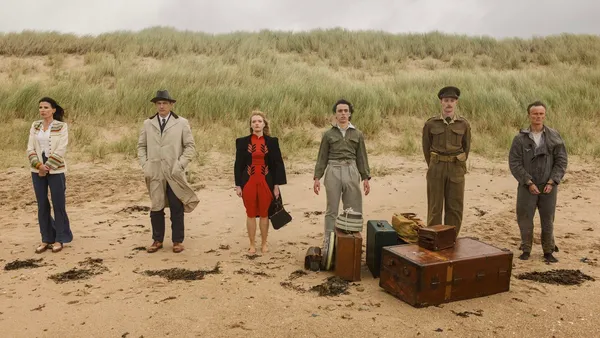
| Left to right: Ronnie Ancona, Ben Bela Böhm, Natalie Quarry, Ollie Maddigan, John McCrae and Jack Bandeira in Think Of England. Poppy O'Hagan: 'We had the last week and a half on Anglesey and that was intense because shooting on an island you're so exposed to the elements and the weather changes hourly' Photo: Giant Films |
That brings together six people from different walks of life, and each with their own agenda – Captain Clune (John McCrea), costume and make-up assistant Agnes Dupré (Ronnie Ancona) and her 18-year-old son Clifford (Ollie Maddigan), German Jewish director Max Meyer (Ben Bela Böhm), acting hopeful Holly Spurring (Natalie Quarry) and bona fide but war-damaged movie star Tyrone Higgs (Jack Bandeira). As the shoot starts, and another presence is revealed on the island, Hawkins considers the minefield of moral boundaries, censorship and propaganda.
The film was produced by dad and daughter team Nick and Poppy O’Hagan from Giant Films and we caught up with Poppy after the film’s premiere at Tallinn Black Nights Festival to talk about Think Of England’s subversiveness and the challenges of the shoot. While this interview doesn’t contain any classic spoilers about the plot, some might not want to know what is revealed here before watching the film, so consider yourself warned.
Tell me about how you came to the project?
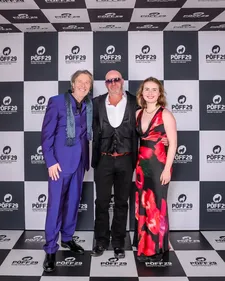 |
| Nick O'Hagan, Richard Hawkins and Poppy O'Hagan in Tallinn. Poppy on working with Nick: 'It felt like a great project to kind of start the journey of my dad and I doing something together because it was a project that was obviously not a huge budget but the story worked for that' Photo: Courtesy of POFF/Erlend Staub |
So I took on a couple of short films and, at the same time, I ended up doing a one day a week internship with Jeremy Thomas at Recorded Picture Company. I did that for a few months and then they offered me a full-time job, which was great, but I'd already committed to doing a lot of short films. So I said yes and just juggled it – that was in June 2023, and then in about September 2023, my dad sent me a script and said, “I'm thinking about doing this but I want you to do it with me if you like it”. I was sort of like, “Okay, I'll read it”.
I really enjoyed it. I thought it was extremely witty and very well contained and it felt like a really interesting project. I met Richard, the writer/director and from there, it kind of just spiralled. There wasn't a moment where I feel in my head that I said, “We're doing this project”, it just sort of happened. We ended up going to Anglesey on a recce in December 2023 and I suppose that's kind of where it all started.
How is it to work with your dad?
PO: It actually works really well. Obviously there’ll be bickering here and there, but, in a way, I think that working together has strengthened our relationship. We definitely have a shorthand that you just don't get with people who aren't family. And with making such a low budget and independent film, you need all the help you can get. I think that the fact that we're family meant that we just got in sync with each other much quicker.
I've always loved slightly weird and wacky films. My studies were in languages, so I always go and watch non-English language films and I think we are much more, in general, open to the weird and wacky ones when they're not in the English language. I think unfortunately there's a subconscious thing where, if it's in English, you end up comparing it to big American films, whereas with foreign films you’re open to the weirdness. So I always loved that. I almost felt this film had that weirdness but it was in English.
So it felt like a great project to kind of start the journey of my dad and I doing something together because it was a project that was obviously not a huge budget but the story worked for that. Not just the location being pretty much in one island and a very small ensemble cast but also the fact that the story takes place during the war. So they're all rationing, they've all got probably one nice outfit and one not so nice outfit.
Were there challenges to shooting some of it on an island?
PO: All the interiors were shot in Shinfield Studios in Reading. We built the Nissen hut there. Then we had the last week and a half on Anglesey and that was intense because shooting on an island you're so exposed to the elements and the weather changes hourly. By that point we’d already shot for a good few weeks so everyone was already a bit tired and then you get put out in the wind and the rain and the sun and poor Sarah Cunningham, the director of photography, had to match stuff together. But you want to feel that isolation and you need to see those landscapes to feel that the cast are on their own.
Were there any challenges around the cast because it’s an ensemble piece and you need them to be free simultaneously, which I’m guessing isn’t always easy?
PO: No, and we needed them pretty much the whole time because almost all the time, they're all in shot in some way. So we basically said to them, “Essentially you're going to be doing what they're doing in the film, which is you're going to be coming to this island – whether it's the studio or the actual island – and you're going to be there for three weeks and and then you can go back to your normal life”. I think there’s something to be said about casting actors who feel ‘period’ and who feel part of that world because that adds to the unexpected nature of it, you don’t know who’s going to make it to the end.
Pulling back from the making of the film, how do you feel about propaganda in the modern world because the film is speaking to that and fake news?
PO: I think it's a very interesting commentary having made this film and seen different people's reactions when they find out that it's not based on true characters. It's very interesting because you kind of get a scale of people being super offended that they've been duped, but then you also get people going, “God, that was really clever, I didn't see that coming" and I think it's interesting because, in our film, we never say it's based on a true story, whereas in Fargo, for example, it does.
It's an interesting one because I think it does kind of provoke the audience to question what they're seeing. I was talking to someone about Braveheart and how if someone didn't know anything about Scottish history, they’d think that was how it was. Even when we were telling people about it before we shot it, we had one person say, “Oh my God, my grandma told me about that happening”.
We know that definitely the Germans, for example, did experiment with how sexual appetite affected morale. Unfortunately, I had to sit through quite a few actual porn films from the era to understand what they looked like. It’s called vintage erotica.
So with your more general producer’s hat on, what else do you have coming up?
PO: We've got Richard's next project. It's called The Most Dangerous Girl In The World and it’s set around 2007/2008, so the dawn of Facebook and the iPhone. It's completely different to this one. There’s comedy and there's romance so it won’t necessarily have so much of the dark satirical elements. Then we have another project that we’re looking to shoot in the US with a duo of directors. I’m also developing a couple of co-production projects with Europe that are in very early stages but it's something I've always wanted to do because of my language background. And I'll continue my work with Jeremy Thomas as well.