 |
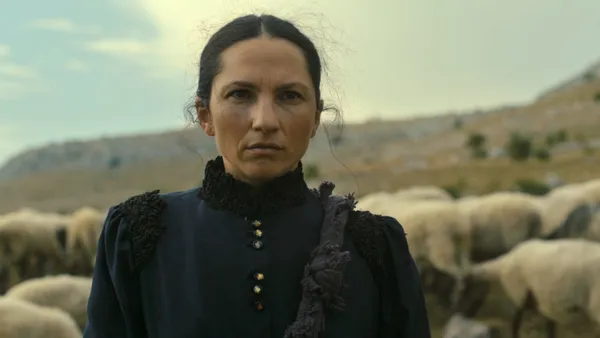
| Manuela Martinelli in God Will Not Help. 'It was much easier to give her directions because she understands the lenses, she understands the movement of the camera' Photo: Courtesy of Thessaloniki Film Festival |
Teresa is the perfect listener, as members of the family are able to share with her in confidence thanks to the language barrier, the very act of sharing leading to a reconsideration of what they want. Writer/director Hana Jušić also introduces dream sequence elements that take the film into another realm, while retaining a strong ambiguity about her central character.
God Will Not Help is playing at Thessaloniki Film Festival this week, after premiering in Locarno and enjoying a strong festival run already. We sat down with Jušić, editor Jan Klemsche, Greek co-producer Yorgos Tsourgiannis and costume designer Katarina Pilic to talk about some of the film’s themes and craft.
Jušić says: “The whole idea started from me wanting to work with Manuela Martelli, the main actress, who is Chilean and I was thinking, ‘Okay, why do I always have to work with Croatian actors? Maybe I can think of a script where the main character is from Chile, because I saw her in a short film.
“I started writing the film and I realised this is going to be a film about communication because there's no other way around it because I also wanted to make a period piece where people cannot use their phones to translate. So then I started exploring this idea that a person in the beginning of the 20th century comes somewhere to a place where they have never heard a person speak a foreign language and how to proceed with that in terms of how to make it viable in a way, how to make it not seem completely unbelievable – that they understand each other immediately – but how to make them form a bonds without understanding each other. And I realised sometimes we form bonds without really understanding the language, relying on looks, and sometimes being wrong can make the bond firmer.”
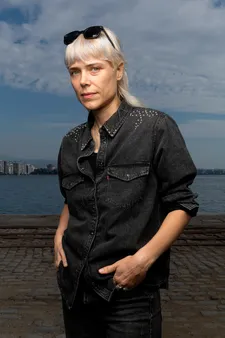 |
| Hana Jušić: 'I realised sometimes we form bonds without really understanding the language, relying on looks, and sometimes being wrong can make the bond firmer' Photo: Thessaloniki Film Festival/Aris Rammos Studio |
When it came to the dream sequence elements that nudge towards what might be considered horror territory, she adds: “We wanted to play with this moment of the supernatural. But that nothing is really supernatural. Everything has a realistic explanation. Also, the concept of Teresa being a witch. For me, when watching horror, always the most disappointing part comes where everything is explained and when we know, oh, she's the witch, or oh he's a vampire.
“So I wanted to stay on the verge of being eerie and being kind of unexplained at the same time. Jan and I tried to make them feel very eerie, but at the same time, mystical in a way that it's not like, ‘Oh, I'm so afraid’.”
Klemsche says that the mixing of these moods “was the easy part”, but adds: “I think the hardest part was the technical parts, like dialogue. That usually takes most of the time. But we’ve worked together for a long time so we know each other and I think that the whole process was very smooth in a way. We wanted to make maybe a little bit shorter movie. That was the hardest part, to stuff all the parts together.”
He says that when he originally read a different part of the script years before “the first thing that came into my mind was song”.
He adds: “I thought about a song and it was a Black Sabbath song called Solitude. It's one of their only ballads. They have this really specific atmosphere in that song and when we spoke with our composers from Greece, Stavros Evangelou, Iris Asimakopoulou, Vasilis Chontos, that was our main point – this Black Sabbath song and Tangerine Dream. So we built it together”
The end result is far different from what you might expect for a film from this geographical place and period, with a distinct electro tone.
“From the start we knew it shouldn't be the music from the period or from the area,” says Jušić. We didn’t want shepherds’ flutes and things like that. Also we didn't want the music to be throughout the film, like a vehicle for emotions. We wanted scenes that would be elevated by this strong atmospheric music.”
In practical terms, shooting on a hillside has its challenges in terms of the elements, something that is reflected within the clothing of the characters, which is beaten by the weather.
Pilic says: “It was all made from scratch so everything was new. So we had to distress it and age it and it was painful.”
She adds: “Lack of people and lack of money but, in the end, I got the winning lottery ticket.”
When it came to references, she used Institute of Ethnology and Folklore Research resources, adding: “But all the photographs were black and white. We had a book from the area and there were many postcards that were coloured afterwards but I read a lot and talked to people. We went to search for locations together so I could talk to local people.”
Some of those they spoke to even had some physical clothes that had belonged to their grandmothers but Pilic notes that “There’s not a lot of clothes preserved today because of the war. Most of it is ruined.”
The whole setting coupled with the co-production element means it was, as Tsourgiannis puts it, “a very demanding film”.
He recalls: “The first time the main producer Ankica Juric Tilic started talking to me about the project was a couple of years ago. And because it is very demanding I think it was very important that Ankica surrounded herself with producers she knows who can get behind the vision. I was very happy to be invited into this but it has been demanding, it’s a six-country co-production. It’s very region-focused because it makes sense. It is tricky when you have so many partners to make it work because you have to communicate and you have to accommodate all the rules and all the complexity of it, which is what knowing your partners and being able to trust and taking some of that complexity out of the equation is really important for a film like that and, all in all it has been fairly smooth for the difficulty it entailed.”
Jušić says that the fact Martelli was a director in her own right also made it easier when it came to shooting the film. “I got only the plusses from this. She helped me a lot. When I was writing the script, she read it and we worked on her character together in a way. Also during the filming, it was very demanding because she needed to walk here and there. It was much easier to give her directions because she understands the lenses, she understands the movement of the camera. She saved me a lot of energy – both me and the DoP Jana Plecas.”
Working within nature also presented some challenges, as Jušić says, “You never know how a day is going to turn out. One day we spent waiting in the car or the rain to stop and then we decided to shoot the whole scene in one shot because this was the only option available. Also, Manuela was supposed to walk at night in her night gown but when we were shooting we realised she would die if she was naked. So we needed to dress her in a black dress at night, which made it quite difficult to see her because we had expected her to be in a white night gown. So these kinds of things meant we need to rearrange our plans.”
In terms of what’s next, Jušić adds: “I suppose we will work together again but we don’t know on which project because it’s up to me to think of something.” She adds, laughing: “Although maybe they have a script…”