|
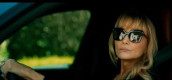
| A Johnny Pigozzi selfie with Jerry Hall and Mick Jagger: ”One day I was with Jack Nicholson many years ago in the South of France …” |
In the second instalment on Julien Temple’s I Am Curious Johnny, Johnny Pigozzi (aka Jean Pigozzi) and I discussed Antoine de Saint-Exupéry’s The Little Prince, SIMCAs in the films of Claude Lelouch and Jacques Tati, why Federico Fellini’s 8½ and La Dolce Vita plus Citizen Kane by Orson Welles are his favourites and not the films by Ingmar Bergman, Jack Nicholson’s Italian dubbing voice actor, what Pigozzi has in common with Albert Einstein, Steven Spielberg, and Martin Scorsese, and the connection to Brooklyn Museum Director Anne Pasternak (featured in Jennifer Ash Rudick and Amanda M. Benchley’s DOC NYC highlight Pretty Dirty: The Life And Times Of Marilyn Minter).
 |
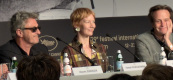
| Johnny Pigozzi with Ed Bahlman and Anne-Katrin Titze: “My favorite films are 8 1/2 and La Dolce Vita and Citizen Kane.” |
When we were joined by music producer and 99 Records founder Ed Bahlman, the conversation turned to Miles Copeland, Ian Copeland, The Police (Sting, Andy Summers, Steward Copeland) at Studio 54. Ahmet Ertegun, John Bonham and Led Zeppelin, Nile Rodgers and Chic, and James Brown at Claude Nobs’ Montreux Jazz Festival. Johnny also spoke about the unexpected reactions to the documentary at the Rome Film Festival, dogs, Birkenstock sandals and more.
The revealing (or not) documentary starts with Johnny Pigozzi learning how to use Zoom (and we hear Johnny Too Bad by The Slickers). Among those who Zoom with him are Michael Douglas, Mick Jagger, Graydon Carter, Jann Wenner, Diane von Furstenberg, Christian Louboutin, Martha Stewart, Charles Saatchi, U2’s The Edge, and a significant number of women from his past and present.
Temple’s film is designed as a patchwork of sights and sounds. “I have an obsession to take pictures,” says Johnny, who describes himself as very curious and impatient. His first memory may be of his father filming him learning how to swim, and there is a photograph of little Jean touching a Leica. His mother, whose story holds a mighty revelation, Johnny recounts, was obsessed with shopping and had a dog, named Lucky, with incredibly bad breath. There were 13 nannies and the child was sent to a detested Jesuit school with a priest who was paid by his father to whip the boy.
Currently at the Brooklyn Museum (with the generous contributions of the Jean Pigozzi African Art Collection) there is a major exhibition of portrait photography by legendary Malian photographer Seydou Keïta. The soundtrack for Seydou Keïta: A Tactile Lens was created by Nile Rodgers and Chmba Chilemba and the exhibition includes remarkable textiles and artifacts that also provide historical context of apparel in West Africa over the past 80 years.
And opening on Sunday, December 14, at the Museum of Modern Art in New York is Ideas of Africa: Portraiture and Political Imagination, the third exhibition in celebration of the 2019 gift of modern and contemporary African art from Jean Pigozzi.
From Rome, Johnny Pigozzi joined us on Zoom for an in-depth conversation on I Am Curious Johnny.
Johnny Pigozzi: Hello! Where are you?
Anne-Katrin Titze: Hi! I'm in New York.
JP: Oh, I heard of that place, yeah.
AKT: I thought so. You are in Rome?
JP: I'm in Rome. Rome, Italy.
AKT: This feels a bit like the film, which has a lot of people, including yourself, asking you questions. All kinds of questions. So, in a way this press tour is a continuation of that. You'll get more questions.
JP: Yeah, but I also ask questions to myself all day long, so that's okay, I'm used to that.
AKT: Let me start with one of my questions. Did you have a favourite fairy tale as a child?
 |
| Jean Pigozzi Me + Co The Selfies, collection Ed Bahlman Photo: Anne Katrin Titze |
JP: Le Petit Prince!
AKT: Because you identified with him?
JP: No, because I'm completely dyslexic, and the Petit Prince was very visual and it was also not scary. And I like the idea of the pilot, and I like the idea of the desert, and I like the idea of the snake eating the elephant. It was very sweet, and the Petit Prince was very nice, and all that. A lot of these fairy tales have horrible witches and things like that, and the Petit Prince was all very nice, and I like his little uniform, and I like the drawings that Saint-Exupéry did, and all that.
AKT: It made its way even onto the French currency for a while, didn’t it? I remember that one of the franc bills had the image of the boa with the elephant inside. [Indeed, in 1994 to honour Antoine de Saint-Exupéry, a special French 50-franc banknote was issued featuring The Little Prince and his author].
JP: I don't remember that. But two days ago, I was in Paris, and I went to Gallimard. There is a little library, and there were some of the original handwritten notes by him. He had incredibly neat handwriting in very, very small widgets. I wouldn't have imagined. First of all, I imagined he would have a typewriter, but it was interesting to see, how nice his handwriting was.
AKT: You are the second person I ever had an interview with where I talked about SIMCA. For you, it's family history. The first one was, Claude Lelouch.
JP: Oh, sure.
AKT: Le Voyou has these wonderfully funny heist scenes. Merci SIMCA? Do you remember the film?
JP: No, I don't think I ever saw the film.
AKT: There's a beautiful caper, and they keep repeating Merci SIMCA, throughout the movie.
JP: But, you know, my father had somebody who worked for him, who was a French guy who had worked before for Charlie Chaplin in Hollywood, and he was in charge of putting SIMCAs into French movies. And if you think, in Playtime of Jacques Tati, and a lot of the Jacques Tati films, there's a lot of SIMCAs, and there's a lot of SIMCAs in a lot of films in the Fifties and early Sixties.
AKT: It's the first car I was ever in in my life. My father picked up my mother and baby-me from the hospital in a SIMCA.
JP: It brought you luck!
AKT: It brought me luck! You mention Fellini in the documentary as your favourite filmmaker, together with Orson Welles.
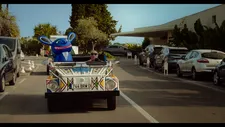 |
| Johnny Pigozzi driving Mr. Limo |
JP: Well, first of all, I like black and white. And my favourite films are 8 1/2 and La Dolce Vita and Citizen Kane. And these three films are in black and white, which is already one important thing. And they're also very extraordinary films with incredible actors, incredibly interesting visually. They're not scary. There's a lot of fantasies and all that, and the story is not too complicated to understand. It's not like a Bergman film or something like that. So I always absolutely loved these three films.
AKT: There are a lot of dogs in the film. You've always been…
JP: I don't think there's any dogs in Citizen Kane.
AKT: No, no, no, oh, sorry, bad segue! Ha, I was not with Citizen Kane anymore! I was back at your film! [Rosebud triggered the thought of dogs.]
JP: Dogs are very important! When I was a child, my mother always had a lot of dogs, and one of them was called Lucky, who had very bad breath, I remember him. And, I always, yeah, I always… but I like them more than I liked them when I was a child. And because I have no children, these are kind of my children.
AKT: Is it any particular breed of dog? Because there's quite a mix of what we see.
JP: No, no. At this moment, I have five dogs from four different races. So I always try to improve. I tried to find, you know… you couldn't do that with, well, some people have done that with wives, they tried a Japanese wife, and a Chinese wife, and an African wife, and a Jewish wife, and an English wife, but I haven't done that. But, with dogs, I guess you can do it. And my latest dog is a Border Collie, who supposedly is the most intelligent dog in the world. We will find out in a few years. But, they all have different things. Some of them swim, some of them are Velcro dogs.
I don't like dogs that bark, so I hope they don't bark. I don't like very, very small dogs, also, because I remember my mother had a friend with a very small dog, and she was playing cards. And she left the dog, when she went to the bathroom, she left the dog on the chair, and when she came back, she sat on the dog and killed her dog. It can be traumatising for the rest of your life. I don't want small dogs. I want dogs that are big enough. I'm starting to like dogs that are bigger, so I don't have to bend down when I pet them. I can work without bending down.
AKT: Very smart. There's some good life advice in the movie, too. Don't eat ketchup at night, it'll give you bad dreams!
JP: Absolutely, absolutely! And no chocolate!
AKT: One more point with the dogs - when you try on your old shoes, the platform boots from Studio 54, we, watching from the audience, we hardly listen to what you're saying about Studio 54, because the dog seems to be totally obsessed with the shoes and with gnawing off the glitter at your shoe. Was there anything on it? Was it the sparkles?
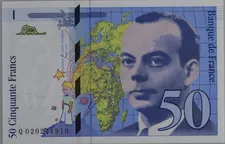 |
| Le Petit Prince 50 Francs bill |
JP: No, no, the dog… yeah, it’s completely natural. I guess the dog has some kind of disco vision or something like that, you know? He was transcending into Studio 54, I guess.
AKT: The shirts that you made for a while, and that we see you wearing throughout the documentary, made me think of the concept of horror vacui. In art it can refer to somebody filling a canvas, the entire canvas with something, as in a fear of empty spaces.
JP: Oh, that's a… I never read that word. You'd have to text me the word, I have to look it up. No, I always was looking when years ago, you would go to Miami, and you would see these old Jewish guys sitting with reflectors on their face. They always had funny Hawaiian shirts.
And I always liked that. But I don't like Hawaiian shirts because they're made out of nylon. And I hate nylon. So I decided I would have the same kind of shirts, but they were made out of cotton. And I tried to find really fun cloths to make these shirts, and they're unique, so I would never find anybody else with the same shirt as me.
AKT: In the end, you say, “perhaps I lied about everything” in the film.
JP: Yep.
AKT: Purposefully you sprinkled in little lies?
JP: I'm not gonna tell you.
AKT: I didn't ask you which ones, but, I mean, did you purposefully add some lies for fun?
JP: There's a few little things, you know, it's like in Citizen Kane, we don't know… We don't really know what is his favourite thing, is it the sled or something? We don't know. It's better, this is not an FBI investigation, you know, this is art, so I can say whatever I want to.
AKT: How does it feel looking at the film?
JP: Oh, my… I don't like looking at it myself, absolutely not. First of all, I don't like listening to my voice, I don't like looking at myself, so for me, it's a painful experience. By the way, when I saw it in Rome last week at the Rome Film Festival, that was the second time I saw it, totally. I saw little pieces of it when we were editing, and there were a few things that I had something to change, but this was the second time I saw it with an audience, and it was interesting, because the film is in English, and the audience was 99.9% Italian, and at the beginning, they didn't laugh.
 |
| Pool Party by Johnny Pigozzi, foreword by Bono, collection Ed Bahlman Photo: Anne Katrin Titze |
And I understand that I didn't really look at the subtitles, but they were not very good or something, and then at the end, they were laughing. But it took them a little bit of time to understand that this was more of a comedy than a serious documentary. So at the beginning, I think they were a little bit lost, and then they understood this was not that Ingmar Bergman had done a film about some old man. It was kind of a fun experience.
AKT: No playing chess on the beach. You could have had Alain Delon do it with the voice of Jack Nicholson.
JP: I could have, but I didn't do it. One day I was with Jack Nicholson many years ago in the South of France, and had lunch with him, and he was depressed. And I said, Jack, why are you sad? He said, well, I just learned today that the man who does my voice for Italy just died. And I became friends with him, and I also feel terrible, because who knows who is going to replace me. I really got used to … and the people in Italy got used to my voice. So, this was well before AI, so at least in my case, I'm doing my own voice.
AKT: Yes, for different countries, and of course the voices are really important. You are attached to the dubbing voices, I totally understand that. Einstein, Spielberg, Scorsese, you say in the film, share dyslexia. It's a thread running through the entire film and it seems as though you see it maybe as a blessing?
JP: Oh, absolutely. It depends. If I was an accountant, or if I was a pilot, it would be terrible, because they would say, Oh, Mr. Pigozzi, fly this plane from Paris to Tokyo, and I would take it to Rio, you know. Oh, oh, I'm sorry, I made a little mistake here. Or if I was an accountant, I would say, oh, there's five million, I'm sorry, I thought it was seven million. So, if you are in a profession, like, if Scorsese kills one more person in one of his films, not the end of the world!
Or if Spielberg has Jaws bite one more person, that doesn't really change the world. So, in certain professions, it's a blessing to be dyslexic, because you really see the world in a different way. I think there's so many different dyslexias that one dyslexic person would not see the world as another dyslexic person. There must be, like, ten different kinds of dyslexia, which is kind of interesting.
AKT: Yes, no, it's never one thing. We just like to put these frames around the many varying ways we see the world. Did you learn anything new about yourself while making the movie?
JP: Well, I'll tell you, the greatest surprise which I had the other day at the Rome Film Festival: After 90 minutes, I was standing there and I was frightened somebody would come, a big man would come and say, I just wasted two hours of my life listening to this stupid bullshit about your life and all that. What a waste. And it didn't happen.
All these people came up and said, oh, thank you so much, it was so much fun, can I have a selfie with you? You gave me so much hope, you told me that you learn how to be curious every day, it's so important, so that was an incredible thing. I never imagined that I could be any kind of example for anybody. So that was a very nice sensation.
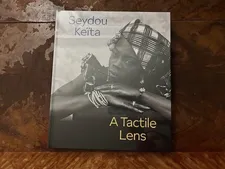 |
| Seydou Keïta: A Tactile Lens exhibition catalogue, collection Ed Bahlman/Anne-Katrin Titze |
AKT: It's a very full film, and have a very full life! Does the Edith Piaf song that we hear early on as an introduction resonate with you? Did you think it’s about you?
JP: Johnny Tu n'Es Pas Un Ange? Yeah. Yeah, a little bit. Yeah, I really like that.
AKT: I've been humming it all morning in preparation to this Zoom. I have someone here who would like to say a quick hello.
JP: Okay!
AKT: You may have met him at Studio 54, Ed Bahlman, music producer and founder of 99 Records.
JP: Hello, how are you?
Ed Bahlman: Oh, hello, Johnny! You're wonderful. You are the most charming subject I've ever seen in a documentary, by far.
JP: Oh my god, thank you so much. That's a great, that's a great compliment. You know, there was a thing yesterday in Italian Vanity Fair. They said this was the most amusing documentary of the century. I nearly had a heart attack when I read that.
EB: And Julian got the sense of whimsy by the choice of songs and the soundtrack, too.
JP: Yeah, yeah, yeah, absolutely. He chose some fabulous songs, and they're really incredible, yes.
Ed holds up the photo book, Pool Party, by Johnny Pigozzi from his collection.
JP: Thank you! I hope you liked that book.
EB: I love it. And, the foreword by Bono: “The right kind [of foolishness] is waiting there as fortunate subjects in the kingdom of Johnny …” It’s the end of the foreword. That's how we felt watching the documentary.
Ed now holds up from his collection, Jean Pigozzi, Me + Co The Selfies.
JP: Oh, you got that one too!
EB: Full circle for the documentary, too. My favourite memory, or my most vivid memory at Studio 54, because I would go to invited private events, industry events, music industry, was the launch of The Police in the US.
JP: Oh yeah.
EB: Miles Copeland and Ian Copeland? For two hours, everything open, catered, everything wonderful. Ian gave me the first Police single.
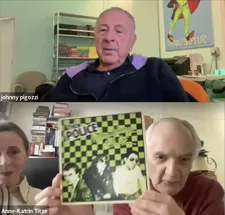 |
| Ed Bahlman shows Jean Pigozzi the first 45 by The Police, given to him by Ian Copeland at Studio 54 |
JP: Whoah. Wow.
EB: That Miles put out, the first thing that Miles ever did on his own label, After two hours, all of a sudden, without notice, the curtains went up and we were in the middle of the dance floor. With everybody. Completely unannounced.
JP: That's fantastic.
EB: Did you have that experience, too, at Studio 54?
JP: Oh, I went many times, but I tell you what, the first time I met them was in Tokyo in January 1980. Because they were on this Japanese label, and I knew the guy who had the label. And he was the most incredible drummer [Stewart Copeland]. Him and the guy from Led Zeppelin were, I think, the two most incredible rock and roll drummers ever. He's a weird man, but he was an incredible drummer. Incredible.
EB: Yes, I remember when John Bonham died, I had also a shop on 99 MacDougal Street that only sold US independent and import records. And all the customers came in and said, did you hear that John Bonham had died? It was in the early 80s, I think.
JP: Yeah, yeah. I was once with Ahmet Ertegun in Lausanne, and Bonham had just spent a month in the studio, alone. I don't know whatever happened of that, but for one month, I guess, he took a lot of drugs and whatever, for one month, he was alone in the studio, in Lausanne, drumming. I don't know whatever happened to this. It would be fun to find it. I don't know when he died [September 25, 1980], but he was an incredibly weird guy.
EB: Did you go to the Montreux Jazz Festival?
JP: Many times, many times. Yeah, yeah, absolutely. I saw James Brown there, I saw Chic, I saw some kind of a version of Led Zeppelin. I went at least five or six times. It was incredible. The guy who ran it was an incredibly nice man.
EB: Claude Nobs!
JP: Claude Nobs. He was a terrific guy. His father made bread.
EB: Do you know the filmmaker Oliver Murray?
JP: Nope.
EB: We had a conversation with him; he did the documentary on Claude last year.
JP: Oh, I'd love to see it. Is it out or not?
EB: We should hook up.
JP: Absolutely.
AKT: We can send you the link to the conversation.
 |
| Jean Pigozzi and Ed Bahlman were guests at Ian Schrager and Steve Rubell’s Studio 54 Photo: Anne Katrin Titze |
JP: Yeah, I would love that, because I knew Claude quite well. He was such a nice man, and so bizarre that this man from Lausanne, which is the most unhip town on the planet. Horrible. I lived in Lausanne, but this Montreux is worse than Lausanne, by the way.
EB: It comes across in the documentary.
JP: Oh, really? But, but he organised this, and he played the harmonica pretty well. He was a pretty good player. And it was an incredible thing, and then it lasted ten days, then the place died. The medium age was 97 and a half years old. It's the most boring city in the world. But for about 15 days, they had the most incredible bands and all the incredible guests.
EB: There is James Brown singing It's A Man's World from 1981 at the Montreux Jazz Festival.
JP: Incredible. That version is an incredible version. Incredible version. Okay, we know the classics here.
EB: Do you have any plans for New York?
JP: I'll tell you exactly when I'm coming to New York. I have a show. I lent a lot of photographs to the MoMA. It will be on December 10th, the opening of the show about studio photography of the 60s and 70s in Africa [Ideas of Africa: Portraiture and Political Imagination]. But now you should go to the Brooklyn Museum, where I opened the show last week, on Seydou Keïta. Incredible show, you should go and see it. And, Niie Rodgers did a musical track. You should really go. It's incredible. And get the catalog, it's a beautiful book!
AKT: Sounds great. Do you want to put your email in the chat?
JP: Oh, absolutely. Do you think I know how to do that?
AKT: You’ll find chat at the bottom. Yet another lesson with Zoom.
JP: Hold on, I'll put my glasses on. Chat here, boom. Okay, I see it. Yeah! Done. Whoa! I learned something.
EB: The Brooklyn show we’ll definitely check out.
JP: You really should see it. The lady who runs the museum, Anne [Pasternak], she’s an incredible lady. Because we started it and then she lost her curator of photography and then Covid came and then last year she sent me an email, saying, October 9th 2025 it will open. The show is fabulous.
EB: How much time do you have in New York when you come in December?
JP: It depends, because I have to go to LA. But I will be in touch, I will send you a text. I used to have an apartment in New York. And I sold it four years ago, and now I have a house in LA.
EB: The Arts and Craft house?
 |
| Johnny Pigozzi (with glasses) interviewing Johnny Pigozzi |
JP: Yes.
EB: Great, it looks good.
JP: It looks like a Swiss chalet.
AKT: And do you still love your Birkenstocks?
JP: Absolutely. The first time I ever saw Birkenstock was on Steve Jobs. I didn't know what a Birkenstock was, okay? And then you would see, you know, German school teachers with big, heavy socks wearing them in the winter? And then the Birkenstocks now, they have these fabulous ones, in, plastic.
AKT: Right, I love them too.
JP: Which I wear all the time at the beach, flip-flops, I love them. I don't wear the leather ones yet with the cork sole thing, not yet.
AKT: The EVA ones are fantastic, they float, they are so light.
JP: I love them.
AKT: Jean, thank you so much.
JP: My pleasure! Bye-bye!
Read what Julien Temple had to say on I Am Curious Johnny and with Ed Bahlman on the soundtrack.
Seydou Keïta: A Tactile Lens at the Brooklyn Museum is on view through Sunday, March 8, 2026.
Ideas of Africa: Portraiture and Political Imagination will be on view from Sunday December 14, 2025 at MoMA in New York through Saturday, July 25, 2026.
I Am Curious Johnny is streaming on HBO Max.
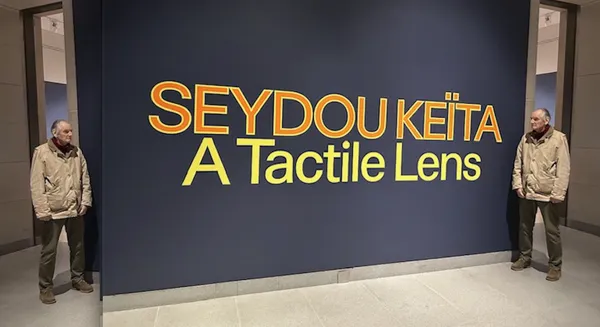 |
| Ed Bahlman meets Ed Bahlman at the Brooklyn Museum Seydou Keïta: A Tactile Lens exhibition Photo: Anne Katrin Titze |