 |
| Largo |
There are few bigger issues in UK politics just now than immigration. last Wednesday I watched Keir Starmer at Prime Minister’s Questions, boasting about his intention to make life even harder for people to find sanctuary in the UK, and his plan to break up immigrant families; and then I went to meet Max Burgoyne-Moore, Salvatore Scarpa and Zack Elsokari to speakwith them about their Oscar-qualifying short film, Largo.
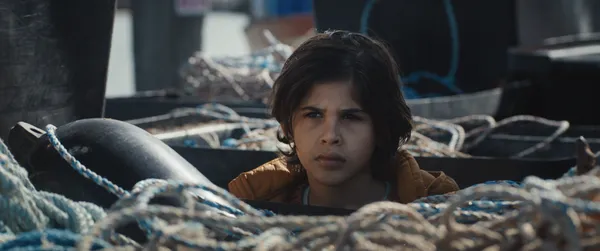
Co-written and co-directed by Max and Salvatore, Largo follows the story of al 11-year-old Syrian immigrant boy, played by capable young actor Zack Elsokari. The boy, Musa, is being looked after by a woman called Grace (Tamsin Grieg) in her home on the south coast of England, but he desperately misses his parents, and keeps hoping for them to come and get him. Driven to the end of his tether by the cruel remarks of adults and other children, he comes up with a desperate plan to build a boat and sail back home. It’s easy to imagine how wrong this could go. The two directors explained how they developed the project.
“We first had the idea about eight years ago when the refugee crisis started making headlines in the UK,” says Max. “Salv and I grew up together in a small town in the Midlands, which is very similar to the one in the film, it's just not by the sea.”
“Although I did grow up there, I was born in a town by the sea in Italy, which is also very similar. The Italian equivalent of the town in the film,” Salatore chips in quickly
“Exactly,” says Max. “So we sort of merged the two. Basically, as the refugee crisis was dominating views, we found out that lots of people in our town, family, friends, neighbours, who we always thought of as nice, welcoming, friendly people, turned out not to be because these were people from another country that speak a different language and they didn't seem to care that they were just trying to find somewhere safe to live and were fleeing war and persecution and really no one chooses to leave their home. So we wanted to make a story that would remind those people of their empathy and how they should be more responsible and welcoming to their fellow human beings.”
At this point, Zack joins us, and explains that he got involved with the project after sending in a self tape.
“A year later, when my mum was doing a play at the National, they called me up to have a talk about the film, and they gave me the job.
“I think it's a very, very important subject that really needed to be addressed and I'm very glad that someone did finally decide to address the subject matter and try and reawaken some empathy.”
“How much did you know before that before we made it?” Max asks him.
“I knew about the refugee crisis. I knew that kids were getting separated from their families, and I knew that we should be doing more to help those kids. And not just those kids, all of the people that have been separated or have had to flee their home.”
“I suppose the thing that makes it a bit different to other stories about refugees, and the thing which is really the most fictional aspect, is it's a story of a refugee trying to leave the UK rather than the story of his arrival,” says Max. “It's him feeling so unwelcome and so homesick and so in need of his parents that he's sort of pushed to leave. It sounds a little bit manipulative when I describe it like this, but we wanted audiences, and the characters in the story, to feel responsible for what happened, rather than it being something that comes into their life from elsewhere. Their actions, their attitudes and lack of empathy pushes him to do this terrible thing.
“It also puts the audience in the shoes of the character, because we all know what it's like to be a small child who feels homesick and lonely. And I think that adventurous running away from home aspect captures people's imagination and makes them forget, just for a moment, what the political context is, so that when it finally comes back at the end of the film, it sort of reminds people of the stories behind those statistics.”
For a child, it's very much a personal issue rather than just a political one, I suggest, asking Zack if he’s familiar with the sort of bullying we see in the film.
“There are a lot of bullies in schools, especially if you're a refugee,” he says. “I imagine that they're getting bullied a lot, because people now aren't as welcoming as they were and as they should be.”
Salvatore agrees. “When we were trying to cast the role of Musa, it was really about finding a kid that was very mature and could understand the situation he's in and the complexities of what's going on with the adults as well. Zack did that very well, and I think that's also something that audiences can really relate to. It's like this position of being a child and feeling homesick and feeling like he's missing his parents. And, you know, children are often much more intelligent that we give them credit for as well. And I think that was one of the things that we were trying to do with this film is not to play the kids off as out of touch.
“In fact, the really important thing for us was to show that the kids were soaking up what the adults are saying and repeating what they're hearing their parents say. It was really important to us to have this kind of message, especially because we have this programme now where we're going to be playing the film in schools next year during Refugee Week. We really wanted the film to have this underlying message, starting at a very young age, to condition kids to have empathy and to not parrot what their parents say.”
“Yeah,” says Max. “To question what you hear adults say rather than just accepting it.”
I mention that I like the scene in the film where Musa finds somebody else who speaks Arabic, because it emphasises the importance of being in touch with your culture as well as with other people. Max nods.
“One of the other threads that we really wanted to keep in the film was this idea that someone shouldn't have to completely sacrifice their own identity, shouldn't have to be cut off from their home in order to have a second home. No one would expect Salv to do that as an Italian living in London, but for some reason, they do expect it of a refugee from Syria. So we wanted to highlight that.”
We talk about the scenes in which Musa works on building his boat. It’s believable that a child could do what he does, but it emphasises the fragility of such vessels. Adults trying to get to safety that way are not going to manage much better, most of the time.
“We wanted it to be right on the line of realism or magical realism, whether or not that would be possible,” says Max. “We wanted audiences to see that this is a kid who's been through a lot, has a lot of world experience that most adults don't have, and is wise beyond his years because of it. He can weather the bullying better than most kids could, and he's experienced enough to know sort of how to build a boat and how to make a sail that just about works or looks like it might work, but then obviously doesn't.”
“My granddad grew up in post war Italy in the late Thirties, early Forties,” says Salvatore. “He was working in a workshop at the age of six, working metal. That's a product of hard times, but he was able to survive and earn money for his family, you know? At the age of six. We just don't live in that time anymore, obviously. But we were really inspired by Italian neorealist cinema, so that was a little kind of wink to that kind of filmmaking that we really see now. You know, Bicycle Thieves is the perfect example of it. The kid is so adult in the way he presents himself and the way he fixes the bike in the film. And that's kind of what we wanted Musa to do. Zack, I don't think you've ever seen the film Bicycle Thieves, have you?”
“No,” Zack says.
“You put it on your watch list. It's a good film. It's my favourite film.”
We discuss the backstory for Musa.
“We talked about it a bit with Zack about what might have happened beforehand and what might happen afterwards,” says Max. “But really, for the audience's sake, we wanted to keep it a bit ambiguous, so that people would invest slightly more. If we got too detailed about the backstory, I think people would start to go ‘Well, you know, it's a product of very specific circumstances’ – rather than it feeling more like a fable and representative of millions of refugees rather than just this one.”
Zack says that he did find it useful to think about his character’s past.
“We do know a bit about his backstory because we obviously know that he is separated from his parents. We obviously know he's been with Grace for a while, and we know that he hates it in the UK because they haven't been very welcoming. But I have thought about it a bit, and I realised that he just wants to be in Syria, which is where his home is. And I think at the end, it's very touching how everyone works together to try and save him.”
What was it like working on the scenes where the boat gets out of control?
“It was fun. It was really fun,” he grins. “And it was cold! We had a line of stunt coordinators, like a circle around the boat, and so that if I actually needed help, they could help me. But everything went smoothly. And yeah, it was a really fun thing to do. You know, it was probably my favorite stunt of the entire film.”
Although this is his first film (he can also be seen in an episode of Hotel Costiera), he has very much been bitten by the acting bug and is looking for other opportunities to do film work, because he’d like to make a career of it.
I ask how they feel about being Oscar-qualified.
“When we started making the film, we didn't really know what would happen, really,” says Salvatore. “We were just out to tell us this story and try to make it. We were kind of naïve when we put it on the page. It was a very ambitious project and we didn't think about how much everything would cost and how difficult it would be to make the film. So really, we're just taking it in our stride. We're trying to do our best to position ourselves in a way that means voters can see the film, and hopefully that will take us onto a shortlist.
“We're just super happy to be here, really. And the company we're in – the short films that we see at festivals, playing with us, they're also well made. The level of filmmaking this year in particular, everybody seems to say it's unlike any other year before. That's probably a product of strikes and Covid and a backlog of material, but it's really amazing to see all these projects, and I think all we can do is try to share it, and hopefully we'll get to the next stage.”