 |
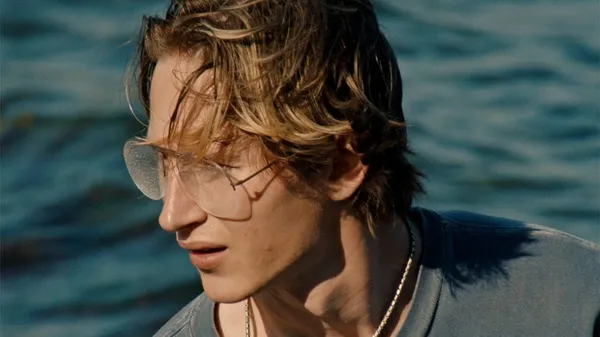
| Edik Beddoes in Blue Heron. Sophy Romvari: 'He had never acted in his life, had no interest in acting but he also had a very personal connection to the story' Photo: Courtesy of Locarno Film Festival |
Sophy Romvari’s feature debut Blue Heron allows the past to have a conversation with the present in unexpected ways. The beginning of the film introduces us to eight-year-old Sasha (Eylul Guven) and her Canadian-Hungarian family, who are newly arrived on Vancouver Island. Events unfold from her perspective as the family struggles to cope with her increasingly troubled older brother Jeremy (Edik Beddoes).
This territory may feel familiar but Romvari ambitiously switches the rhythm in the film’s second half to consider the nature of memory and the limitations of being able to relitigate the past. The film is also notable for being rooted in Romvari’s autobiography, although that description is perhaps more slippery than it seems as we discussed when I caught up with her as the film continued its festival run in Thessaloniki after a Best First Feature win after its premiere in Locarno, the Best Canadian Discovery award in Toronto along with additional wins in Montreal and Ghent.
It’s one thing to make a film about an experience you had in your life but then it’s another thing to go on tour with it and be re-litigating it almost continually. You’ve been at a few festivals now with it so how is all that going and how are you doing with it?
Sophy Romvari: Thank you for asking. I think I'm mostly just trying not to become desensitised. When I answer questions, I'm always trying to really ground myself and answer the question and not just to say the thing I’ve got used to saying.
Also, when making a very personal film like this, it’s not just you, it’s your family who are also involved and I wondered how you dealt with all that while you were developing it?
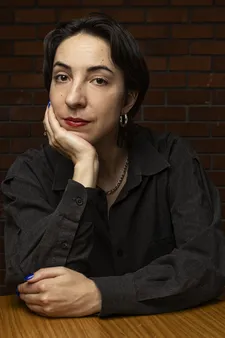 |
| Sophy Romvari in Thessaloniki: 'When I was writing the script I had to kind of acknowledge that I have such little grasp of my memories' Photo: Thessaloniki Film Festival/Aris Rammos |
I think with this moment in the movie where it shifts from the past to the present, I'm trying to show you can have these conversations again and again and 30 years can go by and you're still having the same conversation.
You capture the way it’s difficult to go back over something that has already passed into memory or re-litigate an argument that’s already over.
SR: I think it tries to address that and then by the end, it acknowledges that you can't and that's something that came about during the making of this movie, I think was realising as much as I wanted to really tell this specific story and and express this very specific, emotional landscape by the end it was this recognition that art can only do so much and you can't really control or reshape. Film is the closest you can get to doing that, maybe, but even within that, there’s so much limitation. It doesn't mean it's not worthwhile, I think it's still a worthwhile endeavour but it's just, by the end, I think this character also is kind of realising that, yeah, this is this is as far as I can take this and I have to kind of accept that I can't change the past and I can't change the outcome. It’s about acceptance.
It also touches on the way that memory itself can be quite a fiction. I think alll memories are a little bit of a mixture of fact and fiction because the way we remember them shifts over time
SR: I appreciate you saying that because it's been something I've been talking about a lot, but it sounds a little woo-woo when I'm like, ‘Oh yeah, you know how your memories are all subjective, but I totally agree with this and when I was writing the script I had to kind of acknowledge that I have such little grasp of my memories in a real way. And I think maybe I specifically have a bad memory, not a very strong grip on my memory because there were many times when I was writing in a scene and I couldn’t tell if it was a memory, or something I had been told or a mixture of the emotional feeling that I had. So I think eventually it gave me this creative liberty to say, it doesn't matter if it really happened like this as long as it feels emotionally honest and helps this narrative.
I suppose in a way that’s what memories are – an emotional resonance. When we think about our memories, I don't think we're actually trying to recall that day in December when we ate an ice cream. Most people are trying to recall the feeling of eating the ice cream on the day in December.
SR: And then to depict a feeling is already so fictional. The attempt to depict a subjective feeling. That's why to me when people say, ‘Oh, your film is so autobiographical’ I'm like, ‘Yeah, I guess it is, but it's also very subjective and very fluid in the way that it’s depicting memory but also the characters in the film, especially the character of Jeremy. So much of that character was informed by the actor, Edik Beddoes, who plays him, because if I tried to force this actor to behave in the same way as my brother, it wouldn't work. That was not what was interesting to me. I think when you make personal work, you have to make a decision. Are you forcing this because this is exactly how you remember it or a decision that's actually going to help the experience of watching this movie for someone else. The actor who plays that role was street cast. He'd never acted before in his life and he had a very specific nature. So, I leaned into his nature rather than trying to force him to behave in this very different way.
So how did you cast him?
SR: Basically, every character had a different casting approach. We worked with a traditional casting company and then a street casting company and then a Hungarian casting director for the parents, so they were cast out of Europe. And then, Jeremy, played by Edik, was cast by this street casting company. They mostly find interesting faces and so I was sent a folder of 100 video clips of teenage boys, just talking for ten seconds on the street. I found something interesting about him and then I interviewed him and we had a long conversation. So it was totally a gut feeling. He had never acted in his life, had no interest in acting but he also had a very personal connection to the story. So I think he was interested in exploring that.
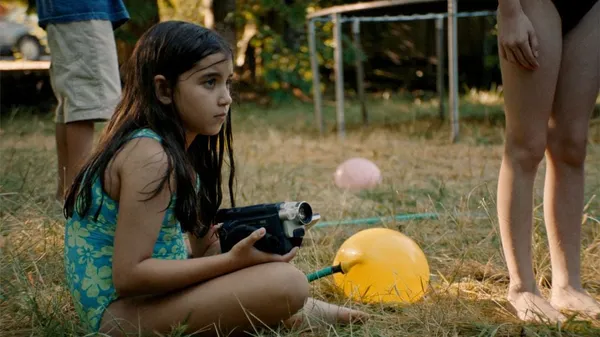 |
| Young Sasha (Eylul Guven) in Blue Heron. Sophy Romvari: 'If I'm to make personal work, it's always because I like this dialogue between the creation and the audience, telling them, this is a construction, but also I’m going to try to give you something real. It’s a constant dialogue' Photo: Courtesy of Locarno Film Festival |
Everyone, in a way, had a very personal connection and as a person who's making personal work, it kind of like offloads the experience into everyone’s experience. Also once you release the film you realise and now there's so many other people who are relating to this experience. So in a nice way, the load is shared because it's no longer just my story. So many people are relating to it in a way I didn't expect, to be honest.
Your short work is personal work as well and now this fiction feature is also drawing on your own biography but there must come a point when you want to perhaps not be bringing it so much from yourself and perhaps shift more to an external subject.
SR: I think this was actually quite a step in that direction. There was a point at which I was going to play the adult Sasha character. That was sort of what the expectation was because of my past work, but I really didn't want that. I wanted to have this artistic separation and I wanted to just direct and I wanted to work with actors and I wanted to be distanced. I’m also a filmmaker who is really interested in ‘meta’. I really like this acknowledgement to the audience of this sort of construction. If I'm to make personal work, it's always because I like this dialogue between the creation and the audience, telling them, this is a construction, but also I’m going to try to give you something real. It’s a constant dialogue.
You’re reconstructing a past, which we’ve said is a bit of a woolly idea anyway and, in a sense you’re overlaying that with another construction, It’s boxes within boxes in a way.
SR: Totally. It’s also this acknowledgement of the filmmaker's desire to control. And I think that's a very typical thing. Obviously, if you're directing, you want control, whether it's your own narrative or if it's just the images that you are using, everything is a decision. So when I watch it I can just see 10,000 decisions.
And how did you find the experience of stepping up from shorts to a feature?
SR: I made shorts for a long time so I think I really was preparing myself and I wanted to make sure I was ready because I took it seriously because I know it’s a lot of labour for other people and the effort it takes to raise the money. It’s not something I wanted to mess around with so I spent a long time working on the script and the structure was very laid out before I started to shoot the film. I was just very careful and did a lot of prep because I didn't want to throw caution to the wind at all.
I think the best thing I did was hire based on talent but also personality and everyone I hired was just such an incredible person to work with and it really elevated the whole experience for everybody. It was actually a joy to make and I would work with every single person again.
Do you think the fact you have a strong online presence helped the film?
SR: I expect that helped a lot with press to begin with, out of Locarno. Maybe people were more aware of it because of the past work. It’s hard to tell what leads into what but I think I think that yeah having the film premiere at locarno and not getting lost at maybe another festival was helpful. I think it helps that there’s people who are already ready to see the film. There’s a sense of anticipation.
So what’s next for you because this is a big chunk of your life you’ve brought to the screen.
SR:Yeah, I know, I might have to live a little more life see where my interests are but I have themes or topics or things I'm interested in but I want to be very cautious because It takes so much of your life to make a film so I want to make sure that whatever I commit to is something that I really care about and also that I'm the right person to to make that film. I don’t know the topic but I know the model that I want to work with but it’s probably not a huge budget jump because that’s where you start losing creative control.
I see this kind of fork in the road and I think that I don't need to have it be so personal but I do need to have a perspective that is strong in myself, because otherwise like, what am I bringing to the project? I'm also very invested in the fact that whatever I make it’s got to be something that excites me formally, because that's the whole point of making films. I’m interested in adapting a few books but I want to be sure that I can bring something to it that makes it an interesting movie and not just a retelling of the book. What can I bring that’s going to elevate the form?