 |
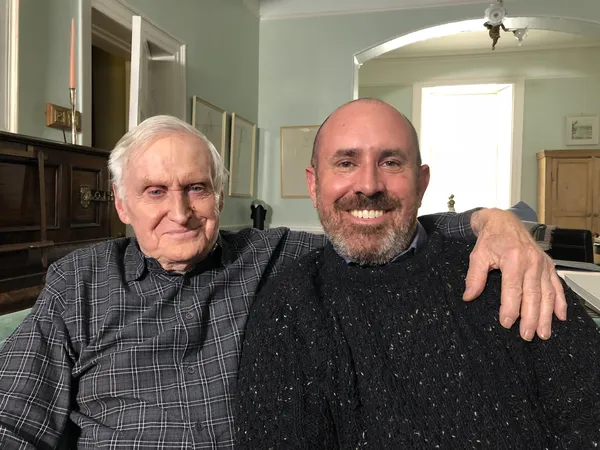
| John Boorman and David Kittredge Photo: courtesy of David Kittredge |
One of the most popular films in the Frightfest strand at the 2026 Glasgow Film Festival, documentary Boorman And The Devil takes on one of the most troubled films in cinematic history: The Exorcist 2: Heretic. Through this, it explores neglected aspects of the career of celebrated auteur John Boorman, looking at how this trial by fire shaped him as a filmmaker and prepared him for the triumphs that were to come. Shortly before the festival I met director David Kittredge and we spent over an hour discussing the documentary, the original film, Boorman’s other work, the cast and crew members he met and some of the stories they told him that never made it into the film. in this first part of our conversation, we began by discussing the documentary’s striking success and the eight year commitment that it took to bring it to the screen.
“I'm very fortunate in the people that I worked with. I can't even express my gratitude to not just the people but the festivals that have programmed us. I mean, honestly, you know when you're working on something for eight years and you get the call. There was the email from the Venice Film Festival saying they want a world première. It's like, ‘Am I dreaming? Oh my God.’ You know, it was huge. It's been a wild ride so far, and it's only getting more wild, which is really cool.”
He did not originally anticipate that the film would take that long to make, he says.
“The pandemic blew a complete year and a half hole in our schedule. We literally could not interview anybody for a year and a half. On top of that, because I'm not wealthy, I had to pay the bills. During that time, I was the lead editor on a limited series on the Shudder network called Queer for Fear: The History of Queer Horror.”
I congratulate him on that. It’s a good series.
“Oh, thank you. But that was like about two years. And I was working on Boorman And The Devil during that time. But honestly, it was such an overwhelming, huge project. And we had so much stuff in that project that did not make the final cut. Literally, we could have had another season and not shot any more. But that was, I would say, two years out of the schedule.
“The third thing was I've never directed a documentary before. I've written parts of documentaries, but these documentaries generally have always had budgets. And this was always a labor of love. This was like a couple of close friends and some family money – the entire budget of this is much lower than you would think. And it just took a lot longer. I think that we had our first rough assembly of the film in September of 2023, but it took two years to get that 196 minute first cut where everyone had a story.
“We had the thought ‘Maybe it's a limited series, maybe it's like a multi part thing.’ But we had a lot of test screenings and the notes we got back were ‘It's fantastic.’ ‘I was never bored.’ ‘It's amazing, but it's exhausting.’ It was kind of like going to a really good restaurant but getting four entrées. By the time you're served the third one, you're like ‘This is too much.’ The fourth one's like ‘What am I doing with this?’ So the whole point, the whole trick in two years of getting it down to its current runtime, was how do we get all the information that we want to the audience and tell this story in the most dynamic and fun and entertaining and really funny way?
“There's a lot of humor in this film. But still at the end, when John Boorman is talking about his life and career, I think it's very moving. The audience had to be moved at that moment and not just exhausted. So we finally found that sweet spot. Not even as a director, as an editor, it was by far the hardest thing I've ever done in my life. The final run time is 112 minutes, and even though that's a bit long for a documentary, the thing moves so fast and is so entertaining that we've never had a single note saying ‘This is too long.’
“One of the things went in with, and the team really, was that we wanted to show the crew. We wanted to show the people that aren't generally shown in these movies about movies. So we interviewed the script supervisor, we interviewed the first assistant camera. We interviewed the second assistant director, and we interviewed the entomologist who handled the locusts. We interviewed the assistant to John Boorman. We interviewed the Steadicam inventor and operator, Garrett Brown. And the thing about it was, you look at these people, all of these people, and they were very young when they did this. It was 50 years ago. It was shot in 1976, came out in 1977.
“They all have dozens and dozens of credits now. They've had long, storied careers. These people just retired recently. These are wonderful, dynamic people, and you would think that this would just be another movie on their resumés, but every one of these people remembered The Heretic and shooting The Heretic like it was yesterday. It was so important and formative and unique. I had so many stories and it was funny because these stories were then validated by other people. There was a 90% overlap on these stories, so it was like, ‘Wow, this is about as accurate as I think anybody can be.’
“In the early cuts, we just put in all the stories. I mean, there's a wonderful story that I wish we could have found a place for where almost at the end of the shoot, they went down to Arizona and shot exteriors on Lake Powell that would match the interiors that they shot at the studio of the Ethiopian cliffs. And they shot for a week in Page, Arizona. Apparently Page, Arizona is a tiny little town and it shuts down pretty early. And Richard Burton, at this point, towards the end of the shoot, he was way off the wagon.
“He wanted a drink. So he grabbed a gaffer or a grip, I'm not clear who, and this gaffer or grip found the bar at the Lake Powell Resort that they were all staying in. And it was closed. And so Burton took a fire axe from the wall, very Richard Burton, and fire-axed down the door to the bar to get in. Now, depending on who you talk to, they either did get the alcohol or the alcohol was locked within the bar and then somebody else had a bottle of rum or something that they all liked. Any way you cut it, he did axe down the door.
“Warner Brothers had to pay for it. And later that night, Burton, who was with his then wife, who he married during the making of this film, Susan Hunt, his agreement with her was that he was going to cut way back on alcohol. I don't think he was sober, but he was going to cut way, way down. He was knocking on their door blind drunk. She would not let him in. So at four in the morning, he woke up everybody. And that was a very funny, entertaining story, and we would have needed another animated section to do that, which would have cost money. But we decided late in the post production that went because I didn't think we needed another Burton acting badly story.”
Some such snippets of material, he says, will end up as Blu-ray extras.
We talk about the origins of the documentary and I ask if he was interested in Boorman's work generally and looking at what might be a starting point or if this particular film always spoke to him.
“It was both,” he says. “I was a kid that grew up around a video store. I'm of that generation and in my teenage years – I grew up in Philadelphia – I was just movie crazed. I really wanted to see movies that were well reviewed. I had this giant Leonard Malton book and I would just read it. I saw The Exorcist on Betamax. I was 15. I had seen the network television version, or most of it, when I was younger, but it freaked me out and I never watched the end of it; but I watched the tape and I really loved The Exorcist. I thought it was a really fantastic film. It was unlike anything I had expected or I'd ever seen before. And so I was like, ‘Okay, Exorcist 2. It's supposed to be terrible.’ That's all I knew. I read the reviews, but I also saw the name of John Boorman. Now, I had not seen any John Boorman films at this time. I knew Deliverance was supposed to be a big deal. I was vaguely aware of Point Blank and The Emerald Forest.
“I think The Emerald Forest was probably coming out in theaters around that time, maybe a year or two before. I don't think Hope And Glory was out yet. So this is like the mid-Eighties. But I rented Exorcist 2: The Heretic on Betamax. Now, the version I rented was the European cut, the shorter version. That was the only version that was around for many years, until the mid-Nineties. It was the version that Boorman re-edited in panic after the initial version was horrifyingly rejected in movie theatres. People threw stuff. People asked for their money back. There were reports of literal riots at a couple of theatres where they literally ripped up seats. They were so angry about this movie. And so I saw the recut version.
“And the recut version has a lot of the moments that made people very upset. The ones that are more, I think, if taken out of context, humorous. And they were omitted. It's an interesting edit of the film that makes it kind of feel more like a horror movie, but it's not really. It's in the DNA of it.
“It's this weird, wonderful movie that he had initially made, and I remember seeing that. I remember being like, ‘Well, that was interesting. I guess I don't know exactly what that was all about, but I found it fascinating. I really took to it when I saw the original version, which Warner Home Video released, in the mid-Nineties. That is the version that, generally speaking, you can rent.
“I found this movie to be really fascinating because it's very clear to me that it's not a horror movie, and it's very clear to me that the horror movie trappings are just used as an excuse to have this weird, really intellectual, kind of spiritual thriller movie. It's interesting because the ideas are so interesting and the technical feats that this movie does are so interesting, and yet it's undermined by some bad decisions and, I would say, a really bad lead performance by Richard Burton, who – I think I can say now, because it's been said a lot – didn't really care about this movie. He was doing it for the paycheck pretty much exclusively.
“Afterwards, I saw all of the Boorman movies and I was like, ‘Oh my God, this guy's a visionary. This guy is an amazing filmmaker, and of course he would make this.’ But the thing I find so unbelievably fascinating is the bravery it took to make this movie. This is a sequel to one of the most horrifying films ever made, a horror movie that is so horror it's iconic. And he made a movie that dismissed it with prejudice, just dismissed it. And even though it refers to it a lot, it's very clearly a movie that is much more obsessed with spiritual development and awakening than horrifying an audience. I don't know if I ever would have had the guts to do that in his position. You could say it's guts or you could say it's arrogance or whatever. I think Boorman basically admitted to both.
“It was very much the movie he wanted to make, and very much an auteurist movie, very much in line with the Hollywood New Wave and all of the films that were around the Hollywood New Wave. I don't think you can actually talk about the Hollywood New Wave without talking about a movie like the Heretic because it's so much a product of that risk taking and that the ability for a studio – and John Kelly in particular, who was running Warner Bros. but was not running the movie for most of it because he was demoted, and then he was reinstated by the end of the film. So he didn't really have a lot to do with it. But he was the one who hired John Boorman because he'd hired John Boorman for Deliverance.
“He was a film executive that really believed in talent, and even though you could point to Exorcist 2 The Heretic as being kind of a massive folly and certainly not what Warner Brothers would have wanted on the balance sheet. More critically, it's a film that I am so happy exists because it shows, in a way, the possibility of cinema thinking outside the box. And there are things in Exorcist 2 that hang with me and hang with people who are kind of open to it. But I've also rarely seen a film that had such a high bar for entry. Like, when you watch a film, you have to kind of give over to it.
“To really appreciate Exorcist 2: The Heretic, you have to go very far into it. It's similar to Zardoz in this way, but it's even more challenging. All of this stuff that doesn't work about the movie, I have to just push that aside and ask ‘What is working?’ And if you do that, I think it has a lot in it. It's kind of like those gourmands, those foodies who eat these foods that I don't understand, but yet they can eat it and it's just like, ‘Oh my God, the flavours!’ And it's because their palate is so developed.”
It’s obviously still a difficult film for John Boorman to talk about – so how did David approach him about it in the first place?
“I was terrified because I thought he was going to think this was a documentary making fun of him and the film. The film has had a few champions, like Martin Scorsese and Joe Dante, but largely it’s known as being one of the worst sequels ever made. Sometimes one of the worst movies ever made.
“I wrote an email to John and I said 'Look, I really think it's one of the most fascinating movies I've ever seen.' I knew enough about the making of it through the Barbara Pallenberg book The Making Of Exorcist 2: The Heretic, which is, by the way, one of the best books ever written about the making of a movie. It’s so, so good, and it gives you such an insight about how this movie was made. Although I heard a lot more stories, when I talked to the crew that weren't in the book. I went to him and I said I would love to talk to him more about it. We had an email exchange, and I think what changed it for him was that this is a movie that he literally has almost never spoken about.
“There have been large retrospectives about John Boorman that would literally show every movie he made except for The Heretic. There was a film forum I went to at Brooklyn Academy of Music in the early 2000s. That's the first time I met him. I was living in New York at the time. And it literally had everything, all the way up to whatever the current one was, maybe The Tailor Of Panama or something. Anyway, he hasn't spoken a lot about this film because it was very clearly a very, very painful moment for him.
“I told him in this email, ‘I really find it interesting that you shot all this stuff, these African exteriors on soundstages, because I couldn't put my finger on why this felt so unique. But now that I read this, oh yeah, that's why.’ It's very similar to what Powell and Pressburger did on Black Narcissus. I did not know that John was a Powell and Pressburger fan. I should have probably figured that out because they're British and of course, they had a run of films that is just, I think, the greatest run of films of anybody in film history. With The Red Shoes; Black Narcissus; The Life And Death Of Colonel Blimp; A Matter Of Life And Death; I Know Where I'm Going – oh, it's just amazing. Decades ahead of their time. Stone cold classic films.
“After I said that about Black Narcissus, he warmed to me a lot because I think he knew I was serious and I was looking at the movie with respect. And Boorman would agree with this: it doesn't totally work. The movie doesn't work in the way that he wanted it to. But it's so fascinating. The more movies I see in my life, there are kind of two ways that you can look at them. And one is. Is the movie good in the sense that does it do what it sets out to do the way it wants to? If it's a comedy, does it make you laugh where it wants you to? And if it's a horror movie, does it scare you? Does it tell the story or give its themes the way it wants? I think Exorcist 2 does not pass that test of being in that definition, good.
“That said, the other way of looking at movies or any work of art really is: is it interesting? Is it doing something different? Is it subverting my expectations? Is it doing things that I didn't expect? Is it telling the story in ways that I didn't think of? Is it showing me something new? And by that metric, this movie is so profoundly interesting. And not just the movie itself, but the fact that it was made, and it was made on the biggest budget in Warner Brothers history.
“This was a mega budget sequel to the third highest grossing movie ever made at the time, and the biggest movie in Warner Brothers history. An iconic movie that we still talk about today. And it's a sequel that changes the genre, changes the vibe, changes the tone, and does something wholly different. Audiences were perplexed and then furious, and critics were, I think, really snide and dismissive. I read almost every review, at least in the United States, of this movie when it came out, and you will not find a single good review, except for Pauline Kael.
“Pauline Kael, months after the fact, went back in a one paragraph aside in a piece that she wrote in the New Yorker, saying that it had more ideas than a dozen movies put together and that Burton's performance turned it into winged camp. But she was appreciative. And I don't think that she gave The Exorcist a good review. I think that she panned that one, but she liked Exorcist 2. And Scorsese said the same thing. Scorsese said maybe it didn't achieve the effect that Boorman wanted, but the movie was kind of done dirty, and I'd have to agree.
"Nobody could believe that I was doing this. 'You want to talk about what?' And it was funny because the first interviews were Boorman, and that was in February 2018, so it was a while ago. Boorman, then Rospo Pallenberg, who of course is still good friends with Boorman. Linda Blair. And then we were so lucky to get Louise Fletcher, who is just, I believe, the heart and soul of this documentary. I can't watch her last bit without tearing up, when she's talking about how she looks back on her life and she doesn't regret any of it. I think it goes beyond just this movie. It's about how you live as an artist. And that's what I think the documentary is really about."
Coming up in part two: David Kittredge on the gender politics of Exorcist 2: The Heretic, Ennio Morricone's score, the changing nature of the film industry, and Boorman's magnum opus: Excalibur.