 |
| The Occupant Of The Room Photo: courtesy of Severin Films |
Kier-La Janisse is always working on interesting projects, from starting film festivals to documenting folk horror films and exploring locations, so it’s odd to think that she has never actually made a fiction film before. Now a producer and acquisitions executive at Severin Films, she has finally taken that leap, with a short adaptation of Algernon Blackwood’s The Occupant Of The Room. It’s a story which I have long been fond of, so I leapt at the chance to catch up and to ask her how this project developed.
“This story in particular is the one that I read every year on Christmas Eve when I have people over to tell stories,” she says. “Luckily, I have different people who attend these events, so they don't know that I'm always telling the same story. I just fell in love with this story. I think when I first was doing an event where I had people over to tell ghost stories, my initial inclination was just to find a short story that could be read in a short time, but then as I read it, and as I would read it again every year, I just felt like that story had found me. That there was a reason why that particular story had come into my life and become such a big part of this annual tradition to me, because so many things about the story are things that I relate to intensely. There's also things about the story that I just find funny.
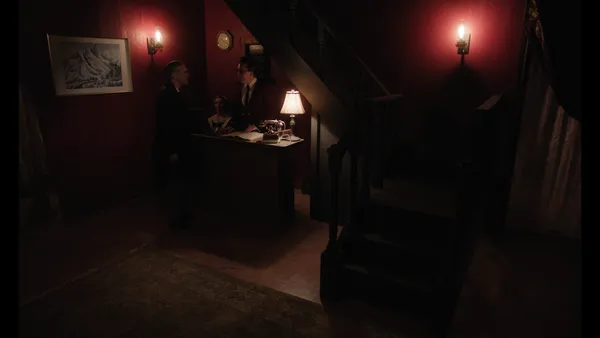
“Originally it was supposed to be somebody else doing the Haunted Season this year, and they ended up getting a project greenlit and couldn't do it, so I had to find somebody else. And I just thought, you know, why don't I take this opportunity to try to do an episode myself, and to potentially do this story? Because after reading it so many times, I pictured things in my head. I pictured what the hotel lobby looks like. I pictured what the room looks like, you know, all these things. And so I was like, if I could figure out how to surround myself with people who know what they're doing, people who have done this before... Because that's what I had always read about.
“I read about David Cronenberg starting. His producers were like, ‘Well, we just put him with people who knew what they were doing.’ So even though he had never done it before, it was okay. He had a buffer around him so that he wouldn't fail. And so I always thought that that's a really important thing when you make your first film: just make sure you have people around you as supports, who won't let you fail.
“My DP, Karim Hussain, is one of my oldest friends, and he became an invaluable collaborator in every way. On the set, he was not the first AD of the film, but he may as well have been the first AD of the film. That's kind of the role that he played, in addition to being the DP and being the camera operator.”
She’s delighted when i tell her how closely her vision matches my own mental picture of the environment in which the story is set.
“I was really curious to see how people felt if they had read the story before. If they had their own vision of the story, how they would feel about this filmed version of it.”
It is party, I say, that her version of that world feels really lived in, the hotel when the action is set and the mountains around it, thick with snow. But also she does a huge amount with sound. So much of the story is internal and is about thought and feeling that the sound is really important, in the background, to help us understand how the protagonist is feeling.
She nods. “The sound design was a huge part of it. My editor, Ben Shearn, when I originally asked him if he would edit it, he thought the budget was too low and he didn't really want to do it. But he said ‘If you let me do the sound design then I'll do it, because I'm trying to build up my catalogue of sound design projects.’ So I said ‘Great!’
“He had actually done sound design on his own sections of Woodlands Dark And Days Bewitched. He was an editor on that, and Winnie Cheung was the other editor, and both of them handled their own sound design. Winnie had done the end sound mix, but both editors brought in all their own sound effects and did their own sound design for whatever they edited. So I knew that he was capable, and I knew that he had a library of sounds and all these things. And I knew from working with him on that film that our tastes would align.
“I would say that our work together was much more focused on the sound even than the visual editing. Because I did a rough assembly of the film where I chose all my favorite shots and I put them in the order and Ben was like, ‘Actually, this edit mostly works. There's a few things that need to be tightened up, and some shots where the eyeline doesn't match,’ or whatever. But the actual visual edit of the film is very close to my rough assembly, so we didn't have to spend a ton of time in the visual edit. We spent most of our time working together on the sound design. We spent two months going back and forth. We used a program that I think is normally used when people play video games together, so that we could work on the film and also see and hear each other at the same time, to do it live but remotely.
“We just tweaked every little sound in that thing. Every second of the film has so many sounds in it. There's like 60 layers of sound on everything. I saw the film projected at one festival where they had the volume turned down really low, and the film didn't work. The sound is a huge, huge part of it.”
I suggest that the sound also gives us a continuous sense of the presence of the mountain at all times. The story isn’t just about a guy in a hotel. It's about the sense that the mountain is all around and all encompassing and threatening, even when he's in the hotel. We also get little cut-aways to scenes there, though we can’t know – for most of the length of the story – whether they’re real or imagined..
“Yeah. Well, the exteriors were something I knew I wasn’t going to be able to shoot on location. We were going to have to manufacture the exteriors where we were. We weren't going to be able to shoot the actors in the locations, basically. So we shot real locations, but not at the same time as were shooting with the actors. And so all the exteriors were done separately. I knew that I wanted to create this sense of a big, isolated place, so we did that partially with the footage and the music, but also then having the map in the hotel, you know, which is referenced in the short story.
“I had this map made where you could see how far off this hotel is from the other hotels. But also because I wanted to set this in the early Thirties, I had to think about whether the audience was just going to think ‘Well, why is he walking? Why doesn’t he drive there?’ So I started to think about, oh, they started building funicular trains going to these various resorts in the Alps, starting in the Twenties, so that you would take your main train to whatever the train station was, and then there would be these funicular trains that would take you to the resort.
“I was actually thinking of Psycho, where they talk about how the new highway just goes past them. And so I was thinking of having this one hotel that had been cut out of the plans of making this funicular railway system, and the effect that it would have on their business. So I was trying to think of how to establish that this hotel is really far from everything else, and that the exterior world seems just very daunting, that he really is not going to want to go back out into that again, you know?”
Towards the end of the film, the protagonist experiences a crescendo of ideas and emotion, and Kier-La abruptly changes technique.
“A lot of the story takes place in his own head,” she explains. “He has these episodes. He has one smaller episode, and then he has one big episode where he loses himself to these feelings that are kind of coming from somewhere else, or perhaps tapping into feelings that he already has in him. But it's this episode, I feel, in the story, where he goes into this thing and then he snaps out of it – but in the story, he's narrating what he's feeling. He's like, ‘I feel like this, I feel like this,’ you know? And I was like, ‘Well, I can't do that in the movie.’ I have to somehow show what I had to try to picture.
“If I had to show a heavy, dark depression visually, how would I do that? You know? So then I started thinking of animation for it and using specifically something that worked with paper and photographic images, animated rather than, like, drawing or anything like that. And so I just looked for an animator that did the style that I wanted, because I had a pretty specific idea of what I thought would work versus what could easily go wrong visually.
“I found this woman, Anna Molina, who is based in Germany. She's Ukrainian, and I just found her on Instagram by going through different animators and trying to find somebody. And then when I contacted her, she had read my book, House Of Psychotic Women, and she had also seen the musician that I got to do the score to my movie, because I commissioned the musician before the film was even shot. But the musician had performed in the town where the animator lives, and the animator had actually gone to see her play. So there were all these fortuitous connections where it's like, okay, this is going to work, because these people are all fans of each other's aesthetic and stuff, so this is going to work out when it all comes together.”
It really does, as you can see for yourself. Catch The Haunted Season: The Occupant Of The Room streaming on Shudder now.