




 |
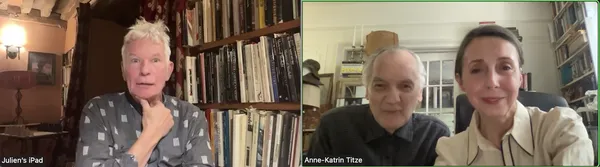
| Julien Temple, the director of I Am Curious Johnny (on the adventurous life of Johnny Pigozzi) with music producer/99 Records founder Ed Bahlman and Anne-Katrin Titze: “I've always been a big fan of Orson Welles' F For Fake …” |
In the first instalment on Julien Temple’s very original and timely I Am Curious Johnny, on the adventurous life of Johnny Pigozzi (aka Jean Pigozzi), the director/screenwriter and I were joined by music producer and 99 Records founder Ed Bahlman. The revealing (or not) documentary starts with Johnny Pigozzi learning how to use Zoom (and we hear Johnny Too Bad by The Slickers). Among those who Zoom with him are Michael Douglas, Mick Jagger, Graydon Carter, Jann Wenner, Diane von Furstenberg, Christian Louboutin, Martha Stewart, Charles Saatchi, U2’s The Edge, and a significant number of women from his past (and present).
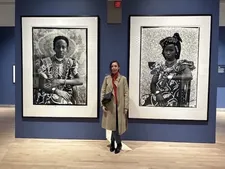 |
| Anne-Katrin Titze at the Seydou Keïta: A Tactile Lens exhibition at the Brooklyn Museum Photo: Ed Bahlman |
The spot-on soundtrack includes Peter Tosh’s version of the Chuck Berry classic Johnny B. Goode; Money (That’s What I Want) by The Flying Lizards; James Brown (at the Montreux Jazz Festival in 1981, performing It’s A Man’s World); Sam and Dave (Soul Man), plus Edith Piaf (Johnny tu n'es pas un ange) and Serge Gainsbourg and Jane Birkin (Je t'aime... moi non plus). One of Malcolm McLaren's early NYC music scene contacts (as far back as '76) was Ed Bahlman. In return, McLaren introduced Bahlman to the boys in the Sex Pistols and Tony Wilson (Granada TV host of So It Goes and later co-founder of Factory Records). On Ed’s recommendation Malcolm presented a preview screening of Julien's first documentary, The Great Rock 'n' Roll Swindle at Hurrah in New York.
Currently at the Brooklyn Museum (with the generous contributions of the Jean Pigozzi African Art Collection) there is a major exhibition of portrait photography by legendary Malian photographer Seydou Keïta. The soundtrack for Seydou Keïta: A Tactile Lens was created by Nile Rodgers and Chmba Chilemba and the exhibition includes remarkable textiles and artifacts that also provide historical context of apparel in West Africa over the past 80 years.
Temple’s film is designed as a patchwork of sights and sounds. “I have an obsession to take pictures,” says Johnny, who describes himself as very curious and impatient. His first memory may be of his father filming him learning how to swim, and there is a photograph of little Jean touching a Leica. His mother, whose story holds a mighty revelation, Johnny recounts, was obsessed with shopping and had a dog, named Lucky, with incredibly bad breath. There were 13 nannies and the child was sent to a detested Jesuit school with a priest who was paid by his father to whip the boy.
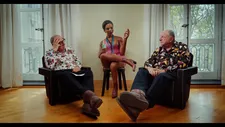 |
| Johnny Pigozzi (with glasses) interviewing Johnny Pigozzi |
The family holds many a secret, and at times the stories sound too fantastic to be true, especially with AI interrogations floating into hallucinations as well. Citizen Kane is Pigozzi’s favourite film and Fellini his favourite director. We hear that knowing the best restaurant in Turin and the dates for truffle season paved the way for his entrance to Harvard (where he studied economics) and how Johnny invented the selfie in 1973 with Faye Dunaway (despite the note that presumably the selfie stick was already a thing in 1938).
Mainly dressed in wildly patterned shirts of his own design (of his former LimoLand clothing line) in I Am Curious Johnny, Jean Pigozzi, art collector and entrepreneur, plunges into his past via an interview with a double of himself and an AI version of his long deceased father, from whom he inherited the SIMCA fortune and Villa Dorane, his famous residence in Cap d’Antibes, that has been hosting for decades coveted Cannes Film Festival parties at poolside.
There is a faked Hollywood star on the Walk of Fame for Johnny, and the tip to avoid ketchup at night if you don’t want nightmares. Not only does he have a collection of very famous friends and acquaintances, there are specific objects and African artworks the self-described hoarder is bedeviled with. Although he still owns his silver-plated platform shoes (that one of his many dogs is obsessed with) from the Studio 54 days, it is Birkenstock sandals, only the water-friendly EVA ones that float, in all different colours he wears non-stop.
 |
| A Johnny Pigozzi selfie with Jerry Hall and Mick Jagger |
No smoking, no alcohol, food is his thing. Houses and travels, a yacht, girlfriends at every port, dyslexia, a menagerie of inflatable pool toys - what does Pigozzi think of eternal life? “We’re not ready,” he says, neither in body or mind. But “I don’t like sunsets,” he concludes looking at an especially glorious one in a spectacular location.
From Somerset in the UK, Julien Temple joined us on Zoom for an in-depth conversation on I Am Curious Johnny.
Anne-Katrin Titze: Hi, Julian. I just got off Zoom with Johnny. Where are you? Johnny was in Rome.
Julien Temple: Right, I was with him last week there. I'm in Somerset, in England, west of England. Where King Arthur used to hang out. And King Alfred, actually. That's where King Alfred burned the cakes. Do you know the story of King Alfred burning the cakes? Pretending he was hiding out as a shepherd, as a peasant? And the wife of the farm where he was hiding left him in charge of the baking, and he burnt everything, because he was a king and didn't know how to bake the cakes. Probably Johnny would have done the same.
AKT: Very, very fitting. I just started out my conversation with Johnny, asking him about his favourite fairy tale.
JT: It's a good one. It's a local Somerset fairy tale, or historical tale.
AKT: Did you have a favourite fairy tale as a child?
JT: Well… Puss in Boots?
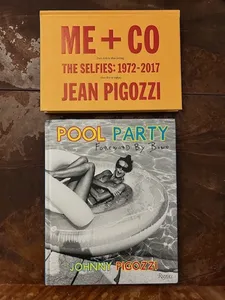 |
| Jean Pigozzi Me + Co The Selfies and Pool Party, collection Ed Bahlman Photo: Anne Katrin Titze |
AKT: Why? Because of the cat? Because of the brother making something out of nothing?
JT: Yes, it's a kind of survival, you know, overcoming all odds to become something, yes. The cat was the thing, yeah.
AKT: Yeah, his brothers inherit all the riches, he just gets the cat, and then the cat turns out to be the best thing ever. Once it has boots. Let’s get to the film. How did you come to make a film about Johnny Pigozzi?
JT: Well, as you know, I'm a punk rock filmmaker. On occasion. And I made a film when I was very young with a producer, a great English producer called Jeremy Thomas.
AKT: I had conversations for features on various films with him.
JT: So, he is also quite a good friend of Johnny's, so although I'd met Johnny a bit on and off at his legendary Cannes Film Festival parties around his pool, I didn't really know him. Jeremy suggested that I would be possibly the right guy for Johnny, and he said, would you be interested in making this film about him? So, it's Jeremy who's responsible for this collision. You know, I wouldn't have sat down and thought I was making a film about Johnny Pigozzi unless someone had asked me to do that.
AKT: And then Covid hit and Zooms did their part …
JT: I mean, I think this is a Zoom movie, in a way. At the core of the film is Zoom, like we're doing now, and I don't think there have been that many movies that are Zoom movies, so this is interesting in that respect, because there are different ways of interacting on Zoom, but friends on Zoom during the pandemic had a very different interaction with each other than, for example, me sitting someone like Johnny down in front of a big camera and grilling him.
It's a very different thing, the way he tells his story to friends, and we took a kind of jigsaw puzzle of that, and moved it around, but at the core is this idea of using Zoom as a way of communicating, and a way of getting rid of the horrible talking head thing you get in an interview, which is this very rigid thing, which disappears with Zoom. And people's faces are always interesting when they laugh or talk. But there is that nightmare of the talking head interview, some old guy in an armchair, and someone grilling them with a light on their face, which is inhibiting in a way that Zoom with friends isn't.
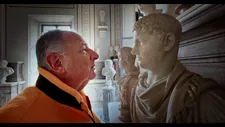 |
| Johnny Pigozzi in deep thought |
AKT: This makes it very much a film of the early 2020s. Zoom really coming to the fore during the pandemic, and then AI.
JT: AI, yeah, that's what I was going to say. You know, we made this film two years ago, so AI was just becoming the kind of talk of the town. We were playing around with how do you make fun of AI? Can a man talk to his [dead] father on AI? And all these things that are probably now really commonplace seemed absurd then, only two years ago.
AKT: Right, we are at the cusp of a completely different time. That's why it's so much the first five years of the 2020s that you're capturing. And also with AI, I think it's the AI father who is hallucinating, right? There's two different time dates for his death. Johnny says he died at age 66, and then the father's AI says: “I died at age 64.”
JT: Well, we were playing around. I mean, I've always been a big fan of Orson Welles' F For Fake, which, however long ago, 55 years ago or something now, predicted the kind of alternative fact universe that we live in now. The film F For Fake was about what's real, what's not real, and leading the audience up little garden paths, and then pulling the drawbridge away from underneath them, talking in fairy-tale terms. But we did play around with that.
I mean, Johnny's life is so kind of fabulous. In the sense of fabulation - for many people he's a James Bond villain with a pleasure dome on a jungle island off the shores of Panama or whatever. So there was an element of daring the audience to believe whether it was true or not, inspired by those ideas of AI hallucinating. Half the time AI tells you nonsense and we've got to navigate that. So the film is playing a little bit with that, as well as the Zoom. As you say, it is a response to where we are at in terms of the digital world we live in.
 |
| Johnny Pigozzi driving Mr. Limo |
AKT: And I have to compliment you on some of the great finds and choices of archival footage, footage that you added to what he's saying. When he says, I smoked a joint once in my life with Rex Harrison, you show Rex Harrison, smoking, probably a cigarette, while holding a baby! It's very funny!
JT: Yeah, I hope there's a bit of irreverence running through the film. Because I come from an irreverent background.
AKT: The section when it's all about SIMCA, and Johnny says, even Kennedy rode in the SIMCA with de Gaulle, you found a clip of them together in the car.
JT: Yeah, it was the SIMCA . And then also Johnny's got his little toy SIMCA with de Gaulle in it, which to me is funny. Because he is a giant toddler in some ways. Which is part of his charm, you know?
AKT: Yeah, there are a lot of toys, including swimming toys. And there's a lot of colour, a lot to capture. It's all very, very full. I just mentioned horror vacui to Johnny earlier. Every shot is filled with light.
JT: Well, I was trying to base the colour on iPhone colour, which is very saturated and strong, and is the colour of our time. If you were making a kind of 17th century drama story, you probably wouldn't grade it in that way, but for Johnny's shirts, and his pool toys, and his interior decorating skills you want something that's really hyper-real and iPhone reality. Again, it’s the 2020s and that's the way things go.
AKT: And you have these interesting threads that lead us through. There are a few moments when he is very adamantly saying, I hated this place, I hated that place, once at the apartment where he used to live, then about the Jesuit school, and I think there's a third thing. It feels structured very organically. How did you work on the editing with this? How did you structure? Did you know exactly how you wanted it to flow?
JT: No, no, no, my films are really about… well, this kind of film that I make, these kind of documentaries, are about the editing, and they're about definitely deciding you don't pre-plan anything. You don't sit down and try and write an essay about what you're going to do. You dive into it, and try and make sense of it as you're swimming through it, which I think has a more spontaneous and a more chance-like element of surprising things colliding and coming together.
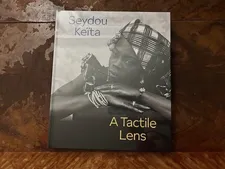 |
| Seydou Keïta: A Tactile Lens exhibition catalogue, collection Ed Bahlman/Anne-Katrin Titze |
But it does mean the edit is quite intense, and it goes on for quite a while. There was a lot of material, because he sent us a million stills. Wonderful archive of a certain part of society over 60 years. But you then have to look at them all, try and look at them all fast. And try and find ways that they can stick together with other things to tell a story not just about Johnny, but hopefully about our time as well, in the time we've lived through, all of us.
AKT: The obsession with pictures and with image-making that he has is central. All these different people, plus AI doubles are asking him questions. And one of the questions is about his first memory. And he can't tell if his first memory is his own or from his father's film of him.
JT: Yeah, it’s a mixed thing. Well, I think that's the case, whether it's film or photographs, memories are entwined with what relics you have, physical or digital photos. Memory has become a different thing from what it was. Before photographs, certainly. And certainly more and more recently with digital technology and AI.
I mean, memory is up for grabs, basically. Do you know what I mean? It's a different thing. Which is worrying, because we are our memory. Without our memory, if someone else is sending you memories every day, like Apple do on your iPad, it’s like, that's not my memory. Or it's a version of my memory that someone else is controlling. It's kind of scary.
AKT: Very much so. The fake Hollywood star, whose idea was that?
JT: That was my idea. I think all Hollywood stars are fakes, in a way. They're just human beings pretending to be something superhuman. Or the publicity machine is doing it for them. I don't know how it works, really.
AKT: The film keeps moving in so many different directions. One line that stuck out to me is about loneliness. There's the sentence: “I will have to buy some Swedish nurses to take care of me.”
JT: Very sad. There's an element to the film where you read between the lines a bit as an audience. I'm not trying to lecture people in any way, but I do want them to respond to the film if possible, actively, and think about it. There is an element of one making a film about someone who would never go to a shrink, as he says, psychiatrist, but effectively, it's a self-therapy session, amongst other things, which to me, is very interesting material of someone who refuses therapy, but actually is involved in it every day of his life, kind of with himself.
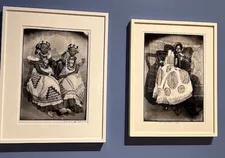 |
| Seydou Keïta photographs in the exhibition, Jean Pigozzi African Art Collection |
And the other thing is, you're still a human being, you can have all the money in the world, but it doesn't solve everything. So, there are things underlying the film that I think are interesting for people to take away from it and think about it. It works on different levels, because he's a wonderfully great company to spend a couple of hours with, but you realise that maybe he isn't the happiest guy in the world, you know?
AKT: I have someone here who would like to say hello to you, Ed Bahlman, music producer and founder of 99 Records, you might remember!
JT: Oh, hello there! Hey, man!
Ed Bahlman: Hi, Julien!
JT: How's it going? You've been listening in secretly.
EB: Absolutely! I have.
JT: Out of frame, out of mind.
EB: Yeah, exactly. I am Curious Johnny is a gem of a movie! I mean, obviously, working with [Malcolm] McLaren, Sex Pistols, The Clash, all that gang prepares you for Johnny.
JT: Yeah, well, not exactly. I mean, I'd never been to some of the places he took me to, but yeah, I mean everyone is a multifaceted person, so I was trying to play some games with how you present someone like this, provoking the audience, as I was trying to say, into thinking their own way through it.
I don't know whether it works, but the idea you buy into the fact that he was a movie director for a moment, and then he opens the fortune cookie and says, that wasn't going to happen. I mean, there are ways of taking the audience up the garden path, and then switching it around, which is fun, because, we're less sure of what exactly is real than we used to be.
EB: But he gave you so much to play with. There he is fiddling with the two Oscars.
JT: Right, yeah, yeah. Well, he loves to live as though he thinks he won Oscars, so I'm going to go with that.
EB: I want to talk to you about the soundtrack choices. The Slickers, starting off with Johnny Too Bad.
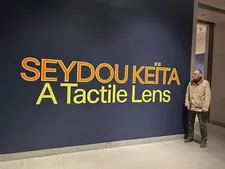 |
| Ed Bahlman at the Seydou Keïta: A Tactile Lens exhibition at the Brooklyn Museum |
JT: Well, we couldn't afford… we couldn't afford the Rolling Stones. I was going to start with Sympathy for the Devil, you know, “what's my name”? We had that for a while, but then that was my second choice, but I think it works great, because it does something. And he loves reggae, Johnny plays it all the time, so yeah, that song, I love that and how it works at the beginning.
EB: And also, Peter Tosh doing Johnny B. Goode. I had never heard that version before.
JT: Oh, it's great. It's really one of the best. I was playing around with the idea of Johnny, you know, it means a lot of different things, that word, and I love the Edith Piaf.
AKT: Wonderful. I've been humming it all morning before getting to the interview. I've been singing to myself “Johnny, tu n'es pas un ange…”
JT: But you know, the original was a Les Paul song with the guitar and Piaf and her songwriters made a French version, which is much better than the original, I think.
EB: I want to quickly add, your film London: The Modern Babylon is terrific. And Thurston Moore sends his regards!
JT: Oh, great! Sending back.
EB: I was in touch with him this morning and told him we were going to meet you on Zoom.
JT: Okay, oh, that's great. Say hi to him, and all the best!
EB: Okay, great. Julian, really good to see you again.
JT: I'm really happy you enjoyed the movie. That's great!
AKT: Thank you very much.
JT: Take care and thank you!
Seydou Keïta: A Tactile Lens at the Brooklyn Museum is on view through Sunday, March 8, 2026.
Coming up - Johnny Pigozzi on I Am Curious Johnny.
I Am Curious Johnny is streaming on HBO Max.
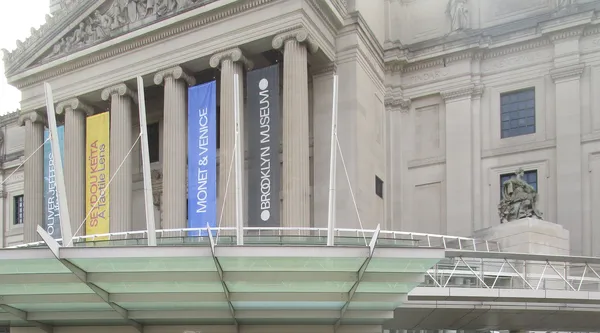 |
| Seydou Keïta: A Tactile Lens exhibition, Brooklyn Museum Photo: Ed Bahlman |