 |
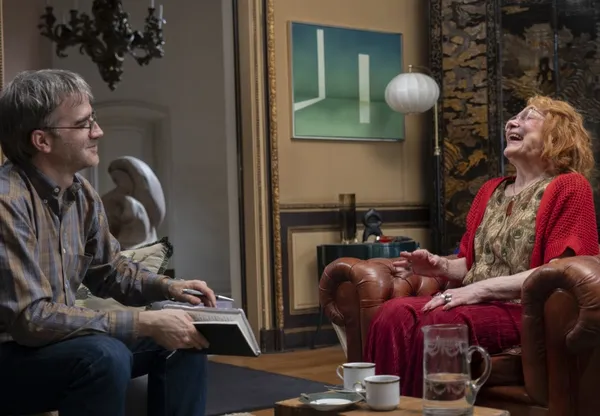
| 27 Nights Photo: Courtesy of San Sebastian Film Festival |
27 Nights, Netflix, streaming now
This enjoyable Spanish tale of elderly rebellion is fresh from its premiere in San Sebastian and hinges on a terrific central performance from Argentinian star Marilú Marini. She plays 83-year-old party girl Martha Hoffman, whose daughters have her committed to a psychiatric hospital for the 27 nights of the film’s title. They claim she has a form of Alzheimer’s that is causing her to be impulsive and give away their inheritance – Martha just says it’s generosity. This leads sweet-natured lawyer Leandro Casales (Daniel Hendler, who also directs) to enter the picture in order to establish what’s what. The result is a gentle, warm-hearted odd couple dramedy that’s well worth a look and comes with added poignancy when you realise it was based on a genuine case that changed the law.
Pooja, Sir, 2.40am, Channel 4, Tuesday, October 21
Deepak Rauniyar and Asha Magrati’s gripping Nepalese crime thriller is making its network premiere in the dead of night, but don’t let that put you off trying to either catch it or catch up with it at a better hour of the day. Queer police officer Pooja (played by Magrati) is sent to a border town from Kathmandu to investigate the kidnapping of two boys – one of whom has prominent parents – against a backdrop of constitutional protests by the Madhesi community. As Pooja investigates alongside local officer Mamata (Nikita Chandrak) – who is also from the Madhesi community – questions of prejudice and social injustice begin to emerge. Sociopolitically complex but presented in a way that is accessible to non-local audiences, the crime plotline is also propulsive, with Magrati’s performance anchoring the whole thing. Claustrophobic and intense. Read what the directors told us about the film.
Accident, 9.05pm, Talking Pictures TV (Freeview Channel 82), Wednesday, October 22
Harold Pinter and Joseph Losey prove a formidable pairing in this tale of mid-life crisis, which also marked the start of Losey’s regular collaboration with cinematographer Jerry Fisher. Dirk Bogarde – who also starred in Losey’s superior The Servant – plays a married Oxford professor with a pregnant wife, who becomes infatuated with one of his students (Jacqueline Sassard). She, however, is also the object of affection of fellow student William (Michael York) and a fellow don (Stanley Baxter). Losey and Pinter take their time exploring the ebb and flow of the four’s relationship and the powerplay between them. Beyond its tense examination of seduction and cold calculation, it also offers a fascinating snapshot of late-60s academia.
We’re All Going To The World’s Fair, 11.35pm, Film4, Wednesday, October 22
Jennie Kermode writes: Since the breakout success of I Saw The TV Glow, Jane Schoenbrun has gained international recognition as a major talent with an intriguingly different approach to cinema, so don't miss the chance to check out this, their first feature, which explores themes around viral fads, online predation and the potential physical effects of virtual experiences. It focuses on teenager Casey (Anna Cobb), who is participating in the World's Fair Challenge, undertaking different tasks each day and also engaging in a ritual said to bring about 'changes' – at the same time as talking to a much older 'friend' who seems to be trying to groom her. Almost the entire film is seen from Casey's perspective and it's easy to feel afraid for her, but at crucial moments Schoenbrun reminds us that we're watching a curated take, and that this is native territory to someone of Casey's generation – far less so for her interlocutor, who may in fact be the more vulnerable party. Complex games are played out in a deceptively simple environment, and Schoenbrun reveals a deep understanding of a medium regarding which Hollywood has yet to grasp the basics. Read parts two of our interviews with Schoenbrun.
Close Encounters Of The Third Kind, 8pm, BBC4, Thursday, October 23
A perfect example of the way the Oscars never quite fall how you think they will, Richard Dreyfus was not even among the film's nominees for Steven Spielberg's tale of allen first contact, although his co-star Melinda Dillon was. He plays Roy Neary, a man whose sighting of a UFO acts as a sort of epiphany – the irony being that he can communicate with aliens more easily than his family – and who encounters Jillian Guiller (Dillon), who is searching for her son. Somehow, Spielberg manages to retain Dreyfus’ everyman quality despite his obvious flaws, while also touching on one of the director's favourite themes, suburban anxiety in Middle America, fuelled by family breakdown to job loss. The visuals have stood the test of time and hover at the sweet spot between awe and horror. John Williams’ five-note sequence has long passed into collective memory as a short-hand for spookiness.
Promising Young Woman, 9pm, Sky Mix, Saturday, October 25
If there's one thing that's not in doubt as you watch Carey Mulligan's performance in Emerald Fennell's directorial debut, it's that she's having a whale of a time as a damaged young woman seeking vengeance on male predators. By day, Cassie (Mulligan) works in a coffee shop but by night she goes on the hunt as a pretend-drunk, waiting to catch sleazebags with her honey trap. Although Fennell sometimes struggles to balance the tone between the romantic comedy element of the film – as Cassie develops a relationship with Ryan (Bo Burnham) – and its darker #MeToo themes, she carefully prises open the lid of victim-blaming and lasting trauma as Cassie's history is gradually revealed.
The Crime Is Mine, 9pm, BBC4, Saturday, October 25
Jennie Kermode writes: François Ozon returns to 8 Women territory with a brightly coloured, high energy adaptation of Georges Berr and Louis Verneuil's 1934 stage play Mon Crime. When glamorous but talentless starlet Madeleine (Nadia Tereszkiewicz) is falsely accused of murdering a sleazy producer who attempted to rape her, she falls into despair, but her flatmate, aspiring lawyer Pauline (Rebecca Marder), sees an opportunity. Rather than championing her innocence, she presents her as a feminist hero defending her honour, and the case is a sensation, bringing them fame and fortune and seemingly perfect lives - until the actual guilty party turns up threatening to denounce them unless given a share. With sets and costumes which mimic the theatrical style of the Thirties, Ozon presents the drama as if his camera were free to wheel around the private world of the stage. The women may sometimes seem ditzy but have a shrewd intelligence underneath, the dialogue is sharp as nails and the twists never stop coming.
This week’s short selection is Joanna Quinn’s bitingly satiric animation Britannia.