 |
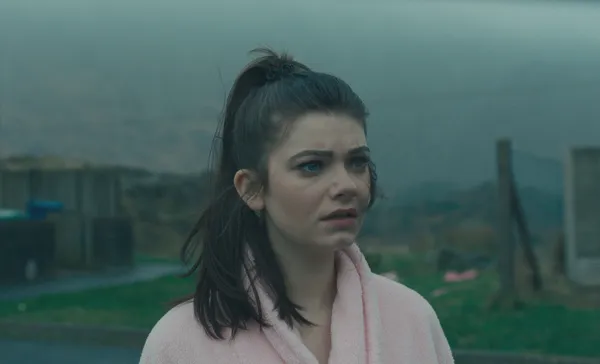
| Effi O Blaenau Photo: MetFilm Studio |
A small Welsh language film made on a modest budget, Effi O Blaenau was one of the hidden treasures of this year’s Glasgow Film Festival. Adapted from Gary Owen’s stage play Iphigenia In Splott, it stars Leisa Gwenllian in the title role as a young woman dealt a bad hand by life who is determined to survive no matter what she finds herself having to contend with. I loved her ferocious performance and was delighted to meet up with her and director Marc Evans to discuss it.
There are some spoilers in this interview, towards the end, but they are clearly signposted, so if you want to go into the film knowing as little as possible, you can still read the first part.
Marc tells me that the subject came to him through the film’s producer, Branwen Cennard. “I'd seen the play and Sophie Melville is brilliant in that,” he explains. “The play relies very much on a first person narrative, so it's very ballsy, and the way she tells the story is what draws you in and it's very challenging for the audience because it's a theatre piece. And then Branwen was looking for, you know, I think she looked originally for Welsh language monologues during the Covid period, and then we started talking about making it a straight drama as opposed to a monologue.
“For me, what interested me was trying to understand where it would sit in a Welsh language context. The reason that we ended up in Blaenau is because it really is a town where people express themselves in Welsh, and it went further and further away from the play in as much as it became a straight, observed story really. And I was just interested in authenticity, I suppose, trying to tell a story. That was such an amazing place though. Wales is a very poor country. So it's a story about a poor girl in a Welsh town and I thought that was something that I haven't seen for a while, to be honest, especially in the Welsh language.”
“I saw Sophie doing it,” says Leisa. “She's the original Effi, the Effi from Iphigenia In Splott, and I saw her doing it in London a couple of years ago. That's why it feels so mad that I got to play it, because I was first introduced to the play when I was about 15 or 16 by my acting teacher. If you're a young Welsh woman who wants to be an actor, it's quite a classic one.”
“It lends itself to a monologue, doesn't it?” says Marc.
She nods. “It does. And I auditioned for drama school with it, so I had this whole history with the play. And so I think I felt quite sure about who she was early on. But as Marc was saying, obviously it's set in Blaenau and it's in the Welsh language, and so that makes it very different. I really tried to not just do a carbon copy of what Sophie Melville did, because no one can do that. It's her own Effi. And I try to make it my own, in a way. I think it being set in Blaenau and being in a completely different language makes that easy. And me and Marc, we talked a lot about what we thought had happened to her in her life and in her childhood and stuff, and we kind of came up with our own version. It's actually quite different to the play.”
“Also originally we had the bits of monologue,” says Marc. “There's a bit at the front, a bit at the end, but we just got rid of it because we felt respectful towards the play, really. The monologue worked really well in Welsh as well because it's quite gutsy, but actually, as the edit progressed, we just got rid of everything except the front and the end.”
I remark that I think the film is really shaped by the landscape as well. There’s a scene early on in which Effi walks out of her front door and everything to her left is cut off by a wall of dark mountain, whilst the mist is so heavy that the sky seems to be sealed off too, and it’s as if she’s living her life in a tiny box.
“Yeah, very much so,” he says. “People in landscape is the thing I love. You know, you can take pictures of a landscape and take a photo, but the bit that really excites me in filmmaking is trying to have a relationship and a synergy between the character and the landscape, and Blaenau just lends itself to that. The weather we had was the weather we shot, but actually it lent itself so well to a sort of isolated beauty that is so reflective of the characters. It's an amazing place.”
“There's a weird kind of energy to the place,” says Leisa. “It's a very artistic place. A lot of our great musicians and artists have come to Blaenau. You really feel it as soon as you set foot there. And we got to meet some of the people. I remember before we started shooting, I just walked around for a bit. I'm not from Blaenau. I'm from down the road but I'd not spent a lot of time there and it does inform so much. I feel so lucky that we were able to shoot so much on location.
“Obviously we had a bit of studio stuff, but all of the exteriors pretty much are in Blaenau. It makes your job so much easier as an actor because it just feels real and you're just kind of there doing the thing amongst the people who actually live there, so that felt really special.”
She also felt responsible for representing people there in a way that would feel right to them, she says.
“I know quite a lot of people from Blaenau. There's definitely a massive sense of pride that they have. I think all Welsh people are just very proud of our little pockets of Wales. And there's definitely a responsibility. It's a really powerful story and what happens to her is very traumatic and I just couldn't stop thinking about the real life Effis who are out there. I'm sure it's happened to more people than you think and it probably happens to a lot of people who live in poor areas in Wales, especially poor rural areas. I think those kinds of people are affected by poverty in like a really unique way, and so I was really aware of that.
“The piece is inherently political and as much as we tried to – we didn't want to treat too much on the politics – you can't get away from the fact that what happens to her is a direct result of the failures of our system. We tried to balance that with also making sure that before all of that, you fall in love with Effi and who she is, and that's the heart of the story: just this young woman who is living her life and then this happens to her. And hopefully we did a right job at that.”
I tell her that I think so. And Effi has a lot of innate agency, which I think is important because when poor people are represented at all in films, they tend to lack agency a lot of the time, or to be looked down on a lot. Effi is very much in control of her life in her own way.
“There's a bit of what I call a social realist, miserableist tradition in Britain, isn't it?” says Marc. “Where actually, you make people victims. Obviously she's a victim of the system, but she's nobody's fool, so I think it's really great to be able to have that energy, that energy of somebody who's downtrodden and ill served by the system, but who’s fighting back, trying to make the best of it, because I think she's hoping for the best, rather than necessarily completely believing that the best is possible. It's like what you do to get through, isn't it? And that spirit, I think, is much more fun to explore a fairly downbeat story in that way.”
I like that with the soldier Effi meets as well, I note, because although he's unhappy about his disability and that’s dealt with in the story, there's a scene where they're going up the stairs together and he has to move slowly and move backwards because of his limp, and it’s used to build up the sexual tension in the scene. We don't usually see disabled characters represented like that.
“It's funny to hear you say that,” says Marc, “because obviously we take representation very seriously, and it's a conversation everybody has all the time, but yes, you're right. We felt we were doing right by him as a character and he is a representation of that. And the war, you know, the meta story is those young boys going to fight those wars for us as well. So it is kind of like political, but it doesn't feel like a preachy film, I hope.
“Leisa and I were talking about it and the story that the mum and the dad haven't quite worked, haven't quite managed to fight against the system. The grandmother, therefore, is almost like a person who just sees... I love the character because she's so awkward, but she's seen it all go tits up a few times, you know. She's a survivor.
“My favorite scenes, I think, are around the girl next door. She’s a bit overweight and she's body shamed a lot, and that's why her little girl doesn't go swimming. So there's all these people who have got this going on that they're trying to fight, but they've all got a bit of guts when they're called upon.”
“I think we all felt quite empowered by Marc's direction and the conversations that we had,” says Leisa. “As Marc was saying, like, it was such an empowering role for me. And, you know, it was a big ask. I'd never led anything before, and it was one of my first jobs out of drama school. But, you know, when you're surrounded by so many creatives who have this vision, we all just came together. It really was great, even though we were cold and all that.”
“You were very cold,” Marc notes.
“I mean, I was quite dramatic about it, but yeah.” She laughs. “We all kind of went ‘Well, let's do it!’ In the spirit of the characters. I think we kind of had that on set as well. We were kind of like, ‘Let's just get on with it.’”
We can look at it as a story of somebody who just has lots of bad things happening to her, I suggest, or we can look at it as a story of somebody who's growing, because every time she starts to think about the world beyond herself, she gets a little bit more powerful.
“It does, yeah,” says Marc. “There was a monologue we took out at the end where she was actually very political. I'm glad we took it out because I think what you've just said, hopefully you pick up on her growth as a person. We just have the slightly contemplative idea of thinking about that cat who had been poisoned and how it's a sink or swim kind of world. But you know, you so feel she's going to go on to greater things, Effi, at the end of the film.”
Was it difficult working in those mountainous locations?
“The town was fantastic. Local people were helpful and it was surprisingly easy to be honest. There's a few moments with rain machines and trying to make things work without enough money. But you know, I just love the energy of that kind of filmmaking. I love turning up and not knowing what the weather's going to do. So you just respond to that. It felt so brilliant just pushing through, whatever it chucked at us. It was a grueling shoot, but it wasn't a difficult shoot.”
There are some spoilers in what follows as we discuss Effi’s journey, beginning by talking about one of the other locations in the film.
“We used an old Covid hospital. There are a few empty buildings they don't use anymore. So you know, that again was a story that Gary [Owen] came across himself. His wife had been by ambulance when she was pregnant and you get abandoned by the system and there's that slight idea that you know, the middle class people with their partners are a little bit better at working in that system. It's something I think a lot of people are very, very aware of now with the National Health when they come across it. Much as we love it and champion it, you know, it's struggling, isn’t it? Yeah, this is quite political.”
Reflecting on the same location, Leisa says “That location in itself it was, it was quite depressing and it was really quite scary. Like, there's a shot when I'm being like wheeled down the corridor and you see all these like little bits of wire and stuff coming from the ceiling. I remember I felt like a really vulnerable pregnant young woman even though I wasn't at all full belly and I was fine. I'd just been laughing with my mates. But I was just thinking if I was pregnant and being put in this kind of hospital, like, God... I mean, I think visually there's just so many of those moments, so many images that are so powerful and so symbolic, and it tells you so much about the state that we're in as a country.
“My poor mother, watching the film, I think she. She really struggled because it's obviously, it's such a distressing birth. It's so traumatic. I was really lucky. We had a really wonderful midwife with us on set, Polly, and she was really good and she helped me with some of the obvious stuff that you wouldn't really think about, like the noises that you make in labour and stuff. And I just watched a hell of One Born Every Minute. That's literally what I did for about a week before the show.
“I love that show anyway, and so I watched a lot of pregnant women and I just kind of closed my eyes and hoped for the best. But it is amazing, that experience as an actor, when you really throw yourself into it. I remember I was quite nervous for the birth scene in particular, just because it's one of those big, big moments that you want to get right, and something takes over you when you really go there and you just think ‘Right, I'm going to give this my all.”
“You were amazing,” says Marc.
“Oh, thank you. Well, I felt knackered. I thought I was going to be sick afterwards. I'd been on the gas and air and stuff. It was physically quite a demanding film but, God, what a privilege to be able to play out those scenes. You know, I feel like it doesn't happen often that you get given a character where you get to experience so many human emotions all in one go. I just feel very, very privileged to have been able to do it, really.
“There were some days that were quite heavy. We had one scene where you and me, we felt a bit teary,” she says, looking at Marc. “You know, the one where she had all the baby clothes and cot and the empty pram in the room and Effi was snuggled up in bed, looking at pictures of the scan and stuff. There's so many moments where you. Where you really do feel it. But again, I was so lucky to just work with really lovely people, and there was also just so much joy. And I think people were aware that the content was quite difficult. And so people were extra caring and just extra light about things, and I really appreciated that. And I remember there was one day where I was going back to my hotel room by myself and I was like, ‘I can't shake the day off.’ I went for a pint with Eira, the DoP, who was just wonderful. It's her début feature as well. I think she's done such an amazing job. And so I always had people around me if I needed to shake the day off and have a little pint.”
“For me, the secret weapon was the relationship between Eira and Leisa,” says Marc. “It was very easy to look at those things from a male point of view, but having a girl behind the lens and a girl in front of the lens in their first film together, I think that was where some of the magic came from, to be honest.”
“I just want to see what people make of it,” says Leisa. “You know what I mean? I don't want to impose anything on anyone. It's there for everyone. It's in the Welsh language, but it's there for everyone. I think the creative team from the get go have been really clear about their ambition for this film. It's a film for Welsh people, it's a film for Blaenau, it's in the title. But the story is universal and yeah, I'm just excited for people to see it.”