




 |
| Sour Minnows Photo: Fantasia International Film Festival |
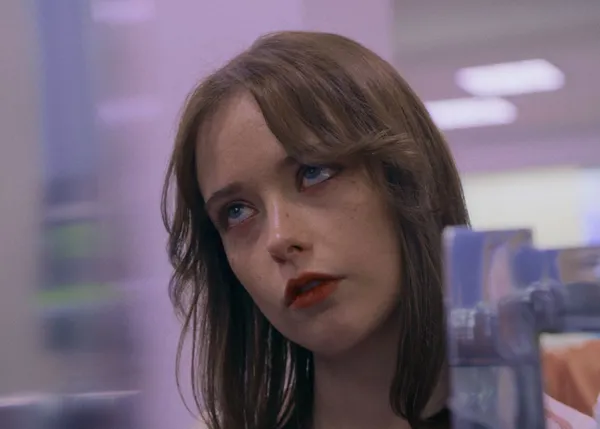
It’s hard to say which is the strangest film at the Fantasia International Film Festival in any given year, but Sour Minnows, which begins with two friends stumbling across a group of men sensually licking the pavement, it’s certainly up there. That should be no surprise in light of the fact that it’s directed by Harrison Atkins, whose previous work, Lace Crater, tells the disconcerting story of what happens to a young woman who fails to use adequate protection when engaging in a sexual encounter with a ghost. Sour Minnows is very different in theme but is likewise unsettling – and importantly, its strangeness is much more than mere decoration. I was delighted to have the chance to chat to Harrison, whose work intrigues me, and I put it to him that he captures things which seem truly alien better than anyone else working today.
“I feel like in terms of cinematic language, I'm maybe most attracted to formal play that engenders sensations that are slippery or ambiguous, or textures that are anathema to what I think a lot of more normative commercial movie stuff is trying to do,” he says. “That's always been what appeals to me. The route that I've taken in my work has always been trying to excavate new tones or new emotional languages, or trying to find the diamond hidden in the cavern or something. I guess a reminder that the medium is young and that it's not tapped out, and that all these established forms aren't all that we have. Maybe that feels alien.”
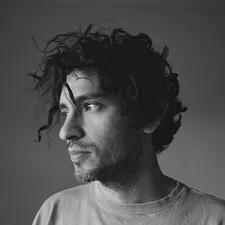 |
| Harrison Atkins Photo: Fantasia International Film Festival |
Fantasia is eclectic, but Sour Minnows still stands out. Did he have a clear idea of the form it would take when he started making it, or did it develop out of lots of different little ideas that came together?
He thinks for a moment. “Sort of both. It's tricky, right? I don't think it's easy to really parse that linearly because I think that the project evolved really poetically. Originally, it was poetry on paper, and then the poem kept expanding and became a screenplay. A lot of the work that I do for hire is editing. I think that lends itself to a really iterative approach. And I think in general, there's always kind of a conversation between the ‘vision’ that you have and then the chaos of reality. This was a guerrilla shoot. We were definitely navigating a lot of chaos and so I think we made a lot of discoveries over the course of production. We made adjustments to the script over the course of production, and then in the edit, I had a lot of fun expanding and trying to render more dizzying the different sort of things that we had found on the day.”
I tell him that I love the tone of yellow that sneaks into it. It’s revealing a very particular presence, and one doesn't see that colour much in the natural world or anywhere else. It’s quite haunting.
“Oh yeah, I appreciate it,” he says. “It was always intended to be a synthetic colour that feels like it catches your eye and stops you in your tracks, but there was definitely a lot of experimentation on the part of our incredible colourist who I think really found the perfect shade of yellow that's in the film.”
Why did he choose to make his human protagonists film fans? Was that something that just happened with those characters, or did it give him an opportunity to comment on film that he wouldn't have had otherwise?
“I think both. I mean, I am really cinephilic, obviously, and I live in Los Angeles in a city that is simultaneously a bastion of cinema and also of a more consumer driven, commercialised movie-making lineage, so that tension was always really interesting to me. Trying to make work in LA that's guerrilla, it can feel there's a productive friction because it's like the city doesn't really have a language for that, compared to, you know, making a guerrilla movie in New York or Chicago or something. I think in LA it's really confusing to people, or people have a different way of relating to cinephilia with a capital C.
“To some extent it’s ‘write what you know’. I’m obsessed with movies and so I felt an urge to explore those – the curdling of those characters, I guess, or the curdling of their world and worldview. Also, I was reading a lot of Raúl Ruiz and I was fascinated by his writing and the labyrinthine structures that emerge from the way that he relates to his poetic conception of cinema. So in a self reflexive way, cinephiles that are watching their world be eaten by cinema felt sort of thematic.”
‘Labyrinthine’ is an interesting choice of word, I venture, because it's hard to tell a story that the audience can connect with using characters who have big gaps in their lives due to memory loss.
“It was, definitely. It was really difficult, and there wasn't really a roadmap in the process of the edit for finding a way to strike that balance. It's like, when is the confusion intentional on the part of the filmmaker, or when is the confusion just something that's unclear? I was always okay with the idea of making a film that's less than linear, obviously, or has a more open approach to formal language and structure to allow for more chaotic or mysterious or ephemeral experiences to bleed in.
“I've always been really attracted to a sort of structural conceit, I guess, that you can find in Philip K Dick's work or something where it's like the structure doesn't fully cohere and it's this friction that's weirdly sublime. There's this weird kind of other transcendent quality that emerges when the pieces don't fit together in a way that satisfies the rational mind. So I felt like maybe there was something in me that felt really driven to sort of pursue a more intuitive relationship with narrative rather than one that's linear, mechanical.”
Is that something that also comes out of the guerrilla experience, if things don’t quite get finished as intended? Did he sometimes capture things that he didn't think he would when he went out to begin with?
“Absolutely. I'm really attracted to a process of working that empowers my collaborators to feel safe on the day to make their own discoveries. The job of a director, in my opinion, is to be really fully present during production: to try to be open to seeing something amazing when it's in front of you, rather than so locked into your view of what you think you want. It’s magic.”
It almost seems at odds with that, I say, but the other thing that I really like about his work is the scenes that he has where nothing obvious happens and there are just a couple of people sitting down and looking at each other, and it's all about the actors. It reminds me of something that David Lynch said about the switchover to digital and how that allowed him to just leave a camera on an actor's face and see what happened. Is that what he’s doing on those occasions?
“I think to some extent, yes,” he says. “And I think Lynch is right that digital filmmaking and a more nonlinear editorial approach allows for that. Or you can endlessly roll and you can find these uncanny emotional spaces. I think Ryan Trecartin maybe has a similar point of view about a digital approach where he, for example, loves to shoot overnight because it engenders this sensation in the actors where they're overtired, increasingly uncanny or unhinged. Performances emerge, you know? But in the case of this movie I cast actors I really trusted. You know, a lot of the actors who appear in the film are my friends or people that I've collaborated with before, and we had a really playful approach to trying together to unearth this strange unity of tone.
“It really isn't something that's easy to describe verbally or easy to put your finger on. It's more something that you sort of know you see it. You sort of feel it or you don't. So in a way, I think that on the day you don't need a ton of money or a big production to hypnotise yourself. You just kind of need the right sort of willingness to go into the unknown.”
So is that something that, again, comes down to the edit, where unexpected things can be found and story emerges in the process?
“We shot piecemeal,” he says. “I was editing as the film was being shot, which was cool. We shot for 35 days in LA over the course of something like six months or a year. The shoot sprawled over the course of a long time. Some of the shoot days were just me and the actors. We had our small crew, our intrepid producers, but the budget limitations that we had maybe freed us to be more flexible in terms of how to approach the production. We were lean and mean and able to zigzag and adjust and respond to the discoveries that we were making as we found a cool location or maybe something fell through and we had to scramble and figure something else out.
“The edit was playful and it took a long time and there were lots of iterations of it and experimentations and discoveries and some structural moves. As an editor, I really believe in rigour. If I have like an impulse or a hypothesis about something, I feel like I have to see it through so that I can know whether or not it works; so in a film like this, where the rubric for whether something works is much more mysterious, I would say that there was a lot of just discovering some little magic strangeness in a footage and then reverse engineering it.”
Lace Crater got a lot of attention and it looks like this film is heading in the same direction. So if somebody were to offer him a lot of money to make a bigger film, would he say yes to that or...
“Yes. Yes,” he says firmly, laughing.
So he does want the money, for the record? He’s not afraid that it would compromise his style?
“Please, please give me money to make a big movie,” he says. “I love that world. I feel like, yeah, the cinema that I'm at is a little bit agnostic about having a big budget. But I feel like a lot of the work that I've made has constantly been in a situation of budget pressure, and I have a lot of other ideas and films and scripts that I've written that would definitely benefit from a bigger budget. It's a situation where I'll make any movie that I can. But if someone wanted to finance a bigger budget film for me, I'd be really excited to explore that.”
He has a couple of scripts that he’s working on presently, he says.
“I'm also continuing to like to edit films for hire for friends or for filmmakers who I admire. But yeah, I'm hoping to direct another feature in the next year or so based on a script that I have, and I'm feeling really excited about it.”