 |
| Mallory's Ghost |
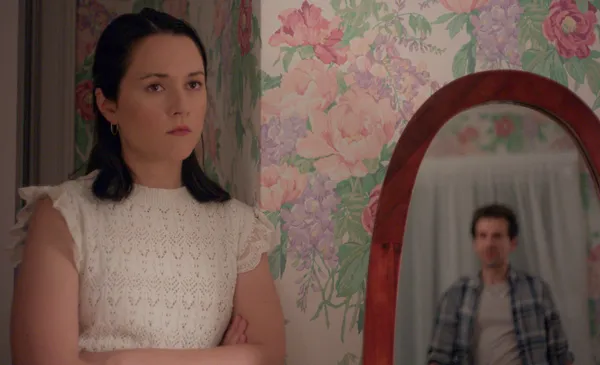
Actor filmmakers Arabella Oz and Nick Canellakis’ directorial feature début, Mallory’s Ghost, follows the titular character (Oz) who accompanies her playwright boyfriend Sam (Canellakis) on a writing retreat — unbeknownst to Mallory, the same place he took his ex-girlfriend Louise (Anjelica Bosboom). As the days in coastal Maine go by, Mallory becomes increasingly obsessed with the glamorous ex and begins to believe she is being haunted by her ghost.
A trained therapist, Oz directed the short film A Party In London, about a woman confronting feelings of loneliness at a friend’s birthday party, and co-directed Colour of His Eyes and Our House.
In conversation with Eye For Film, Oz discussed navigating the film’s tonal complexities, defying easy categorisation and using curiosity for narrative fuel. She also reflected on the psychological effects of cinema and her own journey, mirroring Mallory’s.
The following has been edited for clarity.
Paul Risker: Working as a mental health professional, where does your interest in filmmaking come from?
Arabella Oz: I've been interested in filmmaking and writing scripts since I was a teenager. My mom was a screenwriter, and I always watched her working on her stories, and so, I was drawn to the medium very early on. And then as I got older, I became a therapist and started to practice in mental health counselling.
Mallory's Ghost has an unconventional arc, where the world, the tone, and the type of film it is shifts halfway through. Watching it at last night’s screening, I thought, 'Oh, there is something in how watching a film mirrors the healing process.’ It’s something that I'm just starting to appreciate.
You’re seeing these images and your unconscious is absorbing it in a way that does not have to do with words. And because the film changes and goes into this completely new world, you have to let go of control and see where this story takes you. And it ultimately leads the characters back to where they started, but nothing is the same. So, in that way, I saw how film can be a replica of the healing journey and that can do something to the brain, ideally. I don't know if I accomplished it, but I was appreciative of that last night, and the appeal of filmmaking is being able to work with that on more of a subconscious level.
PR: Pablo Larraín told me that he finds the film in the final cut. Is this an idea that tallies with your experience or was it necessary to find the film at an earlier stage?
AO: What you're trying to accomplish in the screenwriting process, you then have to revise in the shooting, because real life, real people, real moments and circumstances don't always achieve what you were envisioning when writing it — at least for me. Maybe when you reach a certain level of mastery, there's no gap between the two, but there was a gap for me.
It's a complicated story and there were certain elements of the tone and the plot that I was trying to find, and I wasn't sure if it would work. We were definitely in a state of discovery on set, trying to figure out the tone, and how much comedy and how much fear to have, or how dark or how light. The editing was definitely the part of the process where we were trying to find that, because it's so wild how taking out one line or shortening or lengthening a moment of silence can change a whole scene.
At one point, we were a little bit stumped because we had a test screening, and something was not quite working. We brought in this exceptional editor named Katie Mcquerrey, who has worked on a bunch of the Coen Brothers films. She's just a genius at editing, and she found these moments of strangeness and tone that she wove throughout the film. She reshaped a bunch of scenes, and I said, "Okay, yes, this is what we need.” It was what I was trying to accomplish, but I didn't know how to really articulate or find it.
Every stage of the process, up until colour correction, is finding, developing, and delivering the story, because when you first get the idea for the story, it's just a seed of a feeling. You’re trying to figure out how to express something, and I'll tell you, it's definitely not easy.
PR: Films can be deceptively simple, especially if shot in a single location. Mallory’s Ghost might be one of those films that is logistically pared back but finds emotional complexity through its themes and ideas.
AO: There are layers to the film, and even more than the emotional complexity, the most challenging part of the film for me was figuring out the tonal complexity of the film, because it hops genres a couple of times. It’s not an easily categorisable tone. It's a psychological comedy with elements of magical realism and some jump scares. But when you take a step back, and you watch the film, it does actually have a cohesive tone. It's just I don't know the word for whatever the tone is. So, finding that and trusting that or helping the film find that cohesion, even though it wasn't one thing, was the challenge.
PR: Picking up on your point about Mallory’s Ghost not being easy to categorise, the willingness of filmmakers to shift tones, like James Wan does in Insidious for example, is important for challenging traditions of the narrative form. This enables us to explore what cinema is and can be.
AO: It loops back to the first thing we were talking about, the psychological impact of the film. With any art, you're invited to step out of your logical mind and absorb it on a more subconscious level, but especially with film, because there are so many of the senses involved, and stories are maybe more primal. How our brains process time, history, and life is through stories. There is the whole hero's journey, and mythology is so embedded in our collective unconscious. So, the impact of a story in film has the potential to really shift, transform, and feed our internal framework. I know that's a big, bold thing to say, but I think it does, especially if you're taking in that kind of story over and over again.
You can learn a lot about a culture based on the kinds of stories that they're telling. So, a film is visuals, music, words, character, emotion and feelings. It’s also about seeing people, and that actors have authentic emotional experiences means you’re getting all of that input on so many different levels of your psyche. And that’s really the pinnacle and the power of a film. I know I'm not the first person to say that, but I really do believe it.
PR: We’re living through an increasingly adversarial period, where conversation and ideas are divided between two sides. This is causing us to lose our grip on nuance and makes the centrist position an increasingly fraught one. An interesting aspect of your film is looking at the positives of jealousy, as opposed to it being exclusively a negative emotion. The term revolutionary or progressive feels fitting to describe Mallory’s Ghost, and yet, that points to how broken our societies are.
AO: Thank you for picking up on that. The word that comes to mind for me is curiosity. This film was really fuelled by a curiosity about jealousy and peeling back its layers until you get to the kernel at its centre. When you peel back the layers of anything that looks simple or black and white, you always find nuance, paradox, and unexpected elements of the thing. That's probably why that was the experience, because it was fuelled by a deep yearning to understand what the heck is going on with this pattern of comparison and jealousy.
PR: The intriguing thing to note about Mallory’s Journey is that spatially, the characters are mostly pinned down in one location, and yet the experience is one of going on a long journey some place.
AO: Mallory says in the movie, “You’re haunting him across space and time.” Then she says, “Well, actually it's the same space” because they don't actually leave this setting. When you play with time and with an emotional trajectory to try and achieve that sense of a trip having been taken, when you come back around to the starting point at the end, that lands with you even more because you see a starker difference between the beginning and the end.
PR: Is the experience of making a film a transformative one?
AO: Definitely. I share parallels to Mallory in the sense that this film and making a film and being a filmmaker was a burning desire inside of me that I didn't have the moxie to pursue. Making a film is such a bold, challenging and often impossible task to chase. You're saying: This is what I have to say, and I'm gonna say it. I'm gonna use all these people, resources, and places and all of this other stuff. That was not an easy stance for me to take.
So, I definitely have that aspect of Mallory in me — this burning creative desire that I wasn't pursuing, and a pattern of jealousy that kept haunting me. There was a point when I was looking at this pattern, and I thought, ‘I'm not gonna put any more energy into this thing. I'm gonna put that energy into my creative dreams.’ Then, I worked on the film for years, and the jealousy pattern went away. And not only because I worked through the layers of emotion and psychology in the film, but also because when you pursue your calling, you enhance your relationship with yourself, and that's what Mallory's story is about. So, it was really cool that I experienced Mallory's arc in the making of the film — it’s pretty crazy.
Mallory's Ghost premièred at the 2026 SXSW Film Festival, in the Narrative Competition.