 |
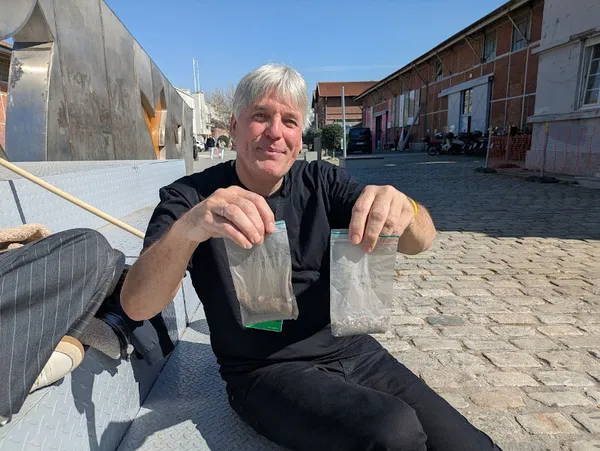
| Jon Larsen with his stardust hunting sample bags in Thessaloniki Photo: Amber Wilkinson |
The film was shot over a decade and, at the start, Jon was still trying to convince space experts to even look at his findings. Given that, when I caught up with him and Rasmussen at Thessaloniki Documentary Film Festival this month, I asked how he felt to find himself suddenly asked to participate in a film.
“I was very happy about it,” he says. “I've been a freelancer my whole life. So, I've been used to doing everything myself – if there is going to be a film, I have to do it myself, things like that. So when somebody else, externally, asked, ‘Can we do something together?’, it was a welcome variation.”
One thing that’s notable about Jon’s attitude is that it appears to stem from a desire to try something as much as a need to actually succeed. Recalling when he started out collecting dust from rooftops and elsewhere, armed just with a brush, a bag, a magnet and patience, he says: “In a way, I didn’t believe I had the ability to do this but my belief, vague – it was not firm – was that I could initiate a search for the stardust. I did it meticulously and kept my journal readable so that others could continue my work when I’m dead.”
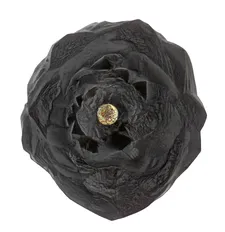 |
| A micrometeorite Photo: © Jon Larsen & Jan Braly Kihle |
“I think I was the most surprised guy in this whole story,” says Jon. “I didn’t think it was possible but somehow it happened. Of course, then, the natural follow-up question is, ‘What now?’. It was like finding the Holy Grail. But what do you do with it when you’ve found it? I didn’t know. I just had to go with the flow and consult all the grown-ups, the scientists, around me and be guided.”
He adds: “When it comes to the scientific part, I think you should remember that even though I’ve been an artist my whole life, for 42 years on the road with my quartet, I started out as a visual artist with paintings, and I thought that would be my destiny, to make paintings. But life happens and we had a radio hit with a Norwegian folk singer, Lillebjørn Nilsen, and it gave us the opportunity of touring and we just went with that. I think I have a scientific mindset that is analytical and it’s open, playful – you need that to be an artist.
“My hobby my whole life has been geology and I’ve really been into collecting rocks since I was a kid. There was real pleasure and real excitement and I still love that. Look, this is what I’ve collected rock hunting in Thessaloniki for the past two days. In here could be some stardust”
Jon brandishes two marked up bags of what looks like grit, which he has collected from the roof of the Olympion cinema and elsewhere in the city, and promises to give me a progress report after he’s sifted through them back home.
He adds: With the scientific mindset I have, I have an interest in reading about scientific history, how things develop. The story of the discovery of the stardust particles is a textbook example of how science works. It has been like this always and it probably always will be. New discoveries and developments always come with strong oppression from those ‘who know’. Three hundred years ago, the German philosopher Arthur Schopenhauer nailed this by saying all new knowledge has passed through three stages. First you are ridiculed, they laugh at you, second stage is when they say, ‘No it can’t be, because’ – they try everything to put you down and vigorously suppress it because they know better, they are the keepers of the flame. Then comes the third stage, the big surprise, it’s accepted as self-evident. You know what they say, physics is making progress, one funeral at a time!”
One thing Jon is also doing is passing his own knowledge on to the younger generation and we see him inspiring the younger generation to pick up their own magnets and go spacedust hunting. He says it’s an aspect of his work that he gets a kick out of.
“I think I have, if anything, a small portion of talent for being with children, which I enjoy. They bring me hope and joy.”
On seeing himself on the big screen, Jon adds: “I’m touched even thinking of it now because it’s so fresh, only two days ago I saw it for the first time. It made a huge impression and now, everybody needs to see Elisabeth’s film. This is the chance we have in the meteorite world to show what we are doing and what things can be, especially for inspiring young people. It’s quite paradoxical that I did this alone – the one person in the world – for seven years. From 2009 until 2016, nobody else did this. But today, ten years later, there’s thousands of people and not only amateurs but professionals in many institutions because they now have access to these materials. NASA uses it not so much for the scientific part but because, as Mike Zolensky told me, ‘We need citizen science outreach otherwise we will lose our funding’. So they use stardust search for engaging the layman and kids, so they can get the money to do their real science.
“At the same time, this is cutting-edge science. There are science collaborations in France, UK, Poland, US and many other places, analysing the cosmic dust particles retrieved from urban environments. But it is also used by tens of thousands of children now, in Wales alone there’s one educator, Emma Wright, who has been to more than 1,000 schools with a programme about stardust hunting for kids with low resources. And they’ve found pleasure in it. I’m not, any more, the locomotive in this movement, I’m the old grandfather.”
With all that going on, how does he keep his feet on the ground?
“Oh, that’s easy, I don’t have any money. You don’t get blasé then.”
And, what about those bags of dust from the top of the Greek cinemas? Well, I checked back with Jon to ask what he had found and, it seems his festival rock hunting met with success.
“Oh yes!” he says, “A micrometeorite from the rooftop of Olympian cinema, my field search 1,220 since 2009, and my micrometeorite #5.616. Barred olivine, 200 microns across.”
Evidence, if it were needed, that staying curious often pays off.
- Read what Elisabeth Rasmussen told us about mixing art, myth and science in We Are Stardust