 |
| Out Laws Photo: Emily N'Kanga |
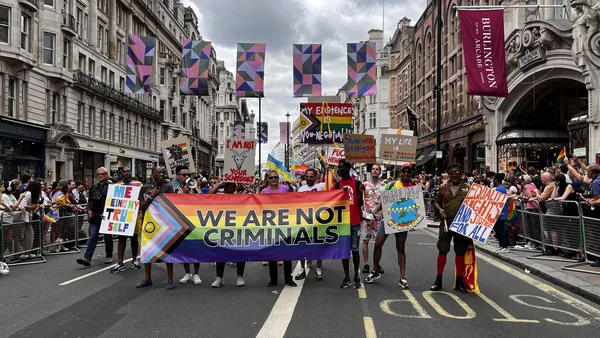
At events like BFI Flare, where people can get together and relax and celebrate LGBTQ+ experiences, it’s important to remember that there are parts of the world where living or even just identifying that way is illegal. in Namibia, Friedel Dausab went to court to call for the law making same sex relations illegal to be struck down. Rosanna Flamer-Caldera founded Sri Lankan campaign group Equal Ground. Learning that the two of them, together with an influential US activist, were going to be in London at the same time for Pride and to stay at a retreat, filmmakers Lexi Powner and James Lewis decided to take the opportunity to interview them, and the project evolved into a documentary, Out Laws.
When we met to talk about the film, James was suffering from tonsillitis and was supposed to be looking after his voice, so was instructed to keep quiet, but the rest of us talked. It was Friedel’s birthday and had been Rosanna’s birthday the day before, so everybody was in a positive mood.
“As a filmmaker, I'd been looking for an opportunity to make my first feature, and when this opportunity arose, it was like the dream,” Lexi says of the project. “James had this access to and trust in the movement already, and he's got this really amazing understanding of the history and the politics. And then from my side, I had the experience of human centred storytelling. So together we could combine and merge the personal and the political, which is, of course, the queer experience and the experience of Friedel and all these people, and make this story.”
“We were invited by Human Dignity Trust,” says Friedel. “It was a global group of activists, mostly in the global south, in Africa, in the Caribbean, in South America, as well as Southeast Asia, that were invited for the retreat, as Lexi said. I got in touch with James and we organised for us to get there a little bit earlier than the rest of the people. It was really exciting because it was such a difficult and such a complex story of what's happening across the world.
“I think Lexi and James did such a stellar job to take a global issue, but also to also tell the story with political sensitivity, to get people engaged and to understand the history and the role of the UK as an empire in what we in the Global South now experience as laws that prohibit our sense of being, so when I was called, I was like ‘Of course, yes.’ I just didn't know that I was going to play such a huge role!” He laughs. “I thought I was just going to be one of the people who contribute to this story. But it was such an amazing experience for me, especially getting to see that parchment in which King Henry VIII had written that first edict [making same sex relations illegal], and how it still impacts my life. I think that's the moment in the entire documentary that really stands out for me that I wouldn't forget. And I didn't really have an idea about that when I was first contacted.
“I met the crew, and beyond Lexi and James, the entire crew were such lovely people, tuned into what's happening in the world. I mean, and what's happening with LGBT politics and politics in general. But it was never really about the politics when were shooting it. It was about connection, it was about telling our stories. And I was able to broach topics that I never really talked to about anyone, both the personal and the political, because both Lexi and James made me feel so much at home and able to open up and share my story. How do we make sure that people don't suffer anymore from the laws that were so unjust and that need to be gone by now?
“My story starts with public health advocacy because of my diagnosis with HIV at the age of 25. That was really before antiretrovirals were available in Namibia. We were pressuring our government to make sure that mother to child transmission was ended and that no baby was born with HIV. I knew, of course, that gay men and trans women were at heightened risk, but our government was not addressing the issue, so that's how I got introduced into LGBT politics.
“I started the first health programme on HIV prevention, treatment, and access to care here in Namibia, so my focus really had been very national, but I've also been working with the African Union on domestic resource mobilisation, to make sure our governments actually give from our budget to health and we don't depend only on donations and international aid for HIV care.”
We talk about how laws and regulations have been changing for the worse recently in countries like the UK, US and Argentina.
“I think that there's rollbacks happening all over the world,” says Lexi. “I mean, if you look just in the past few days at the Transgender Amendment Bill in India, which has rolled back on trans rights there after having had a really great bill for people to be able to self identify. We've got what's just happened in Senegal where the penalty has become greater, even including the promotion of homosexuality. And then on our side we've got the Supreme Court Bill. It feels like it's coming in at all angles from around the world. There's a lot of rollbacks and a surge in conservatism and right wing politics. But I think that this is a hopeful film.
“It's so easy to look on your phone and to read the news and to feel like the right is taking over and the dominant narrative is against us and against our rights. But this film, for me, feels hopeful because if you look at someone like Rosanna, for example, you see her looking sexy in the Seventies at Pride in San Francisco, when it was still illegal in her country to be who she is. But she has taught me to celebrate those incremental changes and to celebrate all the wins along the way and not just worry about that final goal – and to be hopeful and to keep going and to never give up.”
“It seems like years and years of apathy as far as the governments are concerned,” says Rosanna. “Every time we try to do something they push us away or say ‘Oh, yeah, we're going to do it,’ when they want our vote. And then once they come in, it's like, ‘Okay, forget about them. Who cares?’ But that isn't the only thing. I think the most important thing is getting the message out to LGBTIQ persons, plus others, and inviting them to be able to talk with us and understand who we are and become allies and friends and family members who will care about the LGBT community
“There has been quite a lot of that happening over the years. And one thing that we saw the other day was the fact that we were getting a lot of hate speech online because of our tourism programme. And what transpired was there was also a lot of pushback from straight and LGBTIQ people. So that was a really good sign that things are changing in mindsets. And to be quite honest, I think that's the main initiative that we should actually focus on: changing mindsets. I mean, the laws are there. We can't do anything if the government is not willing to. I mean, we've tried everything. Some countries are amenable towards changing the laws or getting rid of the laws. Our country seems to be very stuck in keeping the laws and embracing the laws.”
I suggest that it's also important to celebrate not just the victories, but just the existence of LGBTQ people, and to be able to say it is possible to be happy like this. Because so much of the propaganda focuses on the idea that people will have miserable lives.
“I think that's exactly what Rosanna and Friedel and Raven do in the film,” says Lexi.”Well, I guess the film is doing two things. It's rearchiving and retelling the story of queer history from a queer perspective, which is an antidote to the dominant narrative. But it's also looking at the stories of these three people, and we were really led by them and the way that they talk about stuff and Friedel and Raven and Rosanna, they're just fun. They're just a hoot. We just have a good time with them, and hopefully you see that in the film.
“It was really important for us that this film wasn't from our gaze, that it was a co-creation, and we didn't want to make trauma porn. We didn't want to have footage of people being beaten up in the streets and stuff like that. But that's not the way that they talk about their experiences. They are joyful and they are hopeful, and I think what's beautiful is to be able to have the history and have the context, also, for me, it was really important to have those joyful moments, those silly moments, those tender, intimate moments where you're just with them in the eye of the storm while this big political tornado is whirling around them. Hopefully we can hold those two things in the film and give everybody a well rounded, digestible story.”
“Sometimes I sit back and I think, you know, being the litigant is almost a privileged position, especially in my own context, because I have a security plan,” says Friedel. “I have people who really think about communications and how we communicate. Both my life story, but the legal case and the advocacy. And I keep thinking about the security of those who are not the litigants. I keep thinking about the security of trans women, of young gay people at university, of people who are coming from poor backgrounds who have to try and access treatment as gay men or as trans women. And I think, well, my place probably has a little bit more privilege in terms of safety, security, for life than many LGBT people in Africa, in Southeast Asia, in South America, whose stories are not known.
“Having my story being told somehow also gives a little bit of pressure to our government, makes me known so that people think twice before they do anything to me. It's really the people who are not being highlighted who are at so much more risk as a result. Namibia is a quiet country, but since I've gone to court to date, we've had seven people, trans women and gay men, who have been horribly murdered in Namibia. It really highlights the place where we are now in global LGBT history, where it's almost like a win and a lose. It's one step forward, two steps back. But as Rosanna was saying, we're at a place where people are a lot more aware, and the old power structures, the old belief systems are pushing back, and they're pushing back really hard.
“They're pushing back and targeting the most vulnerable. Trans women, for example, all over the world are really under pressure at the moment because being transgender is just so visible. But I also think that the movable middle is more vocal now, and people are saying ‘That's not right.’ My mum, for example, is a Christian woman. She's turning 80. When she hears the story, she says, ‘That's not right. It's not right for anyone to be killed. It's not right for anyone to be refuse you service just because you're different.’ And I think we're really at a point where we are at a breakthrough.
“Hopefully what this documentary will do is to enlighten more people, allow people a safe space where they can make a decision. Because a lot of people are looking at the ping pong between us as activists and our government that are being repressive, and they are not having a space to make the decision. But sitting in front of the screen and watching the film will probably allow people to make a choice for us, a choice for justice, a choice for freedom and a choice for liberty.”
I ask Rosanna if she thinks the same thing is happening in her country.
“I'll put it this way,” she says: “I think that the population in general, their outlook on LGBTIQ rights has changed quite a bit. On the one hand, there is a lot of people who are now supporting us, allies and friends and family members and so on, and politicians and various other people. But also because of that, there's also that push from right wing individuals and political parties that want to destabilise the government, and they're using the LGBTIQ community as scapegoats because we are vulnerable.
“The issue is that decriminalisation has been on the board for a long time and government after government has just let it just slip away. They're so scared of public opinion and scared of losing their seats or losing the elections the next time around if they go ahead. This particular government that's in power at the moment is supposed to be the National People's Power. I don't know whose people that they are talking about, because they came in with their manifesto stating clearly that they will decriminalise and make Sri Lanka a country where everyone is equal. But things have changed.
“We have three official languages in Sri Lanka: Sinhala, Tamil and English. In the Sinhala version of the manifesto, they have taken out those passages, but in the English version, it's very clear, it's very well written there, what they came in on, saying that they will decriminalise it and that they will make everybody equal. So there seems to be a disparity.
“It seems to me that the government is scared to lose votes, scared to lose power. They are trying to backtrack because there's a lot of religious push for changing the laws and not giving rights to the LGBTIQ community. And it's led by the cardinal of the Catholic Church here, and we are a Buddhist country. However, it wields a lot of power, especially from the previous government folks who are the ones behind all of this targeting.”
Originally the film was only going to be shot in London, says Lexi. “Then this opportunity with Friedel and his case came up, and we could go there for the ruling and the judgment, which was incredible. Namibia is a really peaceful country, and that's what they all told us. We personally felt really safe, but our main concern was around the actual making of the film and the importance of Friedel's safety and security, and the filmmaking came second to that process. And that was always what we were doing in the film.
“We're very well aware of who we are as two white British people making this film, and our priority was to help decolonise, not to recolonise in the making of our film. When went back for the judgment, obviously it was against the backdrop of the multiple murders that had been happening. Things had been really difficult and scary for Friedel and everyone in the community, and we knew that.
“What you don't see in the film is that there's a lot of safety and security briefings that are going on in the background. That's why in the courtroom scene at the end, there's not very good audio, and I'm filming one of the shots of Friedel on my phone because we had to run in there at the last minute to make sure that we weren't interfering or getting in the way of anything. I'm hesitant to centre myself at all in any kind of safety issues. We were welcomed by everybody who was in Namibia, and made to feel really safe. It was just about making sure on that day that Friedel and the community were safe and that we didn't interfere in that.”
Sometimes outsiders can help with these things and sometimes, when they try, it backfires. I ask Friedel and Rosanna what advice they have for people who would like to assist them in gaining equal rights.
“Ever since we started the film and to where we are now, something really important has changed in terms of resources for the LGBT movement worldwide, especially in the Global South,” says Friedel. “We had the ascendancy of President Trump in the US, and what it meant for people who are living with HIV, for example, is that PEPFAR, USAID, and International Development Aid that we relied on so much and around which a lot of the work was done on destigmatising access to public safety services, etc., is falling away – so people are even more vulnerable now than they were before.
“At the same time, when you look at the UK and other governments, the slice of money that was available to development is also shrinking quite drastically. And so in terms of assistance, I think there is such a big need to get people help. I've been working as a safety and security officer for the past three or so years, until last year. And what I know, for example, is that today, if anything happened to someone, that safety and security funding that we had for the past two years is no longer there. If anybody needed urgent assistance today, it would be almost impossible to give someone the urgent assistance that they need.
“The short answer is, I would really encourage people to give, but also encourage that people give as decentralised giving, because historically the top down structures where central governments in the US or in Europe have been giving what they decide is official development assistance to African countries and to NGOs in Africa to do the work that they need to do. But maybe the way forward is more decentralised, from people to people, and we maybe need to put in place more GoFundMes or structures like that where people in the Global North who have a little bit more think ‘I can donate this much’ and put it into a central fund that goes to the Global South for work that needs to be done, but also a lot more cooperation.
“It's not just money that we need these days. It's the changing of attitudes, it is the exchange of expertise, whether it's legal expertise, whether it's safety and security expertise, and we probably need to review what assistance looks like, but more from an egalitarian perspective, where we meet as LGBT people, as straight people who care for humanity, for justice, for equality, and see how we really help each other. But assistance now is even more needed than it was when we started shooting the film. It is a question of how do we do it and how we cut out the power over structures so that we can meet as humanity and ensure that we sort of all start creating a world where everyone, whether you’re straight, gay, older, is first viewed as a human being that needs to be treated with dignity and respect. Or, you know, you can watch the film and donate to the work of Lexi and James so that they can do more of the work that they're doing.”
Lexi looks shocked at this, but Rosanna steps in.
“I agree with just 100% of what Friedel has said,” she says. “I was having a chat with the Canadian High Commissioner this afternoon, and the thing that we were talking about is how effective or not effective it is for high commissioners and ambassadors and international governments to push our governments into looking at decriminalization, looking at improving the human rights record against people who are marginalised in our countries. It's a very thin line. For one thing, if you push too hard, then you're interfering. If you don't push at all, then you don't care. So it's how hard you should push, or how hard not to push.
“For a country like Sri Lanka, it's not only the LGBTIQ community, but we also have a huge issue with women's rights as well. We may have produced the first female prime minister, and we may have had lots of successes, but then after that, we live in a world which has never have been equal for women. And so when you're a woman who's either trans or a lesbian or bisexual woman, there's so many layers of discrimination that go on then, and these laws just help people to say, ‘Oh, there's a law against it, so obviously there's something wrong with these people. They need to be jailed for what they do.’ So I think these kind of diplomatic nudges and conditional aid is very important.”
Friedel is cautious. “A few years back, we had the right honourable then Prime Minister David Cameron, who had suggested that African countries who don't respect their LGBT rights need to be sanctioned,” he says. “The entire continental LGBT community came together and said ‘Not in our name.’ That is definitely not the right way to do it, because if you sanction our countries, the most vulnerable people are LGBT people, and they're just going to be crushed by those sanctions. So it's really a thin line on how foreign governments can work with LGBT communities.
“One of the ways that we always tell them is create room, a diplomatic room, so that we are able to engage our own governments but it is our voice that gets heard. The more important thing is also to enable the movements to be able to do the work that they need to do by not restricting funding, by not making it conditional or deciding the agenda already in the Global North sphere and saying ‘These are the issues that we want to fund,’ but rather ensuring that resources are available so that Global South countries can decide ‘This is the money I can use, whether I work with trans people, whether I work with health, whether I work with economic opportunities – so that there is resource available for us to be able to do the work that we do.
“It could make the Global South more at risk because it perpetuates what people are saying, that we are Trojan horses for recolonisation of Africa and the exploitation of African resources. When it seems, for example, that the UK government is pressuring the Namibian government to change the laws, it allows the right wing evangelicals to point at us to say ‘You see, the UK government is pressuring our government to allow the gays to roam freely,’ with all the epithets and all the stereotypes that follow what it means to be gay in their minds. And so us leading us, changing the laws, us speaking to our governments, is a lot more helpful because we can really – as this film does so well – tell them that the homophobia is actually what came with colonisation, and that what we do as LGBT movements is to decolonise and remove the legal, the social as well as the economic structures that came with colonisation by reforming the laws and social attitudes around homosexuality and gender identity.”
“Sri Lanka has a clause in the constitution which means we cannot challenge any law in a court of law,” says Rosanna. “So therefore we have no options whatsoever to change the law without the government changing the constitution. But we had a Supreme Court ruling a few years back when some people challenged it with a private member’s bill. So this is the way it goes. You have to have a private member's bill at Parliament and it's voted on, and if it's voted positively, then those laws would change. But of course that never went to Parliament for a vote and still hasn't gone to Parliament for a vote. So the opposition, challenged it in the Supreme Court, and the Supreme Court said ‘No, it's not unconstitutional,’ to a degree.
“We have to depend on the goodwill of government ministers or parliamentarians to put in a public or private member’s bill in order to get this law changed, and the irony of it all is it's just stuck there. They haven't even put it to Parliament for a vote. End of story. So we can't do the things that, say, Friedel can do in his country. So we have to see country by country and region by region, because everything is different. I mean, in India they don't have the same law clause, so they were able to remove the archaic British laws criminalising same sex relationships. Not in our country. So it's a conundrum.”
Lexi begins to challenge the idea that people should send money to her and James, but James, temporarily overcoming his aching throat, intervenes.
“We do need money,” he says. “We only have the licensing for the archive and the music for film festivals, and the film has always been designed as a tool for people like Friedel and Rosanna to use in their communities and grassroots organisations, wherever they want it. It's not cleared enough to do that. So we're raising £32,000. We've got £25,000. So we're doing really well, but we do need money. And then what we'll be doing is raising money through foundations and trusts to build campaigns where we'll do private screenings with influential people and then media and public campaigns as well.
“The film was really just an invitation to people to have reasonable discussions around this topic and be invited into a place where they can meet the people who are affected by these laws and understand the context better so that hopefully they can have their minds shifted somewhat, to imagine that things might change.”
We go on to talk about the festival.
“It's so exciting to be having our premiere at Flare,” says Lexi. “I mean, as I'm a Londoner, it's such an important part of the calendar every year, and it's crazy to be there. In fact, somebody told me last night – I was at the opening night last night, and I watched that lovely film, Hunky Jesus, an amazing film about the Sisters of Perpetual Indulgence, who are an organisation in San Francisco. It's a film about them. You have to see it.”
“The sisters started in 78 or 79, and I was in San Francisco at that time, so it was really nice to see that,” Rosanna puts in.
I mention that I have an ex-girlfriend who is a Sister of Perpetual Indulgence, and they all seem delighted.
“Being at Flare, hopefully, is an opportunity to begin the momentum of rolling out the film,” Lexi continues. “And as James says, we need money to get our archive licenses and to complete the film and then to be able to begin the impact strategy, which The Good Side, James' company, is going to roll out. I'm not very good at answering those questions about the impact strategy and the rollout, because that is James. But, yeah, from my side, from the filmmaking side, I'm just really proud to be premièring at the biggest LGBT festival, and I can't wait.”
Out Laws screens at Flare on 23 and 28 March.
Donate to free the film for impact.