





 |
| On Greta Lee performing Bertolt Brecht and Kurt Weill’s Surabaya Johnny in Late Fame: ”It is at the core of it because it’s a movie about people who are lifted up by an idea that doesn’t really exist in reality.” Photo: Anne Katrin Titze |
In the first installment with Kent Jones on Late Fame (a highlight of the 63rd New York Film Festival and the 'Standard' Viennale Audience Jury winner), based on Arthur Schnitzler’s recently discovered late 19th century novella (adapted by Samy Burch of Todd Haynes’s May December), we discussed Greta Lee’s show-stopping performance of Bertolt Brecht and Kurt Weill’s Surabaya Johnny and Weill’s varied work with Ira Gershwin and Maxwell Anderson, plus the siren call for Willem Dafoe’s Ed Saxberger.
 |
| Greta Lee as Gloria and Willem Dafoe as Ed Saxberger in Late Fame |
The past comes back in layers, brittle, shatterable, delicate, with cinema as the perfect medium to probe memory. Saxberger, one night returning home from his job at a Downtown New York post office, finds an eager admirer named Meyers (Edmund Donovan) waiting for him on the sidewalk. The young man, wearing somewhat old fashioned garb (inventively amusing costume design by Carisa Kelly), compliments his idol on his book of poetry, published many decades ago and long-forgotten by the world at large, and invites him to join his group of young writers for their jour fixe at a nearby café. This “Enthusiasm Society” is planning a “sincerely ironic throwback,” an old-fashioned reading, to which their new rediscovery shall contribute a fresh poem.
Saxberger wonders about the lack of girls in the group, just in time to be introduced to “larger-than-life actress” Gloria (Lee). Her gestures in homage to Gloria Swanson and Marlene Dietrich, you realise how much you missed women like her in 21st century cinema, where there seems to be so little room for that kind of tragic playfulness and twinkling doom. “I have a very high tolerance for despicable men,” says Gloria, a sentence equally funny and profoundly sad. Josef von Sternberg's Shanghai Express may very well be one of her favourite movies. Late Fame gives both Willem Dafoe and Greta Lee a chance to show us a side of their acting skills we haven’t seen before.
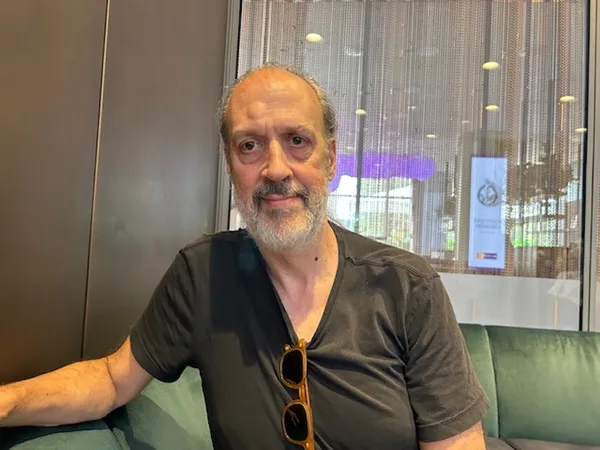
Inside the lobby of David Geffen Hall at Lincoln Center, Kent Jones joined me for an in-depth conversation on Late Fame.
 |
| Late Fame screenwriter Samy Burch with May December director Todd Haynes Photo: Anne Katrin Titze |
Anne-Katrin Titze: Showing Late Fame at the New York Film Festival, I imagine, must have been overwhelming for you! [Kent was the New York Film Festival Director and Selection Committee Chair for seven years, stepping down after the 2019 programme.]
Kent Jones: It was overwhelming for me not only for obvious reasons, but it’s hard to imagine a better screening. Because the audience was just with it every step of the way. It was the same in Venice, but it was a different audience, a more international audience. Here it was a New York audience and obviously it’s a New York film. There were laugh lines that I didn’t even know were laugh lines.
AKT: For example?
KJ: Meyers calls Saxberger and says, hey can you come to my apartment? Then there’s a cut to the inside of Meyers’ apartment. It was really interesting!
AKT: There were laughs, too, at the press screening. I laughed.
KJ: Oh good!
AKT: Because when you think of an apartment in New York, you do not imagine that.
KJ: That’s right. And yet, it was shot in New Jersey. Every time we’re inside in the film it’s New Jersey.
AKT: And the reactions in Italy, in Venice?
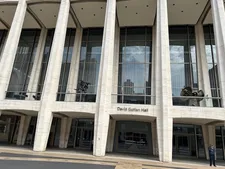 |
| David Geffen Hall, Lincoln Center Photo: Anne Katrin Titze |
KJ: People loved it. You know what it’s like at film festivals when there’s the applause but it’s very ritualised. And then there’s genuine applause. I’m not blowing my own horn but I know the difference.
AKT: If anybody knows the difference, it’s you! With so many Q&As! That must have been special here to return to this place at Lincoln Center where you have worked in another capacity for so long. Were you nostalgic a little?
KJ: No.
AKT: Ha! Not at all!
KJ: It depends on how you characterise nostalgia. I guess it’s nostalgia in a way that’s more of a bodily response, if you know what I mean. Because I was there walking the steps that I used to walk, year after year after year, and at the same time it was unfamiliar because so much time has gone by since I’ve been backstage. And then to be in the reverse, that was … I’ll think of an adjective to describe that.
AKT: I’ve been humming Surabaya Johnny to myself all morning. The song is at the core of Late Fame, I felt.
KJ: Quite true.
AKT: Everything gravitates to it. Where you placed it, how Greta Lee sings it, the audience watching her. Tell me about this choice of Surabaya Johnny of all the possibilities!
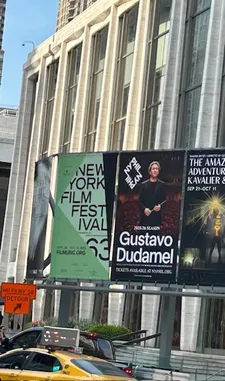 |
| New York Film Festival 63 banner at David Geffen Hall Photo: Anne Katrin Titze |
KJ: Well, Kurt Weill’s music is very close to my heart. I listen to it a lot.
AKT: Didn’t you tell me years ago about a project around My Ship?
KJ: Yes. Which I still want to make. That’s not with Bertolt Brecht, obviously. It’s with Ira Gershwin.
AKT: Lady In The Dark?
KJ: Yes, that’s right! There’s Kurt Weill when he’s with Ira Gershwin and with who wrote Lost in the Stars (Maxwell Anderson). But then there’s Kurt Weill when he’s with Bertolt Brecht and that’s something else. For years I’ve had a recording, Marty Scorsese actually had told me about it, with Brecht actually singing Mack the Knife. Because Three Penny Opera was so popular he recorded it and Kanonensong, I think. There’s a bite, obviously to the Brecht lyrics, and a level of irony that’s quite different. I don’t read the reviews that carefully all of them, but there was somebody who referred to it as a torch song. But it isn’t, Surabaya Johnny.
AKT: No, it definitely is not.
KJ: It’s a stab in the heart. And it is at the core of it because it’s a movie about people who are lifted up by an idea that doesn’t really exist in reality. So the song is about a woman who falls in love with this man but then it turns out that he’s pimping her. I have a job in the railroad, I don’t go off to sea, don’t worry it’s going to be great! But then he takes every last dime from her.
AKT: With a pipe in his mouth.
KJ: With a pipe in his mouth! “Get that damn pipe out of your mouth!” But, you know, the thing is, that that’s what the movie is. The boys have their own idea of a group and I think it’s a very noble, beautiful idea, but it’s also non-existent. It’s just an idea. She has an idea coming to New York that probably would have worked beautifully 30 or 40 years ago. But not really now.
AKT: Well, unless she had met a Surabaya Johnny then.
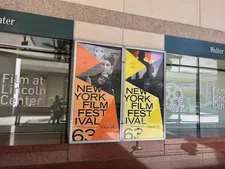 |
| New York Film Festival 63 at the Walter Reade Theater Photo: Anne Katrin Titze |
KJ: The hidden narrative of course is that she’s living with someone and there’s an implication of an exchange. But I think also for him, for Ed Saxberger, who could resist the siren call of: You’re the greatest poet! I rediscovered your book! I read it through, my friends and I, blah, blah, blah. Thinking that he can write another poem, but of course he can’t because it’s not part of who he is anymore.
AKT: It’s beautiful how he realises that. Willem Dafoe gives such a fantastic performance. When he is in the audience during the Surabaya Johnny number you see on his face what he knows and what those around him don’t know. And how he understands where she comes from and what she is going through. And, as you say, he knows he cannot write this poem and when he admits it, there is honesty and vulnerability and strength. I loved his performance.
KJ: Yes, he and I spent a lot of time working together on the character beforehand.
Coming up: More with Kent Jones on Late Fame.