





 |
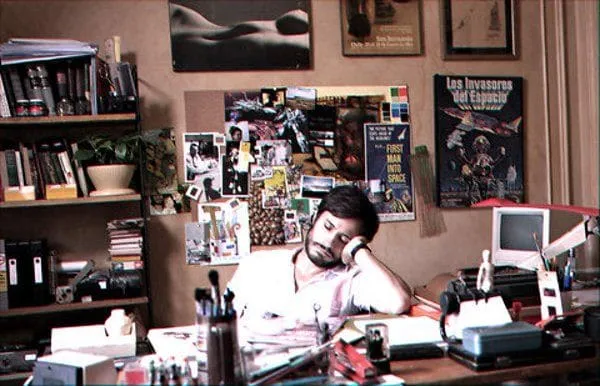
| Gael Garcia Bernal in No |
Pablo Larraín's No marks the third film in his loose trilogy concerning life in Chile under the shadow of General Pinochet. Short-listed for the best foreign language film Oscar - in a strong category that also features War Witch and Amour - the film marks a departure in tone from his earlier Tony Manero and Post Mortem. While they concentrated on the darker aspects of the dictator's legacy, No, which charts the campaign by ad exec René Saavedra (Gael García Bernal) to oust Pinochet from power, has an altogether more upbeat tone. The irony of the fact that the capitalist dictator was brought down by clever marketing is not lost on Larraín. "He created the tools that put him out - he created his own poison," he says.
Larraín says that the feel of the movie was influenced both by the fact that he had less of a hand in the writing - it was scripted by Pedro Periano from the stage play by Antonio Skármeta - and from the more positive note struck by events of the time.
"The soul of the story is a positive feeling," he says. "Even though the movie is called No, which is a negative word, of course, we were talking about something that actually happened, it happened with a lot of epic positive elements. This is not an epic that we created, it's an epic that a whole society created that is fascinating and beautiful. If you're going to tell that story in a very dark way it would be contradictory, I think."
And it's not just the mood of the Eighties that has been captured by the 36-year-old. He was so keen to integrate archival footage from the period he was recreating that he took the unusual decision to step back in time in terms of his equipment, too, employing an Ikegami U-matic camera, which he admits was a risk in terms of the film's overall 'muddy' look.
"As a moviegoer, every time I would see a movie that had archival footage, the filmmakers pretend that I will believe it is something that is actually in the film but it looks so different," he explains. "It breaks my illusion when I'm looking at a film that is shot in any high resolution format and then they cut to archival footage that is made in video or old resolution film stock, it will just look different - I can tell and it puts me out of the film.
"We knew we were going to use a lot of archive footage so we tested. We made tests with every single format that you can use today. When we tested the U-matic one and went to the original and realised that we were achieving the same look, we decided just to use it for the entire movie. At the beginning it was very risky because people who were behind the film, the producers and financiers, were a bit scared. Of course, if I were them, I would be in the same situation. But somehow everyone agreed that we should do it in that format. We were able to create the illusion in a way that fiction became documentary and documentary became fiction."
The end result blends several genres, which pleases Larraín no end. "It's hard to put into a box," he says. "I really like that."
As for the future, politics is almost certainly out.
"I'm done with these movies and I'm moving on to something else," Larraín says categorically. "I love politics and I could do another political movie but it won't be connected with what happened in my country under Pinochet. I made a lot of questions to myself and I couldn't answer any of them, so I'm finished."
A chapter may have been completed but with his films going from strength to strength, Larraín's career prospects look as bright as one of the adverts in No, whatever he decides to make next.
No, is out across the UK from February 8.