





Eye For Film >> Movies >> Nuremberg (2025) Film Review


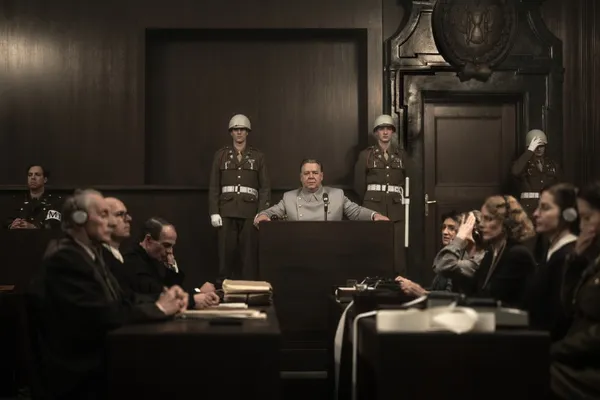

Herman Goering surrenders. Unlike other magicians he cannot produce a handkerchief of the appropriate colour, so a torn bit of hem will do. Having addressed crowds on the triumphal concrete plaza so lovingly documented by Leni Riefenstahl in the aftermath he is shown as short of a pocket square. It's not the only lack in the film.
Based on a book, itself inspired by another's book, history is only written by the victors because structural forces find it hard to hold a pen. Great men, then, in the aftermath of a great conflict, Portrayed by a great cast, but their labours are undercut.
The presentation of footage of Auschwitz, Belsen-Bergen, concentration camps where liberation came too late to save many from the mass graves. The BBFC rating text mentions "images of real dead bodies" but also "Holocaust references" and there are difficult conversations to be had about how Nuremberg presents both those crimes against humanity and the prosecution thereof. Russell Crowe is intermittently charming as Goering, but Bugonia and Frankenstein are overwhelmingly more effective in humanising their villains and showing the monstrousness in men.
That might be the freedom of fiction, but at this remove the description of "inspired by true events" is attempting to paper over chasms. Rami Malek is Dr Douglas Kelly, an army psychiatrist stationed at Nuremberg. He's charged in part with the care and analysis of the surviving Nazi leaders held there, including Reichsmarshall Goering. He would write a book, 22 Cells at Nuremberg, and many of the criticisms in The New York Times' contemporary review of that work ring true for the film. The story of his time would become The Nazi And The Psychiatrist. Its author, Jack El-Hai, is credited as co-writer with director James Vanderbilt.
Vanderbilt's best work is probably his adaptation of another non-fiction work in Zodiac, but his adapted screenplays included 2022's Scream and non-superhero comic-book caper The Losers. His most geopolitical conspiracy work thus far was White House Down. This is only his second feature, and though he's got a great cast on both sides of the noose, the film is never quite able to harness them.
Malek's Kelly is a man of confidence, and with Leo Woodie's young translator he sets about winning over the inmates. His opposition is various, as are the obstacles before Michael Shannon's Justice Robert H Jackson. He's depicted here as the architect of the trials, and while he's arguably responsible for the language of "crimes against humanity", his depiction elides the contributions of countless other judges and jurists. Those include the 1st Earl of Kilmuir, played by Richard E Grant, whose contributions extend beyond alcohol as a character shorthand. Call it Chekhov's gin and it becomes a moment where the court seems more of tennis than testimony.
It relies on often clumsy exposition, a common construction of "only if X" with a cut to "X has happened" leaves one asking "why?". There are endless reaction shots, and as respite from that archive footage they undercut the repeated message to Never Look Away. Others might tell us to Come And See but Nuremberg is intent too often on telling and not showing.
There have been countless films of and about the era, there's a red dress that might be borrowed from one. There's been film of the filming of these trials and while this uses archive footage there's a comic sequence of Rudolf Hess' trip to Scotland that seems more of a pastiche in the vein of Whisky Galore! than anything else. Given the other inaccuracies, it'd be churlish to complain that it's the wrong kind of aircraft but with matters of this importance the capacity for forgiveness is slight.
The use of Brian Tyler's score is also heavy-handed, given his vast filmography it was a matter of probability that he'd have worked on something with cinematographer Dariusz Wolski before and that film, 2008's Eagle Eye is another one where intent and outcome don't quite align.
Everyone involved has done better work. The script labours with portent and under the spectre of both history and news. I paraphrase a little, but a line that amounts to: "I'm a supreme court justice, I can't support shooting someone without a trial" is as jarring as repeated assertions of "never again". Two men loudly arguing in a room could feel stagey, but rather than the thrill of the theatrical one sometimes wonders if they were there at the same time. At least a play would likely have an intermission, at almost all of two-and-a-half hours the film's pacing is not only off but differently so. It dawdles when it should dart, skips when it should be steady. It looks great in places, but that's despite a lack of focus. Nuremberg gets half-way towards a battle of wits but falls short in the execution.
Reviewed on: 14 Nov 2025


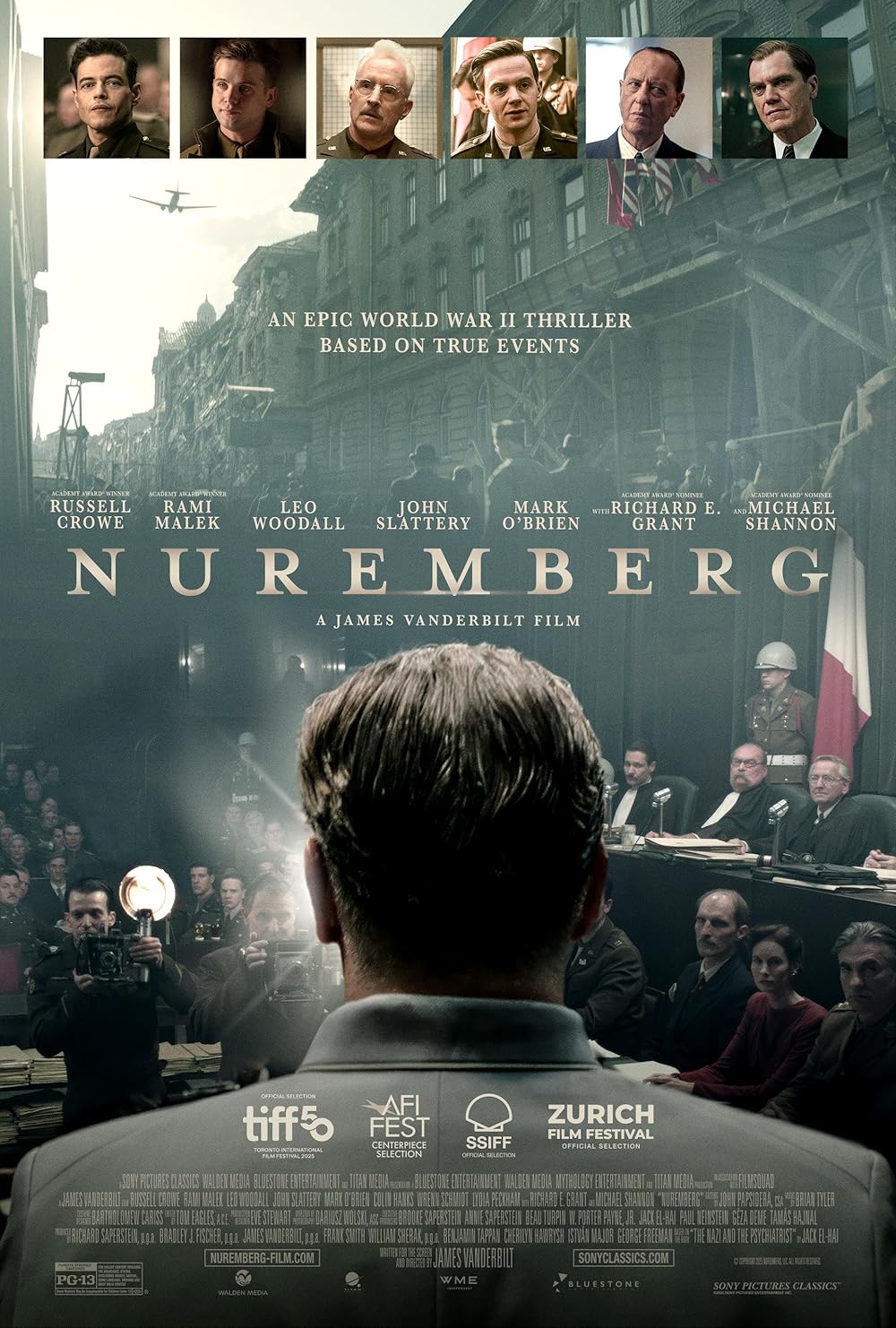
Director: James Vanderbilt
Writer: James Vanderbilt
Starring: Russell Crowe, Rami Malek, Leo Woodall, Michael Shannon, Richard E Grant, John Slattery
Year: 2025
Runtime: 148 minutes
Country: US
Search database:
