 |
| Olmo |
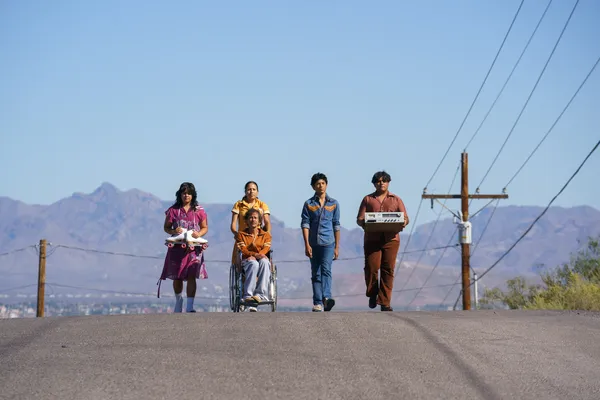
Mexican director Fernando Eimbcke's coming of age drama Olmo, co-written by Vanessa Garnica, is set in New Mexico, in 1979. The story revolves around 14-year-old Olmo (Aivan Uttapa), whose ill father Nestor (Gustav Sánchez Parra) is confined to bed. Olmo, his mother Cecilia (Andrea Suarez Paz), and older sister Ana (Rosa Armendariz), share the responsibility for Nestor's daily care needs. However, Olmo is distracted by adolescent desires: to hang out with his best friend Miguel (Diego Olmedo) and trying to get the attention of Nina (Melanie Frometa), his next-door neighbour who he has a crush on.
When Nina invites him to a party, he finally sees his chance. The only problem is he's supposed to be the one looking after his father, and the invite is also predicated on him having access to a stereo — his father's.
Eimbcke is habitually drawn to teenage protagonists. Among his directorial credits, Temporada De Patos tells the story of two 14-year-old friends surviving a boring Sunday alone in an apartment. Meanwhile, Lake Tahoe is about a teenager who lives in a small town that is transformed by strange events, and in Club Sandwich, a 15-year-old on holiday at a deserted hotel with his mother, enjoys an unexpected summer romance with Jazmin, a beautiful stranger.
Uttapa has starred in the Blumhouse horror Night Swim and appeared in two episodes of the medical drama series The Pitt.
In conversation with Eye For Film, Eimbcke and Uttapa discussed humanity, creative insanity, on-set dynamics, and embracing their inner child.
The following has been edited for clarity.
Paul Risker: How would you describe your relationship to cinema, not on a professional but on a personal level?
Aivan Uttapa: My love for filmmaking and acting is indescribable. I grew up watching a lot of dramatic movies and those really shaped my approach to acting and the way I see film. In general, being able to entertain, and taking art, making it a reflection of people and making it relatable, is the greatest thing you can do with a performance.
Fernando Eimbcke: It's funny because I was doing a Q&A and there was a young lady who asked: "I want to study filmmaking. Do you have any advice?" My answer was, "If you can, avoid it…" because all the people that are involved in filmmaking are insane. You need so much passion and it's such hard work. Everybody thinks it's so romantic, but it's a very difficult job.
I'm super happy and proud to have had the chance to make this film with an amazing team, which you need to have because filmmaking is a collaborative process.
AU: It's worth it.
FE: Yes, it's worth it.
PR: What was the genesis of the idea for Olmo?
FE: The script was co-written by Vanessa Garnica, who I've been friends with since we were 14-years-old. So, we spent a lot of time together [in our youth] having fun, but at the same time, we experienced difficult times with family.
She's a novelist and I had this idea. It was not even an idea; it was more like a vision of a teenager trying to find a vinyl record — that was the story.
I was living outside Mexico, and I sent this to Vanessa. I asked whether she might be interested in writing scripts, and she said, "Yes, let's try it." So, we started to build around that very simple vision. And because we'd both spent time around hospitals, we had a lot of ideas about that subject.
I've made three films previously, and this is the first one that I found the courage to go inside a hospital — my other films don't. I read something from Oscar Wilde that said, "Where there's pain, there's a sacred place." We wanted to go to that place of pain.
PR: And when you first read the script, Aivan, what was it that leapt off the page and made you want to play this character?
AU: When I first got the script, I was reading it in the car with my mom. We were driving for an hour, wasting gas the entire time as I kept on reading. The entire time, my mom was asking, "What's happening?" I told her, "This is great. This is probably one of the most beautiful scripts I've read in a long time." She said, "I think you should do it" and I agreed. So, it all aligned perfectly and stepping into the character wasn't really that much of a challenge. It was basically just me being a teenager and wanting to live life and to do things with my friends. And down to its last detail, it's all human, which I really appreciate.
PR: And what did Aivan reveal to you Fernando about Olmo that you didn't see or think about when you and Vanessa were writing the script?
FE: A lot of things, like the relationship he built with his best friend, Miguel. The scenes and ideas we wrote, they really brought to life. And it was amazing because they were very good friends on the set, which was inspiring.
Another thing is the relationship with Gustavo Sánchez Parra. I don't want to be romantic, but it was difficult because sometimes I gave indications to Gustavo to be rude toward Aivan, even in the setup between scenes, because I didn't want them to be too close in terms of their relationship. And that creates something very interesting in terms of the relationship between Aivan and Gustavo. They were really good friends but between scenes I told Gustavo, for example, to never help Aivan. And if I told Gustavo he could take a break for coffee and Aivan went to help him up [off the bed], Gustavo would say, "No, thank you; it's okay."
PR: One of the striking aspects of Olmo is its commitment to pull its audience into the human moments of its characters. Olmo is a film that is narratively simple but emotionally complex, which honours the essence of our day-to-day lives.
FE: Screenwriting schools talk about how those big moments, or plot points should be very big. That's okay, and I'm not against it, but it can also be about simpler things. You can go deep if you just take the time to explore a scene and not go straight onto the next plot point. And Vanessa really wanted to delve into those deep moments, as did the actors in building the scene. For example, there's a scene when Olmo needs to put the TV on for his father, and he fights with his sister because she's smoking. Life is built around those very simple things, and I was lucky because I also had very good actors. If you want to explore and build around simple day-to-day things, you need to have good actors.
AU: Like Fernando was saying about being a teenager and also having good actors, that was honestly the best part about it. You need an actor who energetically feeds off their lines and really means what they say. For example, there's the scene where my character is arguing with Nestor. He was talking to me like I didn't know anything, and in my head, I was thinking, 'I'm not gonna let anybody talk to me like this.'
You see the resolution of their relationship when they fix the stereo together. I think that creates a lot of emotion, and you know they're gonna be fine. They might argue, but that's only human — it's what families do. I fight with my siblings all the time, and the one thing I'll always say about Olmo is that it's human and tender.
PR: A tender idea in the film is the relationship between adolescence and adulthood. While adolescents cannot understand adulthood because they haven't experienced it yet, adults forget what it's like to be young. From this you draw a captivating tension.
AU: I loved how Olmo was exploring himself and the world, to find what he wanted to do and to find himself. As a real teenager, that's what you want, because no one has it all figured out. And that's one thing I always tell people: "Look, it's okay if you don't have it all figured out. Just enjoy being a teenager; enjoy being with friends, because once you're old, you're gonna reminisce about these times. And you're gonna realise your life went by quickly and maybe you didn't get to enjoy it as much as you wanted to." So, that's one lesson people can take away from Olmo. And no matter how hard life can get, always take life on its own terms.
FE: My previous films were about teenagers, and so, people ask me why? It's because I want to revisit those moments of what it means to be a teenager: the spontaneity, freshness, and innocence that you easily begin losing.
I don't know if you remember Aivan, but when we were on set everything was a problem, from time to locations. But then, when we were doing the scene, we were like little kids playing. And that's very important. Aivan will grow up, and he will realise the conflict between adolescence and adulthood. But then maybe we adults need to be more like kids.
AU: One thing I also learned not just from Olmo, but from being a teenager and finding myself, is that I really believe that no matter what age you are, there's always going to be that little child inside of you that'll bring out your innocence. Another thing, too, is that finding peace, especially with everything that Olmo's going through, was also helpful. And I admire the fact that the movie was based on friendship and love — just being human and just being kids.
Olmo is in US cinemas from 7 August.