 |
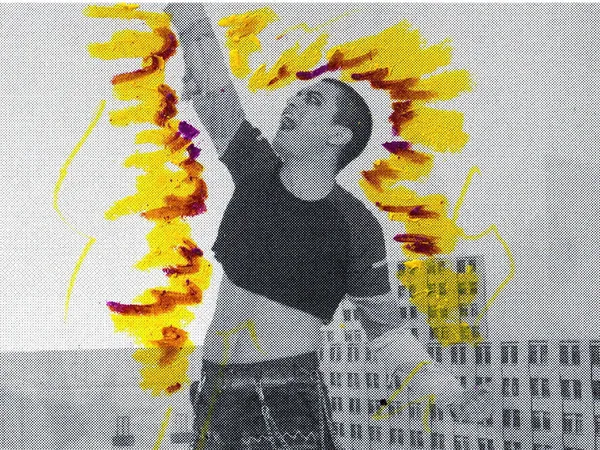
| Matapanki Photo: Fantasia International Film Festival |
Diego Fuentes is thrilled to be at Fantasia. One doesn’t need to ask – it just shines out of him. There are some big name films here, but his bold little black and white punk hero’s journey, Matapanki, has won a lot of hearts. It’s the story of a teenager who chances upon a very special brew and develops alcohol-fuelled powers as a resuli. I ask him if it emerged from personal experience, because I think that many of us have been in that place where, after a few drinks, we feel like we can fight pretty much anybody.
“The movie started like a joke,” he says, explaining that he was hanging out with the camera operator at the time. “We started joking around because we saw a movie – I can’t remember the name – from a Japanese director. We started joking about doing something similar for a punk that drinks alcohol and starts developing powers. We never thought that we were going to do this movie eventually. Now it's real and I'm here and at a lot of festivals, so it's been a nice trip.”
The project began about six years ago, he says. “It was my university project for film school. The last project you do, and my last grade.”
Why did he choose to shoot in grainy black and white?
“Well, when we were the developing the idea and the film, we thought that if we were going to do a punk movie, it wouldn't be a good movie, in 4K and with a big camera and stuff like that. So very early in the development, we knew it was going to be a movie with that style. We took a lot of. We took a little inspiration from the fan scene and independent comics and stuff like that. Really, the punk cinema scene.”
That style of film also made me think of some of the footage of protests in the 1970s, I say, and he nods.
“In Chile, we had a dictatorship era in the Seventies. That time has a lot to do with the United States because it was Kissinger and the Condor Operation, so for us it was really important to make those connections early in the movie. I think that some of the wounds that are still open for us, as Chilean people in Latin America.”
In the UK it's often hard to get young punks to take an interest in history and to connect with the past like that, I note.
“I would say that it's different in Chile. A lot of young people in Chile are very interested in the history that happened because a lot of our parents or grandparents were living in that era, so it's something that actually today is something important for us. I wasn't only trying to put that topic in the table [to encourage peple]. It was something that is important for us, the youth.”
It must be strange that now it's finished and finally getting screened, there is actually somebody sitting in the White House in the US who thinks that he can solve international problems by fighting.
“Yes. That was really weird, because when I wrote the script, a lot of the jokes and the things that are in the movie were in a satirical way. And as of today, it's kind of sad, seeing the movie and thinking that it's something that will happen like tomorrow. Even in Chile we have an ultra right wing president. So when I see the movie like today, I think that this is going to happen tomorrow and it's kind of sad, you know?”
Despite those elements, I say, what we see in the film feels very much like the real world for a lot of young people. Was it based on the lives of him and his friends as they were living them at the time?
“Yes, yes, absolutely. A lot of the things that are in the movie are based on things that happened when I was younger and I was more in the punk scene. Ricardo as a character is loosely based in my personality and a lot of the other characters are too, like Mella is a real friend. And yeah, there is a lot of personal topics that are developing in the movie.”
We talk about the practicalities of shooting on location.
“There was a lot of planning,” he says, “but a lot of the places that we shot were where I live, so it wasn't so hard sometimes. It’s really nice shooting in your neighborhood, because the things that you see every day are transforming into something else, and it's really crazy when someone from my community sees the movie and says ‘Hey, I live here,’ or ‘I've been in those places,’ you know. It's something really that doesn't happen a lot for us Chilean people in the movies.”
He also received support from the community, he explains.
“All of the bands that appear in the movie, they did it for the love of the movie, because we had very, very little budget to pay everyone. We would love to do it, but it was impossible. So a lot of the bands and the soundtrack was for the love of the film.
“We want to do something like a cassette or CD with all the soundtrack of the movie. But what I think is the most greatest thing is that a lot of the bands that appear in the movie, like, the first band who appeared, who is Mano de Obra, they're having real success. They were playing in the last Lollapalooza that we did in Chile, so it seemed very nice for them too.”
So when did the film start to take off, and when did you realize it might have a life beyond university?
“Back in 2025, in October, we had the première back in Chile, in the Film Festival of Valdivia, which is one of the most important that we have there. And it was full. A lot of people sprouted up. I think that's the moment when we realised people like it, because after that, we knew that it was a great movie. You know, we thought that maybe this was going to be something my friends and family were going to see and just that. But then a lot of festivals started calling and doing the emails. And I remember when Berlinale wrote an email asking for the movie, and for me was the realisation that maybe I’d done something that was good – something that would be not only for Chilean people, you know?”
So now that he’s accidentally become a star, where does his career go next? What is he going to do with this opportunity?
“I don't think that I'm a star,” he says, blushing, “ but I'm really grateful for everything that has happened. I don't come from a family of artists or a family that has a lot of money, so having the privilege to go on tour with the movie in a little festival, it's been really nice. And now I'm developing my second film. I can’t say a lot of that movie because it's still in development. It doesn't have the same style of Matapanki, but I think that there are a lot of sentiments and values that are important for me in my future cinema, like the anti-fascism and stuff like that. That is important to me, keeping real stuff.”
Does he think Matapanki is a film which will inspire people in positive ways in reality?
“I hope so,” he says. “Back in Chile there is a lot of film students that have said to us that they were like dropping off school or dropping off college or stuff like that. Then they saw the movie and they wanted to continue studying. So it's been really nice, knowing that in a way, when I was developing the film, there was a lot of movies, Chilean movies, Japanese movies, and a lot of stuff that inspired me. And now having the moment to inspire these people, I think, is one of the nicest things that as an artist you could achieve.”