 |
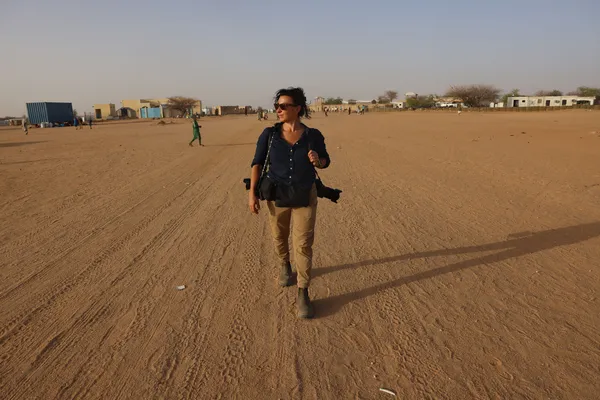
| Lynsey Addario on assignment in Iridimi Refugee Camp, Wadi Fira, Chad Photo: National Geographic/Caitlin Kelly |
Documentarian filmmakers Elizabeth Chai Vasarhelyi and Jimmy Chin have forged a strong collaborative relationship in their telling of captivating and powerful nonfiction stories. Their work has looked upward, from Meru, about three elite climbers taking on the challenge of the Infamous Himalayan mountain, to their Oscar-winning documentary Free Solo, which chronicles Alex Honnold's quest to climb El Capitan in Yosemite National Park, solo, without a rope. Meanwhile, Return To Space offered a glimpse behind the scenes of NASA and SpaceX's attempt to send men into space once again. In Love+War, grounded in conflict and humantarian crises, the filmmakers tell the story of Pulitzer Prize-winning American photographer Linsey Addario, who for the last 25 years has thrust herself into the theatre of war, documenting the human story behind the violence.
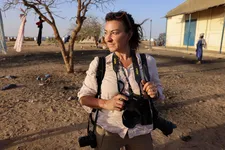 |
| Lynsey Addario on assignment in Tiné, on the Sudanese border in Northeast Chad Photo: National Geographic/Caitlin Kelly |
Love+War revolves around exploring the two sides of this modern woman: the mother and the war photographer. With intimate access to Linsey's personal life, Vasarhelyi and Chin explore how these two different lives have more in common than one might think.
In conversation with Eye For Film, Vasarhelyi and Addario discussed being a voice for the voiceless and preventing the erasure of people's experiences of war. They also reflected on sacrifice, human imperfection and shining a light on truth.
Paul Risker: How did Love+War come into being?
Elizabeth Chai Vasarhelyi: We've been long time admirers of Linsey's work. Her photos have shaped how my generation looks at some of these major conflicts, as well as the humanitarian crises of the past 25 years.
A lot of people wanted to tell her story. I know for a fact she was approached and there are films that we've seen that are based on her, but not explicitly. When Linsey felt the time was right to share her story in a nonfiction form, I was honoured to be allowed to tell her story.
PR: What, then Lynsey, compelled you to accept their offer?
Lynsey Addario: I've been doing this for 25 years, and I've seen so many iterations of war photographers portrayed both in fiction and nonfiction. More often than not, it's a man — very seldom is it a woman. And when it is a woman, I get some sort of side note that, "This has been based on you." It'll say, "I'm not allowed to tell you, but we read your memoir, and now I'm writing a movie based on you." No one ever actually talks to me or if they do, they ask if they can pick my brain without paying me.
I had just arrived in Ukraine, and we [Chai and Jimmy] were talking, and it just felt like now's the time.
The reasons why I go into this work is to amplify the voices of the people I cover. And what better way to doubly amplify them than to have an Oscar-winning team documenting me, and the issues that I cover. So, it just gives an extra voice to the issues that I care about.
PR: So, we could describe your work as being a voice to the voiceless?
LA: I like to give a voice to the voiceless, but also, in a more nuanced way, to the stories that don't really have the platform that they should. There are so many different issues and topics we can cover. As a war photographer and as someone who's covered conflict for many years, the very brave but easy way to cover conflict is to go to the front line and cover the drama of the action — the howitzer, the flames and the trenches. But there are so many important, historical and dramatic photos to be taken.
I'm not the best sort of war photographer because I get scared. I'm a human being; I'm a mother and a sister. I love my family and my friends, and I'd like to continue covering war but actually stay alive. And so, I also look for the more intimate human stories.
I feel at this point in time, people are looking for an entry point into the war. They're looking for a way to relate and why they should care about the war in Ukraine. Well, I'll tell you why. Because there's a six-year-old girl who had a brain tumour that in 9 out of 10 cases could have been cured. And because the full-scale invasion started in the middle of her chemotherapy, she was sent to Poland, and she missed seven months of chemo, and now she's dead. That's why you should care, because there are human beings behind these statistics. That is the reason why I continue risking my life, because they are people, they're not just numbers.
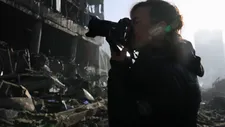 |
| Lynsey Addario photographs a damaged building in Ukraine Photo: National Geographic / Andriy Dubchak |
PR: There's often a tussle to control the narrative in the media, and the experience of Love+War is a reminder of what's at stake on a human level. The film abandons a political position and instead attempts to find the human truth about these chaotic and harrowing situations.
ECV: When I make a film, I would like it to be true to its subject matter and to its participants. Linsey's photographs demand that we not look away, but what is often forgotten is the work and commitment that goes into getting into that position, in the middle of a war zone, and being empathetic with the people she photographs, which is important. And the fact that it's not pretty, a lot of people can identify with her personal struggles of not being in the right place at the right time. It's a horrible feeling when you're at work but want to be at home, and when you're at home and want to be at work. It's horrible to feel guilty about the passion and the meaning you derive from doing very good work. It's like a dirty secret that shouldn't be. It's like the messiness and the beauty of life, and it makes the photography stronger. It makes the love we show those close to us stronger because it's real. So, thank you for saying it's a truth. I hope that it does it with some grace and a lot of heart, because that's what's true to Linsey.
She's clearly brave, because she's photographing on the front lines, but I don't think I'd let anyone into my house. No one wants to see when he can't find his socks or me yelling at the dog. But again, in the service of women and the messiness that is life, truth is under attack, and here is a good example of why truth matters.
LA: It was terrifying to let them into our house, but actually, I feel like I'm tired of seeing these perfect documentaries where the protagonist curates what the world can and cannot see, because everyone comes out looking perfect. And then we all feel like shit because none of us are perfect. So, I felt it was time to be honest.
One of the first times I came back from Ukraine after seven weeks away, [my son] Lucas told me he hated me, and I was a horrible mother. He threw a stuffed animal at my head, and the fact is that's reality. That's what I deal with, and no mom, no parent wants to admit the fact that they're not perfect. I'm definitely the mother who shows up at school to pick up my kids and everyone looks at me like, where have you been for the last five years? But that's the reality and I'm sorry. I have made this choice to live in two worlds, and it's horrible, and it's exhausting. And the other reality is, I can't even sit through the whole film because it's too emotional for me — it's too traumatic for me to watch the trauma that I document, and also the fallout for my loved ones. A testament to the power of the film that they've made is that if I can't even sit through it, then it means it touches a nerve if I feel it is true.
PR: There's an expectation that Love+War will focus on the juxtaposition between a woman as a mother and a photographer in the theatre of war. Lynsey, however, brings her maternal and empathetic instincts to the theatres of war, and uproots these naïve and simplified expectations.
ECV: That's very much the intention of the film. And I think the subtext would be that it's critically important that we have those types of voices or eyes in the field, because the stories that Linsey uncovers, she's often been moved by women's stories.
The stories of those who are most vulnerable in conflicts are those of women and children. And unless she's taking those pictures, then those people's experiences are erased, and I am worse off for it; my kids are worse off for it.
So, that's the point of bearing witness. And this idea of a male-dominated field, we all lose if that's the case. It's kind of part and parcel of the same thing, and that's why we call it Love+War. It's all a big hot mess.
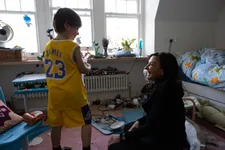 |
| Lynsey Addario at home with her son Alfred before leaving on assignment. Photo: National Geographic/Caitlin Kelly |
LA: I remember when I found out I was pregnant in 2011. It was right after Libya. I had just been kidnapped, and I took a few months off work. Then I got pregnant. I remember literally looking at my pregnancy test and looking at [my hisband] Paul, and I was like, "My life's over" because I thought, how will I keep doing this work? I didn't know a single female war photographer who was even in a relationship, much less with children. And there was one person, I actually can't even remember who it was, who said, "I bet you will become a better photographer now that you're going to be a mother, because you will be more efficient with your time, and you will figure out the stories that are worth you're going to war." I always think about that, and I wish I could remember who told me that because, in a sense, it's true. I don't just go and spend six months as I used to during the war in Iraq, and sort of hang out and wait for a bomb and then run to the roof of the New York Times and figure out where to go. I actually think about what the stories are I need to tell.
PR: It appears that we are caught in a cyclical trap, where we are always returning to a point of having to highlight the prominent role women have played in various field that are often, incorrectly seen as being exclusively male. History has shown us the power, influence and agency of women, and yet we are seemingly in constant denial.
LA: When we talk about the war photographers throughout history, the same names always come up. It's always Robert Capa, and now it's Don McCullin, and rightly so. They are brilliant photographers, but everyone forgets about the women, or they've been overshadowed because they were tangential for some reason. Okay, recently we've seen Lee Miller come up, and I just went to her exhibit and at The Tate, and there was a Hollywood film made about her. Little by little, the names are resurfacing, but at the time, women were never recognised, and they were doing the same job as the men and fighting doubly as hard because they were not allowed the access that the men were.
So, it's annoying we're still having this conversation in 2025, and I'm still referred to as a "female war photographer." Why am I not just a photographer? Okay, I'm a female, but at the end of the day, we need to get to a point where, ideally, there are more women covering conflict because the ratio is still dismal, and that we don't have to talk about gender. We can just talk about people doing their jobs, whether they're male or female.
ECV: Women's reproductive rights are under attack. I can go down the road of, is my daughter's life worse than mine was? Or is her potential less than mine? Is the world more unfair? But then, honestly, it's Linsey's work that inspires me and gives me hope.
In the film, you see Linsey going back to Afghanistan in 2023 after dedicating a lot of her career to documenting these changes — women being able to be educated, and then it all being taken away. But she still goes back to bear witness. And it isn't with bitterness and judgment. Again, it's with this optimism and hope that there is an importance in telling the story, and that's when I think, 'Okay, it's a good fight. We're human and that's what we do.'
PR: I love to psychoanalyse people, and Love+War offers ample opportunity when considering the extreme dangers you have placed yourself in.
LA: I wouldn't suggest you try to go there. Look, the short answer is, I just really believe in what I do, and I believe it's important, and I love people. I believe it's important to document the injustices. I feel guilty that I was born as a woman in Connecticut with such incredible privilege that I never had to beg for an education or beg for food or shelter. My parents were incredible and did nothing but empower me to believe in myself and whatever it was that my heart believed in, and to follow through with that. And so, I think I have to give back.
I really believe in this job as a way of hopefully opening people's minds. It sounds cheesy and cliché, but just my contribution to people, to humanity, to understanding each other, and being more open-minded and less judgmental at a time when we are so judgmental, and we are so polarised. It's so depressing, and we need to have conversations right now and to open our minds, not close them.
PR: We live in a world where we're being encouraged to avoid difficult conversations, and to not confront what needs to be confronted. I always remember the Japanese film director Akira Kurosawa discussing how his brother taught him to not look away from the worst life has to show us. There's something of that here in Love+War.
ECV: Yes, but I do think it's the journalist's or the filmmaker's responsibility to shape and contextualise and to shine a light. But my main takeaway after Free Solo and winning an Oscar was that we have a platform, right? And I don't know how many movies I'm going to make in my life. So, not only do I have to live in that world for X number of years whenever I make a film, and tolerate it, but it has to have meaning or else I'd rather hang out with my kids or do community service. It has to project a world that we want to be in. And what I find so moving about Linsey's work is, again, that ability to face the darkness and go back to Afghanistan in 2023, despite all the work, and still find hope.
LA: It's a tough time for journalists and journalism. We live in a world where journalists are routinely silenced, whether they're put in prison or targeted and killed because they're telling stories or unearthing stories that people don't want the world to see. And it's important to show a more nuanced view of what goes into this work. There are human beings behind every single photograph that you see, and they are often making great sacrifices. And it is not for the adrenaline, it is not for the money, it's not for the thrill. It's for a higher purpose, and I think it's important to see that.
Love+War screened in the Debate strand of the 69th BFI London Film Festival. It was released theatrically in the UK on 24 October, and will open theatrically in San Francisco on 31 October.