 |
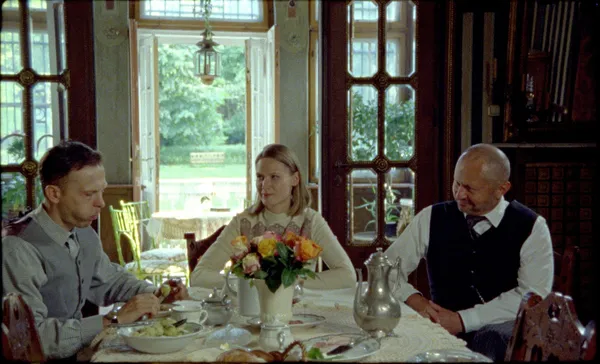
| Wilhelm Sasnal on food in Robert Walser’s 1908 novel: “ I was actually struck by the first scene with the food when I was reading this.” |
In the second installment with Wilhelm Sasnal, co-director with Anka Sasnal of The Assistant (Czlowiek Do Wszystkiego), a highlight of the 54th edition of Film at Lincoln Center and the Museum of Modern Art’s New Directors/New Films, we discuss how Robert Walser’s novel employs food as security and weapon, costume design and nail polish inspired by cars, and the meaning behind the kids on their bikes dragging cans. A special Polish comic book, his exhibition Painting as Prop at the Stedelijk Museum and what he painted for the film, Hitchcock’s use of artworks, Thomas Bernhard’s Frost and Francis Bacon also came up, as well as his love for the work of Bruno Dumont.
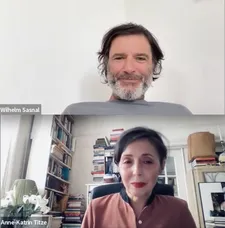 |
| Wilhelm Sasnal with Anne-Katrin Titze on the period costumes in The Assistant: “ I know it reflects the idea of the times.” |
The Assistant, highly original and capriciously sumptuous, begins unlike Walser’s 1908 novel in a kind of present in which the protagonist Joseph Marti (Piotr Trojan) attempts to bind a book in a workshop. It doesn’t go well, he gets fired, and a friendly unemployment officer (Roman Gancarczyk, who has a Da Vinci on his wall, painted by Wilhelm Sasnal) suggests a job as assistant to the inventor Tobler (Andrzej Konopka), who lives with his wife (Agnieszka Żulewska) in a beautiful villa out of town. “Why have you come today” is his greeting. Too early, too eager the new employee seems to be. This foreboding first encounter is where Walser (who was greatly admired by Franz Kafka) begins his book about servitude and disobedience, hospitality and social norms too mystifyingly strange to ever really make sense. The Sasnals take it from there.
From Los Angeles, Wilhelm Sasnal joined me on Zoom for an in-depth conversation on The Assistant.
AKT: I have a few points about the use of food in The Assistant! It is funny, and it is violent, and it is disgusting all at once. When Joseph arrives, and that's also in the novel, I remember that Tobler was constantly feeding him. Very proudly so. You can have as much as you want; all the food in the house is yours! And so he eats, and then, later on, we have the girl being fed, and then him again, being stuffed during the choreography for the ESG song Dance number. Tell me about the food!
WS: That's interesting. I was actually struck by the first scene with the food when I was reading this. The richness of the whole array of food was quite funny, and the description how Tobler is showing off that Marti may have this or that. Honestly, I think the feeding can be expression of love, or very often it's like a sort of security. I know how it worked in my family, because of the Second World War, the shortage of everything. Then, after the war, my grandma, she was quite obese because she was trying to cover up the shortage of the Second World War. I know that the food is something else than just taste.
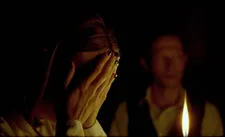 |
| Wilhelm Sasnal on Mrs Tobler’s (Agnieszka Żulewska) nail polish: “At the time the nail colour was taken mostly from the cars. I mean that the color of the car paints influenced nail polish!” |
AKT: And in this story the mother never feeds the child. The maid does, and the feeding isn't taking care of her at all. It's the opposite. So there again, I think it's fascinating how it can be one thing, and its opposite as well. It can be the feeling of being taken care of with all this food, or it can be: I stuff you! And it turns into a weapon.
WS: Yes, it can be also a weapon. Yes, of course.
AKT: The smoking, too. The smoking drew a big laugh at the press screening, when Tobler says, 'Ah, good! You smoke? How great!' I like how with the clothing you switch elegantly from the present into the past. I like Mrs. Tobler’s period outfits combined with the black nail polish that is so out of joint. Can you talk a bit about the costume design?
WS: Her black nail polish was interesting, because I learned that at the time the nail colour was taken mostly from the cars. I mean that the colour of the car paints influenced nail polish!
AKT: I have never heard of that!
WS: Yes, that's what I heard when we were talking how Mrs. Tobler is supposed to be dressed and about her make-up. That's how I learned about this. But it was interesting with the costumes, because when I first saw the characters dressed in these historical costumes, I was afraid that this is something I don't feel comfortable with. It took me quite a while to accept that. Okay, they have to be dressed like this. It was sort of dressing up. In terms of Tobler and his wife, that was for me a little bit difficult, a little bit too much theatre. But I know it works, I know it reflects the idea of the times.
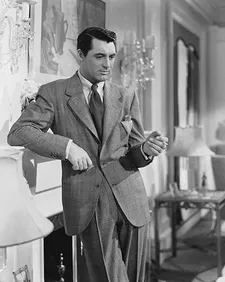 |
| Cary Grant is visually stabbed by the knife on a painting in Alfred Hitchcock’s Suspicion |
AKT: It works absolutely for me. It's beautiful and doesn't feel costume-y as it does sometimes in period pieces. You managed even to combine the clothes of the past with the backpack strap that Joseph carries. It all works together. I was a bit puzzled by the boys, the children with the cans dragging behind their bicycles. Is there a special meaning?
WS: Hmm! This is, well, maybe I shouldn't go too far, but there was a scene that we didn't include in the final version of the film, with a little bit of violence of the kids. The cans they have attached to the bicycles, maybe it refers to the opener invented by Tobler, and that's the reference, maybe, to the war.
AKT: Marti knows about the two wars coming in his future. With exact dates.
WS: Yes, and the noise they make. But it was just to have something attractive in the film. That was that. There’s not that much behind it.
AKT: The comic book with the monkey, was that yours?
WS: It's a comic book, very famous in the Eighties. When I was a kid I loved it and still like it. We didn't have superheroes. We had a monkey, and that's what I love about it, that it was totally different than this American idea of superhero. We didn't have superheroes. We have this monkey that meant to be a human, but it always rejects. I mean, the monkey is always beyond, and is smarter than the humans.
AKT: I want to ask about your paintings, the artworks that you repainted. I read that there was an exhibition, Painting as Prop [in 2024], that you did in connection to the film. Can you talk a little bit about that?
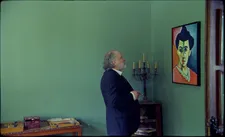 |
| Wilhelm Sasnal on his paintings as prop: “I did a show in Amsterdam, in the Stedelijk Museum, with the paintings I made for the film.” |
WS: Yes, I did a show in Amsterdam, in the Stedelijk Museum, with the paintings I made for the film. Not only these paintings, but these paintings were the core of the exhibition. Because with the preparations for the set, we had a very tight schedule. We had to do that very quickly. So I painted the paintings quite quickly to have them on the walls for the film.
After the shooting I decided to get deeper into these paintings, to change some of them, to make them more dense. And I also picked these paintings because these are not just the copies of the original ones. They are rather variations.
AKT: One is a variation on Leonardo da Vinci!
WS: Yeah, call it that, though he says, “This is my Leonardo!” Also because the book was released in 1908, it overlapped with the birth of modernity, modernism in art. That's why I picked these paintings to decorate the Toblers’ villa.
AKT: It's beautiful. It fits so well on so many different levels. And it also has a connection to film history. Hitchcock put lots of paintings on the walls and used them in different ways for the narrative. He had detectives come into a house and look at paintings, at modernist paintings on the wall, and not understand them.
There's a scene in Suspicion that I love where the detectives come in and one looks at a painting puzzled like that. There's another typical Hitchcock scene where in the background there's a painting, a still-life with a knife and Cary Grant's head keeps moving into the knife, visually stabbing him. It's fascinating, the concept of painting as prop.
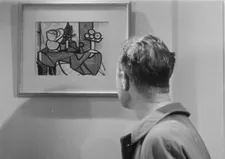 |
| In Hitchcock’s Suspicion a detective is thoroughly confused by a modernist painting |
WS: I love this. I mean, because I'm a painter. So I love these links. Funny enough, yesterday I completed reading Thomas Bernhard’s first novel, Frost. The first important book. And this is about this. This is about the links of this book, for instance, the links to Francis Bacon. I loved how different fields overlap or interact.
AKT: There's a moment in the beginning of your film when Tobler dictates to Joseph, and he's writing down the numbers, and you show his face, it's so Kafka-esque! And Kafka, of course, was a great fan of Robert Walser’s work! All of these overlaps are fantastic. Are you working on an exhibition, a new film? What's coming up for you?
WS: I'm working on an exhibition in Los Angeles, because for the last couple of years I lived with my family one school year here, one school year in Poland. That's because of our daughter. But now we are going back to Poland definitely. But I will have a show in Los Angeles by the end of May. My wife, she wrote a script, and hopefully we will shoot by the beginning of next year.
The film is based on a Polish writer, on a Polish book called Someone. I don't know how to translate, but this is more or less about the end of the world. But it's not. It's not a utopian story. This is taken from everyday life stories. But everything ends. The idea is that when one dies the whole world, everybody dies as a fictional character. So the whole story dies with a person. And what we know later on about the person equals the fiction.
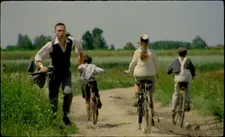 |
| Wilhelm Sasnal on Marti (Piotr Trojan) with the kids on bikes: “The cans they have attached to the bicycles, maybe it refers to the opener invented by Tobler, and that's the reference, maybe, to the war.” |
AKT: Sounds mysterious.
WS: It is a little bit mysterious and I don't feel eligible to describe it, because this is my wife's story. But I will be the cinematographer. I will be the cameraman.
AKT: As you were with The Assistant!
WS: Yes.
AKT: Thank you for this, and please stay in touch with your upcoming projects.
WS: Yes, yeah, I will! And, you know, I realised you did the interviews with Bruno Dumont! He's my favourite director ever, ever!
AKT: Yeah, I've done five conversations with him, I think.
WS: I realised! I read them. His last film, it's a masterpiece!
AKT: The Empire!
WS: Yeah. The Empire. And it's not around. Not playing everywhere. I mean, it's supposed to be the Oscar winner for me! I mean, there is humor, but it's so multilayered, so interesting. And, yes, for me, it's a philosophical piece.
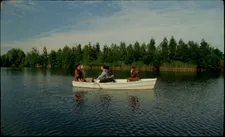 |
| Wilhelm Sasnal on the clothes in The Assistant: “When I first saw the characters dressed in these historical costumes, I was afraid that this is something I don't feel comfortable with.” |
AKT: And the black hole is a big washing machine. It's all here. I also loved Slack Bay. Did you like that one? That was his costume drama with Valeria Bruni Tedeschi, and also Lucchini? It's the one with the cannibals, Ma Loute? They speak in strange ways. It’s a beautiful film!
WS: This is with a beach, with the shallows?
AKT: Yes, that’s it.
WS: Okay, yeah, that's great. This one, this one is awesome. I didn't know the English title.
AKT: So very nice to meet you!
WS: You too! Bye-bye, bye-bye!
Read what Wilhelm Sasnal had to say on adapting Robert Walser for The Assistant, fairy tales, and onto the soundtrack with music producer and 99 Records founder Ed Bahlman.