





Eye For Film >> Movies >> A Long Winter (2026) Film Review


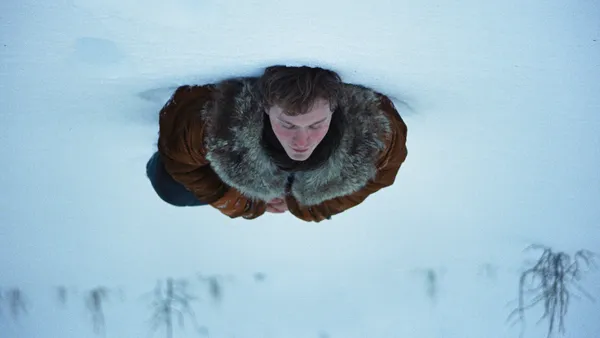

In director Andrew Haigh's drama, A Long Winter, the disillusioned and trapped wife and mother Louise, played by Caitríona Balfe, says, "Folk always find a way through." That is until they don't. Haigh's new film, which screened at the London Film Festival, is a sad story that sees the scars inflicted by life experiences push one to breaking point.
It's adapted from novelist Colm Tóibin's 2006 short story of the same name. Mike (Fred Hechinger) returns home to the Colorado mountains, after spending time working on a farm in Idaho. In the short time before his brother Tommy (Kit Connor) deploys to Korea, a familiar order returns for the family — each member an important cog in the clan not only functioning but surviving in the rural mountain terrain.

Around the kitchen table, their father Lester (Ebon Moss-Bachrach) and mother tell the story of how they first met and swapped city life to live at the top of the Colorado mountains. With a humorous quip, Louise puts the decision down to Lester's seductive smile. Lester puts on a record and dances with his wife. However, there's an obvious underlying tension, sowing in our minds the roots of their marital discontent. Then, one day, Louise mysteriously disappears in the first winter snowstorm. Efforts to find her are fruitless, but Mike never gives up. In the absence of his mother and brother, he's forced to negotiate a new power dynamic with his father.
Throughout his career, Haigh has singled himself out as a compassionate and sensitive director. His work notably addresses the theme of homosexuality, which he continues to draw on. You'd assume that Haigh would be a steady hand for the sensitive drama of A Long Winter, and also because 45 Years was adapted from English poet David Constantine's 2001 short story In Another Country. And yet, Haigh's expectant steady hand noticeably trembles.
One of the first complaints I heard in the ether about A Long Winter was that at nearly two hours it was slow. There is a subtle distinction between 'slow' and 'steady', and the latter best describes this slice of familial drama. Haigh progresses the story at a deliberate pace, steadily allowing us to familiarise ourselves with the characters and their world. However, A Long Winter is far too coy, and beset by Haigh's indecisiveness, the story struggles to complete itself.
Mike's homosexuality draws our attention to the sexual aspects of the film, creating the expectation that Mike's sexual coming of age will form more of a significant crux than it does. This is one of a series of neglectful patterns. Louise's brother Frank, played by Martin Freeman in a standout performance, is underused. Even the escalating tension between Mike and Lester, in which Frank should have played a more pivotal role, instead becoming a device for exposition, is too tidily presented.
A Long Winter has the feel of a treatise, whose themes and ideas about familial dysfunction are the victim of systematic process and structure. Worse than incomplete, Haigh's film lacks a fully developed soul. This is in spite of striking aesthetic moments and sharply written scenes complemented by strong performances from the cast. Moss-Bachrach delivers a fine performance, shaping Lester through nuanced movements and verbal delivery that nearly make the actor unrecognisable. Even the way he eats off his fork and sits behind the wheel of his truck create the illusion of onscreen reincarnation.
A line that tidily sums up A Long Winter is: "Loving someone isn't always enough." Haigh is telling a story about how cruel love can be, but without malicious intent. Lester says: "I built a dream up here for her." Undoubtedly, in his mind, he built a home to keep his wife and sons safe, but he failed to ask whether he was forcing his family to live his dream. A Long Winter therein becomes a reflection on the family as a prison, which propels a quest for absolute freedom like the one Louise pursues or a compromised freedom through finding one's independence in the family's power dynamic. After all, before going to Korea, Tommy tells Mike: "I don't want to spend my life in this dump." He explains to his brother they have no friends and things are happening elsewhere.
A Long Winter's core themes and ideas are compelling. They are politicised by Lester, who is a symbol of patriarchal tradition. If there's a defence for the criticisms laid out here, the neutralising of Mike's sexual coming of age is because it synchs up with the interiority of the homosexual experience. The restraint on exploring the familial dysfunction more deeply is because the characters occupy a space where honest communication is laboured. This frames Haigh's restraint as the authentic pursuit of his character's reality. However, the story is asking to be freed from such restraints, and to be given the opportunity not to narratively complete itself but to thematically and spiritually complete itself. Meanwhile, the visually striking space should captivate, immerse us and have a transportive effect. The incompleteness of Haigh's vision means that it falls flat, pacifying rather than engaging us, and denying the spatial the chance to become the character it was supposed to be.
Reviewed on: 16 Oct 2026


Director: Andrew Haigh
Writer: Andrew Haigh
Starring: Fred Hechinger, Caitríona Balfe, D'Pharaoh Woon-A-Tai, Kit Connor, Ebon Moss-Bachrach, Manuel Garcia-Rulfo, David Furr, Susan Serrao, Anthony Timpano, Geoff Gustafson, Camille Sullivan, Martin Freeman
Year: 2026
Runtime: 118 minutes
Country: UK, Canada
Search database: