





Eye For Film >> Movies >> Doppelgängers (2024) Film Review


What does the future of space exploration look like – and, perhaps more to the point, why do we imagine it in the way we do? Even the language that we use to talk about it – colonising new world, the conquest of space – binds us to ways of thinking which are ethically problematic, scientifically unlikely and creatively restrictive. How might we reimagine our extraterrestrial ambitions in a scientifically informed, ethical, postcolonial way – and what might we discover if, in doing so, we are able to open up our minds to new possibilities?
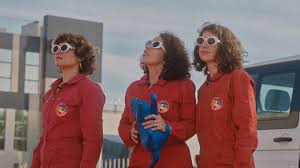
“Armenians make really good shoes,” observes documentarian Nelly Ben Hayoun-Stépanian, who believes that understanding our own roots is an essential part of the preparation we need to engage in before turning our minds to the future and wider universe. Everything we do out there will, after all, have its roots in Earth’s cultures and ideas. She explains how the patterns in traditional Armenian carpets encode meaning, each one specific to a particular region and tradition. Reaching out to stranger places will require us to recognise and interpret unfamiliar patterns; to do so effectively, we will need to be aware of the personal biases that we bring to the game. Nothing is pure and separate – even space exploration does not hinge on a perfectly spherical explorer operating in a vacuum. In fact, for the dramatic stretches of this film, Ben Hayoun-Stépanian splits herself into three parts, played by three different actors, to explore possibility and bring different perspectives to bear.
Needless to say, there is more going on here than in the average documentary. Doppelgängers demands a lot of its audience, but it has a lot to give in return. It is not a film that can be skimmed; there is really no point in engaging with it unless you are prepared to make an effort, to set aside your prejudices and preconceptions, because the process of exploration begins right here.
We need to go back to first principles to interrogate what we know, Ben Hayoun-Stépanian says. What is life? Our existing definitions are rather clumsy. They struggle to account for everything we find on this planet, never mind what we might find when we look further afield. We need to understand life in a way that goes beyond the individual, that encompasses the ecosystem, beginning by learning what our Terran life support system consists of. What plants would we need to take with us to survive somewhere else? What microbes? Can we really look at an exoplanet and be confident that it is uninhabited? What damage might we do by landing there? Do microbes might have rights? Could they – en masse, if not individually – have intelligence?
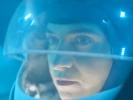
Perhaps it helps to reflect on our past experience of exploring an alien environment. We have done that, in a sense – not on the Moon, but in our own deep oceans, which even now are full of mysteries. Down there, life works in very different ways. Ben Hayoun-Stépanian presents us with early diving equipment – and, as in the other parts of her film, finds one of the world’s leading experts to speak about it. It brings into perspective the bravery of the pioneers, both there and in space; and it makes it very clear how far away we are from the kind of spacefaring adventures we were sold in 20th Century pulp science fiction, even if we want that. There is no room here for the fantasies of billionaire dilettantes. After all, we have seen what happens when they try to build their own submarines.
If this brings home to you the fact that you’re never going to have that dream dome-shaped condo on Mars that you always dreamed about, don’t be sad. It doesn’t really make the current age less exciting. The work of imagining and enabling different futures begins now. This is partly why the aforementioned dramatic portions of the film are important. They allow us to think about different realistic scenarios. An initial base on another world, Ben Hayoun-Stépanian suggests, would almost certainly be underground, and so her three avatars train in a cave in the Spanish Pyrenees, reflecting on how they might deal with boredom in such a place. It could take several lifetimes to complete a successful terraforming operation, even on a well suited world. To survive that, would we need to become something different psychologically? “Think of the Moon as a place where madness is permitted,” she says. “Madness is just normal.”
Entering into this imaginative space highlights the madness of what has gone before. The fate of women in pulp fiction colonies has never held much appeal. Ben Hayoun-Stépanian includes a trans woman in one of her scenarios, making the point that if we’re going to approach this seriously, every individual must be valued for their individual skills and abilities, not simply as a reproductive unit. Furthermore, we must approach any expansive future as a whole people: space is for everyone, not just one section of humanity. We need queer visions of the future, just as we need multi-racial, multi-ethnic ones. We will never achieve best results if we draw only only a part of our strength as a varied, wonderfully complicated species.
If the film demands hard work, Ben Hayoun-Stépanian’s personal enthusiasm carries it through. Very much a part of what she refers to as ‘the space community’, she is an artist and thinker who insights in this area are highly valued, and Doppelgängers functions like a sample class for people from any number of disciplines who might be interested in getting involved themselves. Though it struggles occasionally with pacing, a side-effect of cramming in so much, it’s full of captivating visual flourishes, and her brilliant use of colours invites us to see beyond that familiar hypothetical world outlined in white and chrome. The film reminds us that, for all that we have learned, space is vast and unknowable, doubtless full of things which we have not yet begun to imagine. Allow it to get under your skin and you will feel all the wonder that space inspired in you as a child come flooding back. We are all children here, participating in a great adventure, and the adventure is now.
Reviewed on: 23 Nov 2025


Director: Nelly Ben Hayoun-Stépanian
Writer: Nelly Ben Hayoun-Stépanian
Starring: Myriam Amroun, Rémy Bennett, Manuel Leira Casanueva
Year: 2024
Runtime: 73 minutes
Country: US, UK
Search database: