





Eye For Film >> Movies >> Winter Of The Crow (2025) Film Review


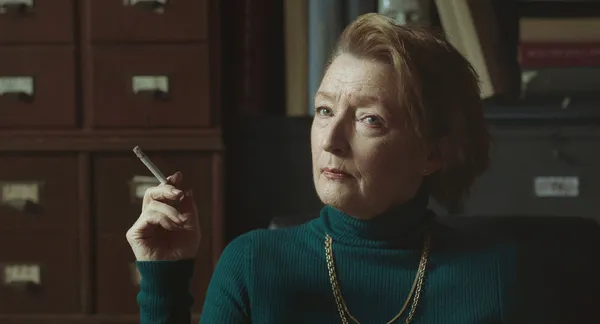

Winter Of The Crow, directed by Kasia Adamik, is an adaptation of the short story Professor Andrews In Warsaw by the Nobel and Booker prize winning author Olga Nawoja Tokarczuk.
The acerbic Dr Joan Andrews flies into Warsaw just before the declaration of martial law on the 13th of December 1981. She is addressing a small conference to promote her novel approach to treating schizophrenia. Her speech is disrupted by a pro Solidarność (Solidarity) student protest. By the next morning First Secretary General Wojciech Jaruzelski has declared martial law in Poland.
Stranded in a city she doesn't know, without so much as a word of Polish, she wanders the streets obsessively taking pictures with her Polaroid camera. While documenting what she thinks of as objective reality, film as opposed to subjective memory, she captures the moments in which Marek (Jakub Guszkowski), one of the protesters at her lecture, is murdered by the secret police. Burdened with this evidence she must navigate a city in chaos.
The film and the short story share a number of superficial elements: vignettes, sometimes comic, of incidents that the Dr Andrews character finds baffling. But at their hearts they are two different stories in terms of plot and subtext.
In Professor Andrews In Warsaw the academic never witnesses a murder. He is simply left isolated in the middle of events he cannot understand. The story is about him, without language or the understanding of the culture's social norms, trying make some form of human connection. At a deeper level it is about how we cope when our intellectual interpretation of the world fails.
In Winter Of The Crow the story becomes a low key Cold War spy thriller. The search for human connection becomes survival. It could be easy to say the film misses the point of the original. On the surface the narratives, even though they share scenes and imagery, are completely different. Underneath there is deliberate, almost diametric opposition. What happens when reality starts to reflect your paradigms.
Kasia Adamik uses a number of cinematic tropes that are associated with mental illness, schizophrenia in particular. There is garbled speech, oppressive patterns, the droning whine of industrial noises and flickering lights. Dr Andrews starts seeing Warsaw through the eyes of her patients. As a director Adamik is good when it is close up and claustrophobic. When Dr Andrews is trapped by oppressive walls of Soviet concrete or the scene in a lift with activists and a member of the SB. When it comes to open spaces her composition can be a little lacking and when that happens action can feel a little flat.
There is something a little ironic about the crows. The ones in the film and the dream crow in the short story they represent change. Poland wouldn't see real change for almost a decade.
Reviewed on: 16 Oct 2026


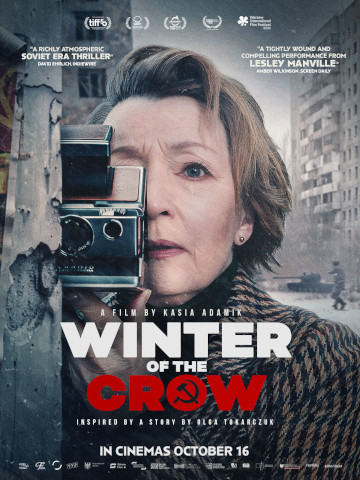
Director: Kasia Adamik
Writer: Sandra Buchta, Kasia Adamik, Lucinda Coxon, inspired by the short story Professor Andrews In Warsaw by Olga Tokarczuk
Starring: Lesley Manville, Zofia Wichlacz, Andrzej Konopka, Sascha Ley, Tom Burke, Magdalena Smalara, Miron Jagniewski, Jakub Guszkowski
Year: 2025
Runtime: 101 minutes
Country: UK, Poland, Luxembourg
Search database: