





Eye For Film >> Movies >> The Sweeney: Series One (1975) Film Review


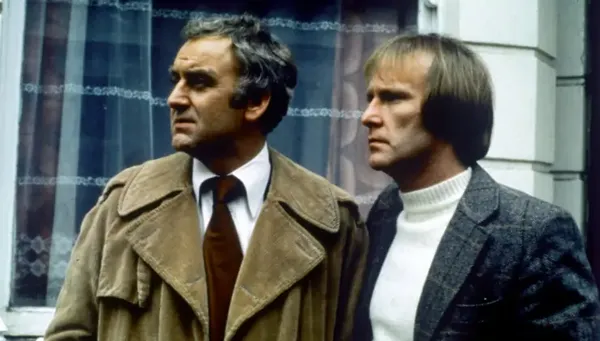

"Shut it!" or "Get your trousers on, you're nicked!", are the quotes that you hear when anyone mentions The Sweeney. One you don't hear, one that sums up the show, is as follows.
Maynon (Morris Perry): "There is nothing terribly wrong with revenge being harnessed to justice."
Haskins (Garfield Morgan): "Maybe not, but you're taking about harnessing it to Jack Regan."
(S1,E4: Queen's Pawn)
The Sweeney starts with the Armchair Cinema episode Regan. It was part of a series of six made-for-TV movies by Euston Films that screened on ITV during the mid 1970s. In the episode, Detective Inspector Jack Regan (John Thaw) pulls in a former subordinate, Detective Sergeant George Carter (Dennis Waterman), to investigate the murder of a fellow member of the Flying Squad. It is in essence a pilot episode for the series. Unlike most TV of the period, with the exception of feature length pieces, it makes extensive use of cinematic techniques and location filming. TV drama at the time was more like a filmed stage play, relying on theatrical techniques. The low angles and pans reflect the nihilist crime thrillers of the Seventies. This look and feel is inherited by the following series.
The Sweeney takes its name from the Cockney rhyming slang for the flying Squad, Sweeney Todd, the demon barber of Fleet Street, a fictional serial killer. Does that speak to how the people they policed felt about them? DI Regan leads a small squad within this branch of London's Metropolitan Police. The unit is charged with policing serious crime, mostly robbery. Regan is a hard nosed copper who will bend or break any rule to get the job done. No warrant: no problem. No evidence, no confession: coercion, "...so unless you want a kicking you tell us where those photographs are." He most often pairs up with Carter, who acts as his sometime better angel. "Excuse me for asking, guv'nor, but what the hell are we doing here?" DCI Haskins, his immediate superior, clashes with him constantly over his behaviour. This dynamic wasn't new (Dirty Harry was already out there) but it hadn't been done much on TV before.
After a short plot teaser, the opening credits crash in. It's what made The Sweeney so distinctive. The title sequence: monochrome, blue and black, a journalistic photomontage of cops, guns and the car chase, Ford Consul GT and Jaguar S-Type. Over the top the iconic, thumping jazz-inspired theme by Harry South. It was stark, gritty. It screamed cop show, a new type of cop show. The scripts were fresh and sharp, full of witty banter between coppers. They had fights and car chases superbly choreographed by Peter Brayham. He made them dirty and chaotic. As a trained boxer, Dennis Waterman [1] was particularly convincing in his stunt work. And in the end they almost never had a conventional wrap up. There was going to be something wrong with the ending. Some of the damage done by crime and policing was left to linger in your mind. Over the end credits, the music is slow and mournful, giving you time to think about that ending.
Subtextually The Sweeney is about police corruption and malpractice. On the surface it stays withing the broadcasting code of the time. Police insuperability is maintained and villains always get what's coming to them. But in the context of the Metropolitan Police of the 1970s it does not paint a rosy picture.
Before the murders of Stephen Lawrence, Sarah Everard, Daniel Morgan, before David Carrick, PC Jamie Lewis and PC Deniz Jaffer, before the Oval Four, the Guildford Four and the Maguire Seven, and before the shooting of Jean Charles de Menezes under the direct command of Cressida Dick (later promoted to Commissioner), the Met was embroiled in scandal.
Newspapers had uncovered massive police corruption and malpractice. Commander Ken Drury, the head of the Flying Squad, had been suspended for holidaying with Jimmy Humphreys, pornographer and carrier criminal. Later, he and 12 other senior officers were jailed on charges related to corruption, most notably Detective chief superintendent Bill Moody, who headed up both the Obscene Publications Squad and the Anti-Corruption Squad; and his boss, Commander Wally Virgo. These convictions happened in 1977 during the middle of The Sweeney's four season run. Robert Mark ("A police force is one that catches more criminals than it employs.") was brought in as Deputy Commissioner. He set up A10 (an internal affairs unit). As a result of its actions many hundreds of officers were dismissed or resigned before action could be taken against them. By 1978 Operation Countryman had been set up. Its findings are sealed by public interest immunity.
The Sweeney changed the way that TV shows portrayed the police. It went as close to the line as it could in implying fallibility and corruption whilst at the same time being thoroughly entertaining.
[1] His brother was Peter Waterman, British and European welterweight champion.
Reviewed on: 29 Aug 2025


