





Eye For Film >> Movies >> The Himalayan (1976) Film Review


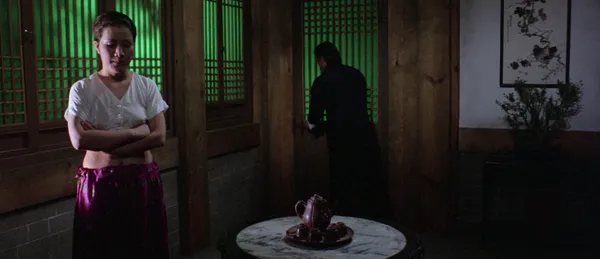

Warning: this film contains a scene in which chickens are killed.
The Himalayan opens with a self aggrandising, fourth wall breaking voiceover. The Golden Harvest company has spared no effort, no resource in tracking down an ancient form of Buddhism and its version of kung-fu to showcase. The director, Feng Huang, shows off one of the things he is best at. There are stunning shots, slow pans, of the Himalayan peaks framed above and below by bands of cloud.
Kao Chu (Sing Chen) and his little brother Kao I Fan (Ling Han) approach a gathering. Chu has arranged that his brother be married to Tseng Ching Lan (Angela Mao). I Fan is having second thoughts about this marriage. That is understandable: he is in love and betrothed to someone else. There are entertainments, a dance in which one of the pair of performers peruses the other romantically, followed by an exhibition match pitting the martial arts skills of Ching Lan and I Fan against each other. Ching Lan wins, comically stealing I Fan's hat, which exposes the birthmark on his forehead.
When it becomes apparent that his little brother won't go though with the marriage, he murders him and replaces him with a body double complete with painted-on birthmark. Sing Chen made a name for himself playing the villain. The nefarious is revealed. Kao Chu, once formally a inlaw, will move to take money and power from Ching Lan's father Tseng (Shan Kwan), a rich and powerful kung-fu master. Everyone arrives at the father's estate and Ching Lan and the new I Fan get married. There is a complication: someone else loves Ching Lan. It's Tien Chiang (Tan Tao-liang), Ching Lan's childhood friend, now one of the servants.
New I Fan is getting nervous about the plan. Kao Chu renders Ching Lan insensate with his Tiger Claw Style and then frames her for I Fan's murder. At the same time he arranges for Tien Chiang to be caught in a compromising position with a woman, forcing him to flee the estate. The unconscious Ching Lan, shackled to a pallet, is brought before her father for judgement. Seeing her obvious guilt, but unable to go through executing her himself, he has her thrown in the river. He never asks the questions: how could someone commit murder while unconscious? and why are there great big bloody claw marks on her neck? Kao Chu is now the closest living relative to Tseng and therefore in line for inheritance.
Tien Chiang spots Ching Lan floating down the river, saves her from her watery fate. The pair work out what has been going on and head to a monastery to train in a technique to counter the Tiger Claw Style.
Feng Huang started the film the way he intended to go on. His shots of the Himalayas and from the highlands looking down on cloud below can be quite beautiful. He uses the natural landscape and the architecture of the region to good effect in reinforcing the narrative and framing the action. The health and safety-defying shots of Angela Mao being washed down the river, for instance. The exteriors are bright and have a slightly washed out look. This is clean mountain air, not city smog. Feng Huang does tend to take his filmmaking as far away from the back lot of the Shaw Brothers studio as possible. The Himalayan has a very distinct sense of place. It's not just the mountains and the buildings, it's the locals used as extras, their clothes, their music.
For a kung-fu movie, The Himalayan is light on the fight scenes. It is more character and dialogue-driven than kinetic. It is melodrama punctuated with kung-fu. When the punches and kicks do start flying they are more impactful as a result. The cast have a balance of martial arts and acting ability that makes the film work. The fighting is well choreographed as is always the case with the collaboration between Feng Huang and Sammo Hung. Just because it has fewer fights doesn't mean that it abandons action movie sensibilities. They are in there in the filming of the traditional dance and display horsemanship at the start of the film, and the unconscious Ching Lan being washed down the river.
There is also a little gentle comedy and a bit of romance. The final scene is a little melancholic, with a choice between love and duty. Like the last scene of Crouching Tiger, Hidden Dragon stripped down to a single line.
Reviewed on: 27 Aug 2026


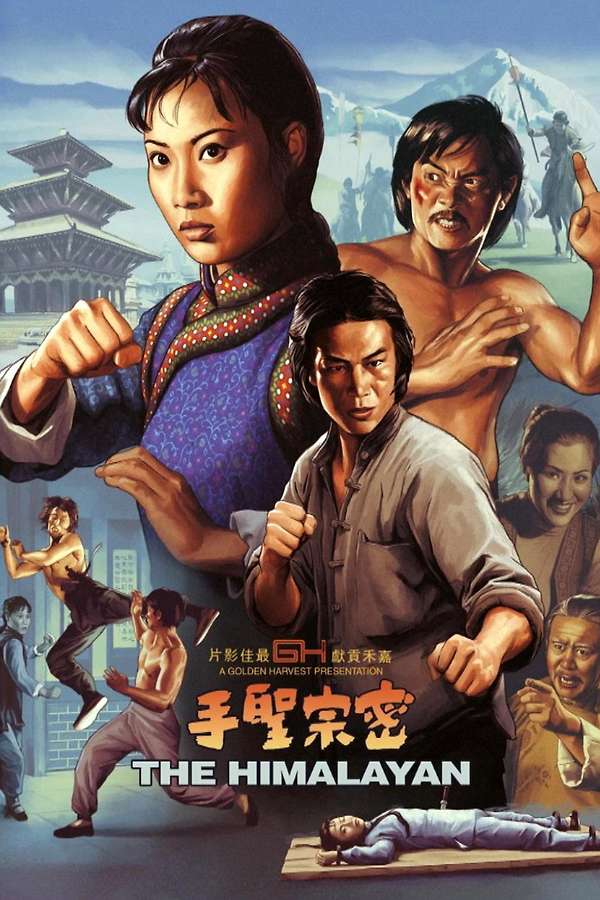
Director: Feng Huang
Writer: Kuang Ni
Starring: Angela Mao, Sing Chen, TanTao-liang, Shan Kwan, Billy Chan, Lung Chan, Ching Po Chang
Year: 1976
Runtime: 117 minutes
Country: Hong Kong
Festivals:
Search database:
