





Eye For Film >> Movies >> The Hidden Fortress (1958) Film Review

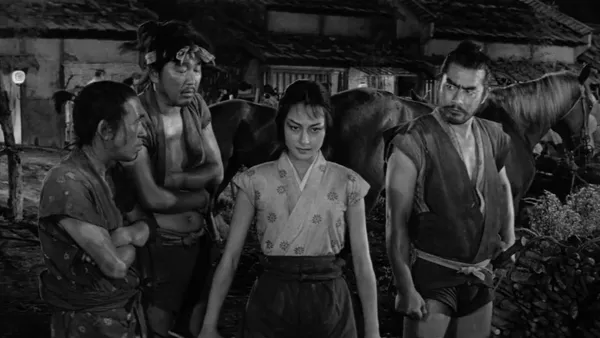

Before Star Wars there was The Hidden Fortress. Both stories were told from the perspective of the underclass. Two destitute farmers, Matashichi (Kamatari Fujiwara) and Tahei (Minoru Chiaki), short and tall, bickering like an unhappy married couple. These characters map directly onto R2D2 and C3P0. But here Kurosawa is drawing on a bigger tradition that encompasses vaudeville, Laurel and Hardy, and the various odd couples of Jack Lemmon and Walter Matthau. The way that Kurosawa shoots the stark scenery of the Hōrai Valley, the framing of landscape and deep focus, can be scene in the deserts of Lucas's Tatooine. Lucas always talks enthusiastically about his indebtedness to Kurosawa, who likewise talked of John Ford.
The Hidden Fortress isn't just the film that is behind the cultural phenomenon of Star Wars, films, TV series, toys, books and perhaps most importantly computer games (the franchise may have come to sticky end if it had not been for Knights Of The Old Republic). Misa Uehara's sharp, angular, physical performance as Princess Yuki echoes through modern manga and anime. Acting against Toshiro Mifune (General Rokurota Makabe), her speed and dynamism provide one of the few occasions where he is given a run for his money. Mifune's performance with sword and spear help cement the Samurai, the Katana within western popular culture (even into the culinary space with its the reverence for Japanese knives).
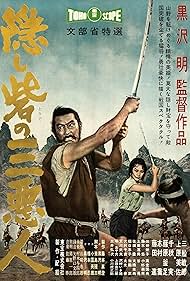
Kurosawa opens The Hidden Fortress with Matashichi and Tahei walking through a deserted landscape. They whine and insult each other: comedy. Out of nowhere a wounded Samurai warrior staggers into shot, thundering horses, the riders cut him down: violence, counterpoint. It is sudden, swift, a statement of intent: this film will subvert your expectations. They split up, an argument over looting the corpse. Individually captured, their lives goes from bad to worse, destitution to slavery (Lucas will do the same to the droids 20 years later). They find each other again, escape captivity, and discover the gold from The Hidden Fortress. The defeated General Rokurota Makabe finds them. Two greedy men and one Samurai to exploit them, three villains. It's in the original title of the film, Kakushi Toride No San Akunin (The Three Villains of the Hidden Fortress) Three villains probley refers to John Ford's silent classic 3 Bad Men, with which The Hidden Fortress shares some elements. The trio have to get the gold and the Princess Yuki to safety across enemy lines.
When it comes to the performances in The Hidden Fortress, Kamatari Fujiwara and Minoru Chiaki have an amazing comic chemistry. Mifune's mercurial physicality is the embodiment of the Samurai warrior. But Misa Uehara as Yuki is often derided. Was there something a little racist there? How could the Japanese, who make shoddy tat for poor people [1], outclass Hollywood. Uehara, untrained as an actor, was an easy target. Her role as a fugitive princess travelling incognito required her to play the roll of a mute, a hard performance to pull off, but pull it off she does. She is the centre of the film, its moral compass. She doesn't want people to die for her. She insists that a woman should be rescued from slavery in a brothel. She enjoys life as it presents itself to her. Uehara does it all through physical performance. Quick and angular, she mirrors the stance and action of Mifune's samurai. She conveys force of personality through movement. Maybe it's the masculinity of her performance that unnerved critics.
Akira Kurosawa's first foray into widescreen is first and foremost a highly entertaining piece of work. It balances comedy, action and suspense. It is stunning to look at, from the expressionist influenced interiors to the natural vistas of Hōrai and Fugi. It is at its heart a ripping yarn, but if you want to look closer The Hidden Fortress is about the conflict between honour (or lack of it) and morality.
[1] Back when I was a kid, 'made in Japan' was synonymous with cheap tat. Then the Japanese started to mass produce electronics that were significantly better than Western ones. A number of racist excuses were used to explain this. Then 'made in Japan' became 'made in China'.
Reviewed on: 17 Aug 2025


Director: Akira Kurosawa
Writer: Ryûzô Kikushima, Hideo Oguni, Shinobu Hashimoto
Starring: Toshirô Mifune, Misa Uehara, Minoru Chiaki, Kamatara Fujiwara, Susumu Fujita, Takashi Shimura
Year: 1958
Runtime: 126 minutes
Country: Japan
Festivals:
Search database:
