





Eye For Film >> Movies >> The Curse Of Frankenstein (1957) Film Review


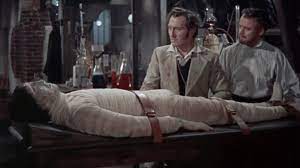

Hammer Horror’s first venture into colour, and the first major effort to adapt Mary Shelley’s novel after the Universal versions, The Curse Of Frankenstein is also one of the studio’s more satisfying dramatic offerings. It features Cushing’s first big screen leading role, and he was always at his best playing dark, morally compromised characters, despite later becoming famous as the heroic Dr. Van Helsing. Here he is another doctor, the young Victor Frankenstein, heir to a vast estate and thereby at liberty to pursue his scientific ambitions – at least up to the point where he alienates everyone around him.
We often lose sight of Victor the hero but Cushing lets us see it, at least initially: this brilliant young man who realises that if he dedicates his life to a singular purpose then he really might be able to cure death. We get a sense of his frustration when religious and superstitious objections obstruct his work; he comes across throughout not only as unusually intelligent but as ahead of his time, which creates a special sort of loneliness. These factors combine to separate him from positive moral influences, so it makes more sense that he begins to devalue everything except the work, to the point of being willing to do monstrous things to keep it going – and once that has begun to happen, sunk cost fallacy makes it even harder for him to stop.
The most positive influence in his life is Paul (Robert Urquhart), his former tutor and an early collaborator in his experiments who gradually becomes uncomfortable with the lengths to which Victor is willing to go. Hazel Court’s Elizabeth has less opportunity to contribute and is unfortunately reduced to a damsel in distress in places, but she gets her moments, and we see the strength of her affection for the fiancé she has known since childhood, whom she struggles to believe has gone this far astray. Then there is Justine (Valerie Gaunt), the servant with whom Victor is having an affair – a reasonable interpretation of Shelley’s original text, allowing that in both cases what we see is limited by point of view. Justine’s naïvety plays differently here, but still emphasises the power imbalances at play and the extent to which his aristocratic upbringing has predisposed Victor to think of people as objects whose significance lies in how he might make use of them.
From the outset, the filmmakers wanted to distinguish their monster from Universal’s. Though history has proven the former to be the more successful – with most people still picturing the face of Boris Karloff when they imagine it today – theirs is an interesting effort, and closer to Shelley’s original idea. Played by Christopher Lee, whose full potential the studio was yet to appreciate, he has a haunted quality, dangerous because of his strong instinctive urges and impulsivity, combined with great strength, but close enough to human to inspire a natural empathy. Lee and Cushing were already close friends by this time and there’s an intimacy about their onscreen interactions that adds to the horror of the monster being rejected by his maker. The sensitivity of Lee’s performance helps to draw out the ambiguities in Shelley’s work, and the moral complexities which, acknowledged or not, are a critical component of the story’s staying power.
Not everything here is done by the book. The budget would not allow either for Shelley’s Arctic-set ending or for a Universal-style mob with torches and pitchforks, so what we get is more dependent on personal drama. It still makes an impact. In its time, the film was considered shockingly gruesome and was, accordingly, loved by the public and rejected by much of the critical establishment. Today the special effects don’t make the same impression, but the darkness remains and is more potent than in later Hammer offerings.
The historical significance of this film is such that it’s a must for serious horror fans, whilst others will find it dramatically satisfying and admire the elegantly crafted sets and costumes. Less camp and more serious in tone than much of what followed, its key achievement is in making the story more than a gimmicky tale of crazed experimentation or a short cut to monster mayhem – in making it matter.
Reviewed on: 01 Oct 2025


Director: Terence Fisher
Writer: Jimmy Sangster
Starring: Peter Cushing, Hazel Court, Robert Urquhart, Christopher Lee, Valerie Gaunt
Year: 1957
Runtime: 82 minutes
BBFC: 
Country: UK
Search database: