





Eye For Film >> Movies >> The Conjuring: Last Rites (2025) Film Review


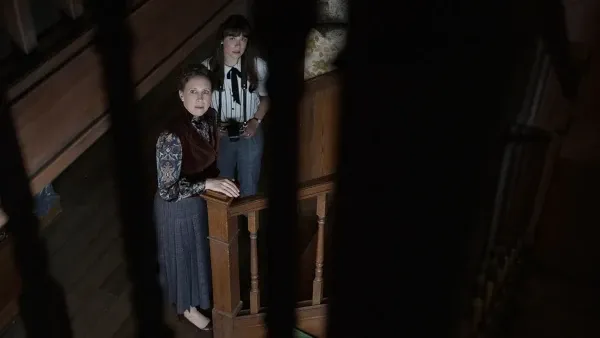

Since its beginnings, The Conjuring has always been a franchise in limbo: half archaic, with its revival of Seventies and Eighties 'Satanic panic'; and half contemporary, in its presentation. The time has finally caught up with the franchise.
Last Rites marks the end of one of the most popular and most-watched horror franchises in the last decade, marked by the ever-increasing number of new franchises. It's directed by Michael Chaves, who cut his teeth and rose to prominence within The Conjuring film series.
The film opens with a scene from the late Sixties, when Ed and Lorraine Warren were young, with their young counterparts played by Orion Smith and Madison Lawlor, respectively. Lorraine is shown giving birth to Judy, but the baby dies not let out a single cry for an awfully long time. Just as the doctors are ready to give up, as a kind of motherly miracle or as a result of a giant leap of fate, Judy starts to cry in her mother’s arms, marking the start of their journey both as a family and as a force fighting paranormal demons.
Just moments later, we’re introduced to a different clan in Eighties Pennsylvania, where a large household of siblings and close relatives share a lively family life. As a gift for her First Communion, a young girl receives an antique mirror from her grandparents, but little do they know, the mirror is haunted. Their local priest, Father Gordon (Steve Coulter), believes the Warrens could help, but due to Ed’s worsening heart condition, the couple have largely retired from ghost-hunting and have instead turned to a life of teaching about their findings over the years. However, once the spectres hunting the family take the life of an old priest and start calling on recently engaged Judy, the Warrens will soon realise that this is no ordinary case of evil spirits but the case that started it all for them, many years ago — the only case they abandoned.
The Conjuring always seemed like a forced franchise — due to the huge success of its inaugural 2013 film, directed by James Wan, and the profitability of its Annabelle (2014) spin-off — so it is only natural that the very last film in the franchise ends up being the most forced of them all. The film essentially has two beginnings, and feels like three movies jammed into one, where all the elements individually maybe hold some water, but combined, they’re just marking time until we reach the final credits.
Conjuring was always half horror and half run-of-the-mill family drama, positioning it in a kind of no man's land: too tame for horror enthusiasts, and too shallow and, perhaps, nonsensical for people looking for a proper drama. Perhaps the biggest draw and appeal of the franchise early on was James Wan’s way of building ominous tension, his mise en scène and, in general, elaborate jump-scare setpieces. Although the first film has no obvious profanity or extreme gore, the film was stamped with an R rating simply for the overall feeling Wan builds over the course of the picture. Although all the rest of them share that same R rating, every film since The Nun (2018) could have easily been a PG-13 film, and that also stands for this one.
While the rest of the franchise remained steeped in Wan’s style, which has largely defined middle-of-the-road mainstream horror, each sequel carried even less of the initial spark, scarce as it was to begin with. After a decade, Wan’s style of horror ceased to be the only game in town. With body horror entering the scene and 'elevated horror' and/or 'slow horror' of the likes of A24 and Neon, The Conjuring is in its biggest state of non-belonging since its beginning, which is addressed in the film itself.
Given that the film is set in the Eighties, the large pop-cultural landscape shaped by movies about demonic possessions shows itself in the film as well. Early on, a group of young people call Warrens 'ghostbusters' in reference to the Eighties hit franchise, in multiple instances the John Wayne poster in the cellar is mistaken for a ghost and one of the central mechanics of the plot is the haunted family’s decision to call the media so that their troubles could be seen and reported on to the wider audience. This part of the plot is glossed over, but the media eats the story up precisely because, in the Eighties, the demonic craze was in full swing – thanks in part to the Warrens themselves. In a way, the film’s narrative suggests that their work penetrated the culture around them as a watered-down, thrill-seeking form of entertainment, and this dilution is reflected in the film as a watered-down and archaic form of thrill seeking.
The story of this final instalment tries to resolve the theme of family as a force of good by contrasting two families, but in doing so, both families end up being underdeveloped, leaving us with a sense of trying to reach a profound point that never comes. A subplot involving Judy Warren, who also sees ghosts, could be argued has a has a fate-like arc in the vein of Sleeping Beauty, but since she has no real agency in the plot, the entire theme serves mainly as a narrative mechanism to inject a bigger sense of importance to the simple 'inspired by true events' story.
The art of embellishing hoax stories as true events is a staple of exploitation cinema, or if we’re talking strictly about mainstream cinema, it’s merely a stunt for selling the movie, but not something addressed in the movies themselves. The Conjuring franchise tries to treat Warrens and their story as 'legitimate', but that approach ironically made it less serious in a way that makes the film silly in the wrong way, but more importantly, incredibly dated, as though it’s from the time the film is set in.
Reviewed on: 05 Sep 2025


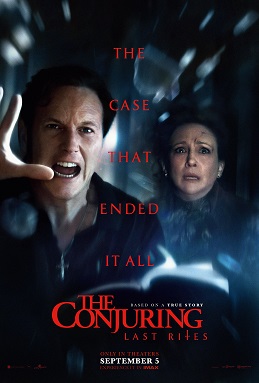

Director: Michael Chaves
Writer: Ian Goldberg, Richard Naing, David Leslie Johnson-McGoldrick
Starring: Vera Farmiga, Patrick Wilson, Elliot Cowan, Ben Hardy, Beau Gadsdon, John Brotherton
Year: 2025
Runtime: 135 minutes
Country: Canada, US
Festivals:
Search database:
