





Eye For Film >> Movies >> Silent Legacy (2025) Film Review


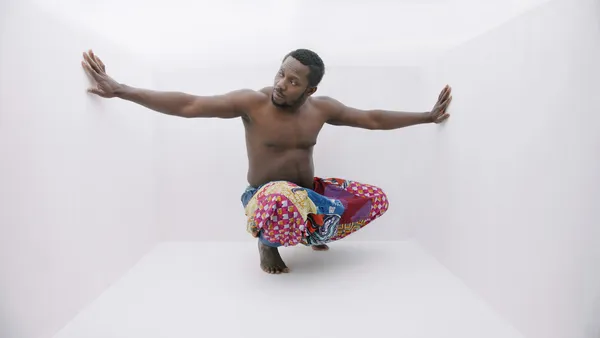

Finnish directors Jenni Kivistö and Jussi Rastas take an appropriately balletic approach to the life of contemporary dance choreographer Sibiry Konate. They elegantly pirouette between his life in Finland, where he has an additional job in a postal sorting office, and the village he is originally from, Tiene, in West Africa’s Burkina Faso.
A film built largely from observational footage but punctuated by dance segments created and performed by Konate that speak to psychological and emotional terrain he discusses in interviews that flow over what we see, the approach is immersive.
Films about migration have historically focused on the way people become integrated into new lives and cultures or on irregular migration, including the plight of refugees. That is only part of the story, however, with ordinary migration happening for myriad reasons, and recently more films have come to consider the tensions between an established new life and the pull of what the emigre has left behind. For Konate it’s the “heavy load” of expectation from people back home that weighs him down the most.
That expectation is that those who head to Western Europe will then send or bring back cash to the community. It’s an expectation that is illustrated by voice calls we hear Konate receiving from family members and friends asking for help. It’s put succinctly in one conversation with a Burkinabe friend in Finland, “People see you as money”. While the directors don’t labour their metaphors, one dance, within a boxed space, speaks to the restrictions Konate feels. Close up camerawork that deliberately drifts out of focus, also feels illustrative of the dislocation he has experienced – a literal realisation of Konate’s observation that, to those back home, “You become an abstract object”.
The second part of the documentary is driven by a decision Konate makes to try to take something concrete to his home village, rather than just money. There’s a poignancy to this attempt, not just in what unfolds but in the fears that this raises within Konate about expectation and delivery. Beyond the personal, the film extends out into a rumination on colonialism and its legacy on places like Burkina Faso, with the choreographer noting that change “cannot depend on white people”.
As the film shifts from the snowy city streets of Finland to the rural heat of Tiene, the Finnish directors stick out like a sore thumb. That makes for some interesting observations from the locals – “those people all look alike” – that the world can be very small when it comes to parochial attitudes and views of outsiders. The hybrid nature of the documentary is particularly successful as it allows to Konate to fully express his feelings within the frame of the film, while the documentarians are also able to offer a more observational portrait in tandem.
Reviewed on: 13 Aug 2025


