





Eye For Film >> Movies >> Self-Help (2025) Film Review


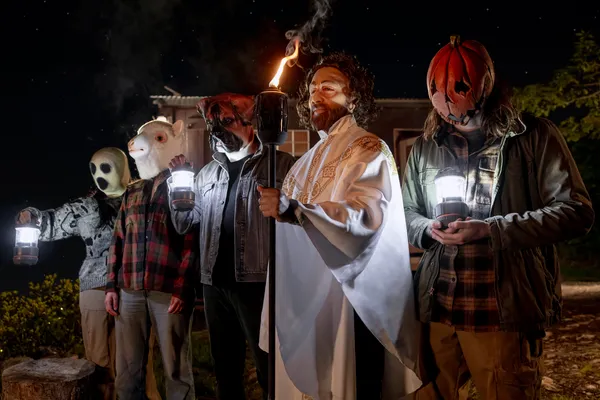

Olivia (Landry Bender) has always had a difficult relationship with her mother. Erik Bloomquist’s latest work, which screened as part of Frightfest 2025, engages with familiar horror tropes from a different angle. Murder, madness and occult ritual are all on display, but are seen for the most part in a more mundane way than is usual in cinema. They’re no less disturbing as a result.
Rebecca (Amy Hargreaves) doesn’t come across as an inherently bad person. Maybe she just wasn’t cut out to be a parent; maybe it’s that she’s struggled with the weight of a secret she had to bear on Olivia’s behalf. The two are bound together by an incident we witness in a prequel, but which we get the impression they have never spoken about directly. Now it’s ten years later and Olivia learns that Rebecca has a new man in her life – guru Curtis Clark, referred to as ‘the truth ambassador’, who wears dodgy suits and has a dodgier internet presence. Her sudden reaching out is a transparent effort at cult recruitment but Olivia responds, best friend Sophie (Madison Lintz) in tow, because, just as obviously, she wants to get her out of it.

“Remember, I am not the Messiah: you are,” says Curtis (Jake Weber), alternating between shows of generosity and lofty criticism. Ever appearance is a performance, whether he’s speaking to 20 people or just one. His followers keep reassuring one another of his greatness as he spouts the kind of wisdom one can find on posters beside images of sunsets or kittens, but it’s the apparent self-deprecation that really gets them – one flicker of humility and they assume that he must be an honest man. In a similar way, his average looks and not particularly flattering presentation work in his favour. His manner is a little different with Olivia, though. He expects a degree of resentment, so he’s patient and lets her have some space.
This polite distance also allows the audience to explore the dynamics of the cult from a fresh angle – with something of the privilege of an insider, but without the filter of belief or the cynicism of a point-of-view character’s absolute rejection of it. Mostly, Olivia is embarrassed by it. She has always been troubled by her mother’s sexuality, and inadvertently witnessing her involvement in a sex game awakens destructive impulses which may prompt you to wonder which of these women really has a problem. There may also be an external threat, as it emerges that a former cult member, feeling the pain of rejection, has come looking for bloody revenge.
Despite all these issues, many people seem to be happy there, undertaking an assortment of bonding exercises, and it’s all fun and games until somebody loses an eye. initially hostile and dismissive, Olivia gradually comes to care about them, and wrestles with the ethics of interference – but she may not be the only person there with an agenda. Her real challenge lies in figuring out, if and when it all goes wrong, whether she should once again be there to pick up the pieces for her mother, or finally cut the strings.
Bloomquist invites us to think again about the type of people who are drawn into cults, and to reflect on what is missing that they need to replace in this way. The visible need that many have to be close to others contrasts with Olivia’s increasingly obvious need to be on her own – but who is really keeping her in this toxic situation? Is it her mother’s fault; has she been overindulgent; or is she too getting something out of it that she doesn’t really want to let go of?
The difficulty with the film is that these internal struggles weigh heavily on its structure, giving it an uneven tone not adequately compensated for by the various threats. Though it comes together at the end, you’ll need to exercise a bit of patience as it gets there.
Reviewed on: 06 Oct 2025


