





Eye For Film >> Movies >> Out Standing (2025) Film Review


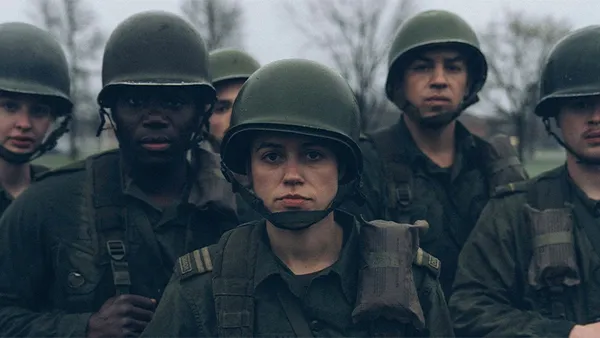

The first female infantry officer to serve in the Canadian Army, Sandra Perron had a distinguished military career, receiving an exceptional service commendation for her work in Croatia and being elevated to the rank of major prior to her retirement in 2003. Ask the average Canadian about her, however, and the image that will most likely come to mind is of her tied to a tree after a beating. This infamous picture was snapped duringa training exercise in whjich other soldiers were subjected to the same or similar treatment, and Perron fought against its release, not wanting to be thought of as a victim. Part of the reason for that, as she made clear in her 2013 memoir Outstanding In The Field, was that she had been subjected to abuse throughout her career, but it took a very different form. It’s that subject that this partial adaptation of the same memoir addresses.
If it’s difficult to talk about harassment directly without it being reduced to discrete sensationalised incidents, that’s still more difficult in cinema. To create this outstanding film, which screened as part of the Toronto International Film Festival, director Mélanie Charbonneau has strayed a long way from Hollywood. The narrative builds up slowly, moving back and forth between different stages of Perron’s life, and its major structural elements are not ones which would be likely to grab attention during a pitching session. It’s the mass of minor incidents along the way which give it power, and it’s Charbonneau’s commitment to presenting them in this way that makes this an important work.
It’s tough viewing. We begin in 1991 when Perron (Nina Kiri) has already obtained the rank of captain but as just transferred to the infantry and is entering training in New Brunswick. She’s not the only woman present, sharing a room with Susan (Hayley Festeryga), but the latter, being blond and having more prominent breasts, gets the worst of the bullying. Sandra is studiously cool, never wanting to let the male recruits feel that they’re getting to her. The officers try to strike a careful balance, tackling inappropriate behaviour without showing anything that might look like favouritism, but sometimes they too are problematic. The only real sympathy she gets comes from a Black recruit (Adrian Walters) who has likely experienced his own portion of microaggressions.
Charbonneau balances these carefully. After a heads-up that makes it clear the women are resented, we move on to the sort of sexist joking and little comments that mainstream films used to serve up as entertainment not long ago, and that some still do. Then there are more serious infractions, such as men wandering into her tent at night on exercises, which contrive to keep her on edge, unable to overlook the small stuff because she never knows when it might signal real danger. We also see how hard she has to fight to access career opportunities appropriate to her rank and experience, and how, when the story of her treatment begins to break in the aftermath of her retirement, she finds herself blamed for the trouble that the army could face as a result.
It would have been easy to present this story simply as an exercise in outrage, and Perron as a heroine who triumphed against the odds, but that would not be true to how she saw herself at the time. Grim as it is, there’s little about her treatment that will surprise most female viewers, let alone shock. What Charbonneau aims to get across is the relentlessness of it, and how exhausting it is to deal with on top of the already gruelling experience of training and serving as a soldier. At one point we see a male recruit attempt to justify his hostility by suggesting that, as a woman, she must be physically weak, and that could put them at risk in combat – but one comes across throughout is her strength. not only is she physically competent, but she has tremendous psychological powers of endurance. The question a senior officer will eventually pose is whether she should depend on that, putting her own well-being and therefore her capacity to do her job at risk, or fight back. It’s a difficult question to answer when all she wants is to be a good soldier.
Present in every scene, Nina Kiri delivers an exceptional performance, letting us know exactly who her character is despite Perron’s reluctance to show emotion. She shows us the layers of deep psychological bruising as they stack up over time, and the weight of the unfairness of it all. There is so much pressure there that when it finally gives, it’s as if we are suddenly looking at a different person. In this, Kiri is supported by Antoine Rochette’s deceptively subtle score and by solid work from the remainder of the cast.
Defying as it does the conventions of the feminist biopic, Out Standing delivers something much more powerful, effectively addressing the scale of opposition that pioneering women have faced – and sometimes still face – as well as paying tribute to Perron’s achievements as a soldier. In accepting that the personal is political but also acknowledging that the political can be very, very personal, it does right by its subject and makes for compelling viewing.
Reviewed on: 13 Sep 2025


