





Eye For Film >> Movies >> Nosferatu The Vampyre (1979) Film Review


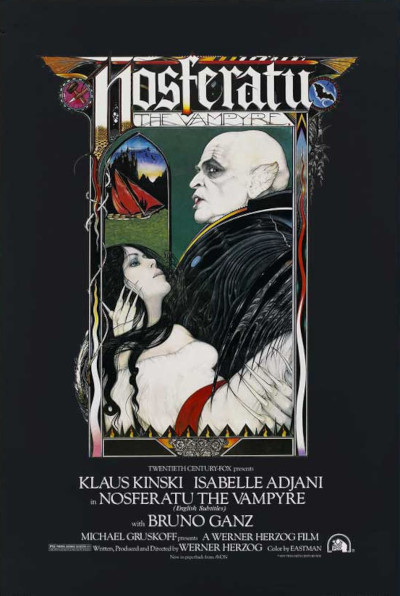
Werner Herzog's Nosferatu The Vampyre/Nosferatu: Phantom Der Nacht is/are in actuality two almost identical films. The two films, one English language and one German, were filmed synchronously and share non-dialogue footage. The films are based on Friedrich Wilhelm Murnau's 1922 silent classic Nosferatu and on Bram Stoker's novel Dracula (from which Nosferatu was famously ripped off).
Herzog's film sparsely follows the plots from the novel and film. There isn't a lot of plot. Herzog cuts it down to the bare minimum required to support the film. An estate agent from the town of Wisborg, Jonathan Harker (Bruno Ganz), is commissioned by his boss Renfield (Roland Topor) to travel to Transylvania to conclude a property deal with Count Dracula (Klaus Kinski). After sealing the deal and discovering that Dracula is a vampire, Harker flees the Count's castle and returns to Wismar. He must warn the people of Wisborg about what is coming, a vampire and plague, and save his wife, Lucy (Isabelle Adjani), from the fiend.
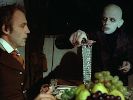
Adjani's performance has an ethereal, otherworldly quality about it. It is what makes her portentous dream connection to the vampire effective. Kinski on the other hand is the sex pest, the unwanted repeated violation of personal space. He is the creepy teacher, or the guy in the club that wont stop staring.
Cinematographically, the film is characterised by a naturalistic approach, Jörg Schmidt-Reitwein's exquisite framing and disjointed hard cuts. It has a nervous, frigid yet dreamlike quality.
Nosferatu The Vampyre has its problems. The disjointed hard cuts become a bit of a one trick pony. After about half an hour of the technique being unrelentingly applied, they lose their artistic impact and just become wearing. Herzog has spoken about using the film to connect back to the expressionist film making that existed before the rise of the Nazis, to provide a historic bridge over a dark time in German filmmaking. The trouble with this is that expressionist techniques, the distortion of reality to convey meaning, are diametrically opposed to Herzog's naturalistic style. They feel incongruous within the film. Some might consider Roland Topor's pantomime portrayal of Renfield's insanity incredibly irritating.
Beyond what is shown on screen there are the issues of Kinski's behaviour, and animal cruelty. Kinski physically and sexually abused his first daughter, he violently assaulted women and has been accused of the attempted rape of a fellow actor. You have to ask yourself how much of his act in this film was actually an act. Of the thousands of rats to be used on the set of Nosferatu, half died of starvation before their filming even began. They were white laboratory rats. Herzog insisted that they be dyed black. The process involved them being briefly submerged in boiling water. This killed half of the remaining rats. The dye didn't stick and the remaining rats licked themselves clean. If you know what you are looking at, a number of other animals in this film look distressed.
If you are comfortable separating the artist from the art then you can get something out of Nosferatu The Vampyre. If you aren't, then watching the film, with knowledge of Kinski's behaviour or of the on-set animal cruelty, will leave you with a distinctly queasy feeling.
Reviewed on: 21 Sep 2025


Director: Werner Herzog
Writer: Werner Herzog, Tom Shachtman, Martje Grohmann
Starring: Klaus Kinski, Isabelle Adjani, Bruno Ganz, Roland Topor, Walter Ladengast, Dan van Husen
Year: 1979
Runtime: 107 minutes
Country: West Germany, France
Festivals:
Search database:
