





Eye For Film >> Movies >> Niñxs (2025) Film Review



Why do trans people face so much difficulty finding acceptance in today’s world? A lot of it would seem to be epistemological. Most people who grow up in a society with two distinct, neat gender categories struggle to imagine anything else – and if they accept that there must be something more, they either assume that people magically snap between those two, or imagine a distinct third category. It’s difficult for them to appreciate the mutability and porosity of categories that many trans people perceive. Rather than trying to accommodate the rigidity of that kind of thinking, and the innate stress it occasions, Mexican director Kani Lapuerta invites both viewers and star to change their frames of reference in a documentary as bold as it is charming.
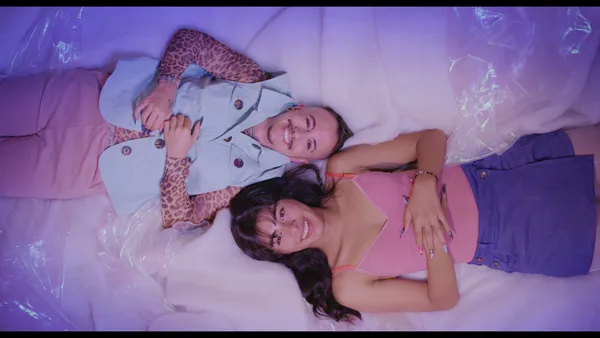
Screened as part of Newfest 2025, where it got a special mention from the Grand Jury, Niñxs is a story of friendship and growth and the inevitably complex process of working out how to fit into the world as one navigates one’s teens. Its star is Karla, who lies on a plastic sheet next to the director as they discuss her story. The plastic might be interpreted in multiple ways. In many a trans-focused story it would signal artificiality or, worse, suggest a body bag; but this is a thing not like the others. With softer sheets beneath it and gentle pink lighting, the impression it gives is, rather, of a magical bubble in which the two of them float, a space in which it’s easy to be completely real, out of contact with the pressures of the day to day world.
That world, for Karla, began with flour – lots and lots of it, as he parents were bakers or, as she puts it, ‘punk hippie food artists’. This had the advantage of making them adaptable, enabling them to shape their lives around her needs, even if they didn’t always get it right. Taking her out of the city to the small town of Tepoztlán was good for asthma, but not for her social life. She recalls coping at school – as she would later cope with transphobic and misogynistic taunts in the street – through the power of dissociation. Later, when she was ready to live openly at high school, Covid hit, and the world got a lot smaller in an unexpected way.
An abundance of material recorded during these years fleshes out the story. We see Karla in the gym where she loses herself, see her disappear into a crowd of girls when performing as a majorette, and watch her hanging out with cis peers who are so accepting that they don’t get why she spends so much time applying products, micro-analysing her looks; they don’t understand the difference in her experience. Support comes from Aunt Poppins, aka Lia Garcá, aka the Mermaid Bride, who arrives to heal the soul, starting with a little tiara which has a story attached.
Even early on, Lapuerta has an eye for details. We watch Karla peeling an apple, no working her way around it as most people would, but chipping away at it bit by bit. We see parents who love and try to accept her but don’t look up from their kneading when she comes in, their briefly distracted hands creating little puffs of flour which occlude their sight. They want to help, they say, but they want her to accept herself. This seems to mean accepting an intolerable future. They don’t make a case for this. Karla tells Aunt Poppins that she’s not afraid of dying but she’s afraid of being killed.
As teenagers, Karla and Lapuerta record a message to their future selves. What is their dearest wish. “We hope you still have drinking water,” they conclude, after some discussion, and speculate further about how much they might have fucked up the planet.
Looking back at all this archive, the two become aware of just how much they’ve changed. Karla has learned that not ever trans-themed film now kills its heroine. She can choose her own ending. Brave, vivid and very personal, the film is, Lapuerta says, a weapon against forgetting: a love letter for Karla. For the audience, it’s an invitation to celebrate the complexities of life as it is actually lived.
Reviewed on: 23 Oct 2025


