





Eye For Film >> Movies >> Mektoub, My Love: Canto Due (2025) Film Review



Life could not be less peachy for the French filmmaker Abdellatif Kechiche. His biggest success – Palme d’Or winner Blue Is the Warmest Colour – was overshadowed by Léa Seydoux’s accusations of the director’s exploitative behaviour on the set (which he "categorically denied"). His next project, the intended “magnum opus” Mektoub, My Love, divided in three “cantos” and one intermezzo he also got a reputation as an uncooperative megalomaniac. Canto Uno (2017) had a Venice premiere, but the director’s inability to strike a compromise in milking the money for sequels scared off some of investors and distributors. With Intermezzo (2019), the allegations of mistreating the actors, and especially the actresses, resurfaced, and so did those of megalomaniac ambitions. After the Cannes premiere, the film was practically buried. Canto Tre was cancelled, which leaves us with Canto Due which, after six or seven years of post-production hell, finally premiered in official competition at Locarno.
For starters, let us explain the whole Mektoub, My Love: Canto thingy and its background. The three-part title in three languages could be broken down to the following. “Mektoub” is the Arabic word for destiny that cannot be escaped. The “My Love” part is the most obvious, as it is what the characters search for in the movies, while the “Canto” part comes from renaissance poems and ballads, representing the sections of the particular work.

As for the background, officially, it is an adaptation of François Bégaudeau’s semi-autobiographical novel, but with the setting completely changed to fit the biographical data of Kechiche: the plot was moved from the Eighties to the Nineties, and from the predominantly white French Atlantic coast to the ethnically mixed Côte d’Azure and, more precisely, the town of Sète which is under strong Tunisian cultural influence. Furthermore, the protagonist and the focal point of the film is, unlike François in the source novel, named Amin and is a former medical student who has turned to filmmaking.
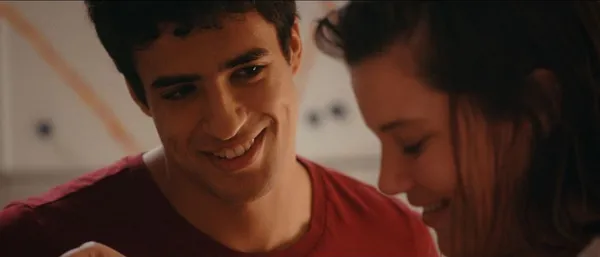
As we might have understood from Canto Uno, the whole multiple-part epic follows Amin (Shaïn Boumedine) and his group of family and friends over the course of summer of ‘94. He is a sweet young man obsessed with movies and filmmaking who just returned from Paris to work on his scripts. His horndog of a cousin Tony (Salim Kechiouche) is chasing tail all over the place, from tourist Charlotte (Alexia Chardard) to Amin’s childhood friend Ophélie (Ophélie Bau) who is engaged to be married to a serviceman stationed abroad. Tony actually knocked Ophélie up and she is relying on Amin to get a secret abortion in Paris on the pretence of buying a wedding dress.
The novelty of Canto Due are a couple of Americans, soap-opera actress Jessica (Jessica Pennington) and her producer husband Jack (Andre Jacobs). The film starts their entrance to Tony’s mother’s restaurant after it has shut for the night with a desire to eat couscous and the will to upset the whole workforce. They get the food, but for the price of having to read Amin’s newest script. Which is actually good and makes both Jessica and Jack interested. Tony, on the other hand, tries to put himself as some kind of a liaison between Amin and the couple, which puts him dangerously close to Jessica.
Without spoiling it too much, one can assume that all that breeziness of casual, carefree summertime will amount to some kind of a shocker or tragedy. And it does, but until then, we are stuck with endless dialogue-driven scenes done in reverse shots, passages of characters moving and contemplating set against classical music and chaos-cinema level of shaky cam in Marco Graziaplena’s cinematography. When the twist, or better said, something actually resembling a plot, arrives, it is too late and the mechanics of it are too illogical, while the ending comes abruptly.
The saving graces of the film come in the form of a relatively reasonable runtime of just over two hours and the acting of the returning cast members. The explanation for both lies in the previous instalments – the actors had time to forge some mutual chemistry and group dynamics, while both Canto Uno and Intermezzo – which is basically one extended sequence of partying and sex with a prologue – ran for over three hours. Also, it seems that Kechiche has toned his voyeurism down a bit, or maybe masked it to appear more tasteful.
However, Canto Due is a living proof that the novelty of a free-wheeling, summer-breeze approach where we watch hours of young people having a good time and stirring turmoil with their “love affairs” in a casual way has worn off by now. Maybe with the whole Mektoub: My Love series of films Kechiche tried to make his own Amarcord. But, truth to be told, he is no Fellini.
Reviewed on: 13 Aug 2025