





Eye For Film >> Movies >> Magellan (2025) Film Review


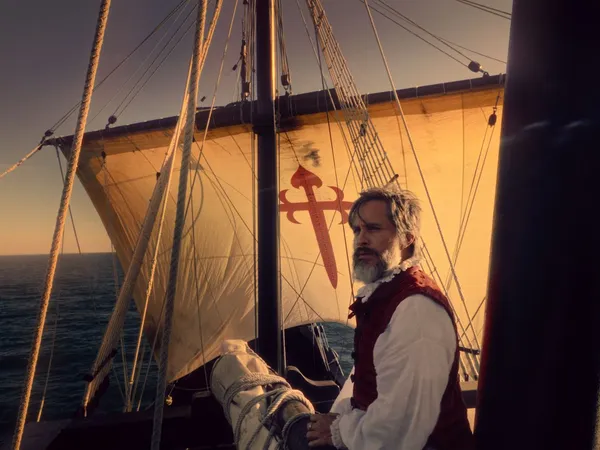

If you grew up in the Global North, even in the early 21st Century, the chances are that you were taught about Ferdinand Magellan as one of history’s greatest explorers. He was, it’s true, the first man know to have circumnavigated the Earth, no small accomplishment in wooden ships; the first European to discover what is now called the Strait of Magellan at the southernmost tip of South America. He also has two dwarf galaxies named after him, along with a NASA spacecraft. But there was another side to Magellan, and he is understood very differently by the descendents of many people he encountered on his travels.
Short for a Lav Diaz film, at just 160 minutes (the reason being that it has a nine hour companion film, Beatriz The Wife), this nevertheless packs in a lot of that story hitherto untold in the cinematic medium. It opens with an indigenous perspective on the arrival of Portuguese soldiers preparing for their successful assault on the city of Malacca in Malaysia in 1511, so we are immediately rooted in the thriving culture that they would go on – under the command of Afonso de Albuquerque (Roger Alan Koza) – to try and destroy. There, an enslaved man is purchased by Magellan (Gael Garcia Bernal) and watches Albuquerque give an impassioned speech about the need to conquer and convert faster than Muslims, with a view to overwhelming Islam so that everyone in the world will be Christian, Christ will return to Earth and Armageddon will occur.

Given the name Enrique, this man (Amado Arjay Babon) becomes the observer through whose eyes the tale is told, though he speaks only briefly. His continued silent presence invites us to think about what Magellan’s behaviour might look like to someone from outside the European tradition. Even viewers embedded therein may find this a little alien to begin with, however, because Diaz has made more effort than most to get into the mindset of that time. Albuquerque’s speech sets the tone for a film in which Christian end times philosophy feels very real and immediate to the characters, and in which abiding by religious rules has as much to do with survival instinct as morality. Magellan’s willingness to bend such rules is part of what enables him to get ahead, but it also casts a shadow over him and seems to feed into a destructive paranoia as the story develops.
Though rigorously researched, this is not historically perfect – notably, Enrique’s native language, Cebuano, is delivered in starkly modern form even though the Portuguese used for most of the dialogue is closer to period-appropriate (and is beautifully handled by Bernal, who learned it especially for the film). Elsewhere, anomalies seem to be present for a reason. Magellan’s statuette of the Christ child, which he hugs like a teddy bear at times of stress but eventually gifts to a powerful Cebuano family, has dark skin in contrast to the white of the actual relic, something that might speak to the general whitening of such images across subsequent centuries, or to efforts made to re-engineer Christianity to suit different environments. The treatment of Lapu-lapu as a fictional rather than historical figure is contentious but enables Diaz to establish the people of Cebu as politically savvy and sophisticated, in contrast with previous depictions of them as savages whose only skills were martial in nature.
There are little observations along the way which remind us of Magellan’s dilettante genius: his passion for astronomy, the sweets he makes to treat scurvy. Brief scenes with his wife, in person and in luminous dreams, hint at an emotionally complex man. There is also a moment when freshly returned to the sea, he pats the ship’s rail, pleased by its sturdiness – it’s a rare glimpse of his true values, of who he is when not concerned with how he will be perceived by other people. When two members of his crew are caught having sex, the punishment he inflicts on them is suggestive not just of a desire to perform religiosity where it’s easy, but of a resentment born out of his own loneliness. One wonders if the buggery might have been overlooked without the kisses.
There are moments when the film resembles another set in the 1500s: Werner Herzog’s Aguirre: The Wrath Of God. Both feature central characters whose ambition takes precedence over other people to the point where they find themselves increasingly isolated in hostile environments. Where Klaus Kinski strained his character at the seams, however, Bernal exercises considerable restraint. Wearing such a heavy beard would tempt may actors to ham up their expressions for fear of not being able to communicate effectively at all, but he approaches the role with confidence, trusting in Diaz’s lingering camera to give him to space to let us see what we need to. It’s through his eyes that we understand his love of exploring for its own sake, and the fear that lies behind his determination to do everything his own way. Whilst the film might fairly be viewed as a condemnation of his life’s work, Bernal pulls in the other direction, and it’s in this tension that the film finds its magic.
There is also a good deal to be said for the craft involved in constructing this unusual epic. Artur Tort’s cinematography makes it visually alluring throughout, and there’s superb costuming by Zeus Bascon, Célia Fernandes and Kim Perez, making its characters look as if they could have stepped straight out of the paintings of the period. This effect is enhanced by Tort’s fondness for chiaroscuro, a look naturally suited to the forest landscapes in which much of the action takes place.
What binds the whole film together – as South Sea Islanders say it binds the world – is water, whose flow we follow throughout, from a river in which an indigenous woman takes shelter, across the broad sweep of an ocean in every shade of blue, to the waves that crash against the shoreline where it all comes apart, from whose embrace Magellan seeks to drag a man so young that he must have been in his teens when he first donned armour and gave himself over to that ill-fated voyage. Has the Portuguese Admiral conquered the seas or have they delivered him, inexorably, to his fate? It is Enrique who gets the final word and he, on a personal level, has bigger things to be concerned about.
Reviewed on: 29 Nov 2026


Director: Lav Diaz
Writer: Lav Diaz
Starring: Gael García Bernal, Amado Arjay Babon, Dario Yazbek Bernal, Ângela Azevedo, Hazel Orencio, Ronnie Lazaro, Rafael Morais, Bong Cabrera, Tomás Alves, Ivo Arroja, Valdemar Santos, Sasa Cabalquinto, Mario Castro, Paulo Calatré, Max Grosse Majench
Year: 2025
Runtime: 160 minutes
Country: Philippines, Spain, Portugal, France
Search database: