





Eye For Film >> Movies >> Ithaqua (2026) Film Review



What do you think of when you hear the term ‘horror’ in a cinematic context? Injury, certainly, and perhaps mutation and rapidly spreading infection. Fear in facing a specific and immediate foe. Violence of various kinds. Yet there are other types of horror that the genre barely touches upon. In between working on my coverage of the Frightfest at which Casey Walker’s Lovecraft-inspired chiller has its première, I’m talking to friends in Gaza who haven’t eaten for days and are slowly watching their children starve to death. This is happening, they know, in part because it presents a geopolitical advantage to a small number of men whose greed for more cannot be satiated, no matter that between them they already possess almost all the wealth in the world.
The indigenous people of Turtle Island, known to its more recent settlers as North America, have a name for this phenomenon. They call it the wendigo. They see it as a type of infection – one for which there is no cure. When that kind of greed develops – often for human flesh or for the suffering of others (what David Lynch called garmonbozia), but also for wealth in all its forms – the individual possessed by it will go on and on destroying until they are killed.

HP Lovecraft gave a name to the evil behind this. He personified it as Ithaqua.
Ithaqua, the wind walker, a Great Old One who inhabits the far north, associated with famine and cold. A deep and resonant terror whose impact is felt long before he is seen. Ithaqua who now also has the honour of having become Hammer Studios’ first new monster in nearly six decades – because it is Hammer which came upon Walker’s script and recognised its potential. Once the biggest name in horror in the UK, the studio has made a few attempts at comebacks in recent years, only to have them flounder – not terrible, but far from standout works. This time, it has got it right.
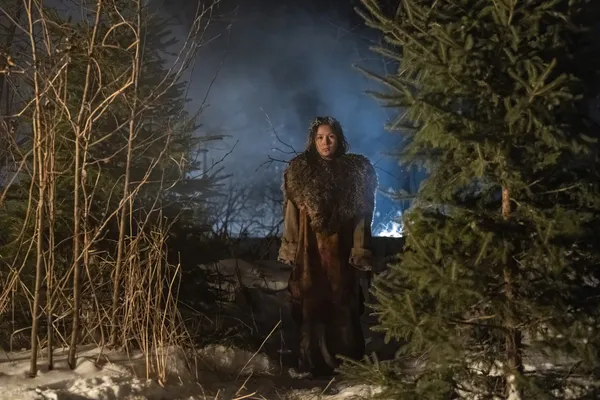
The story begins at a frozen outpost on that continent, a wood-walled fort on a snowy plain at the edge of a pine forest. Cole (Luke Hemsworth) is a seasoned hunter returning empty-handed from a trip into that forest. It’s uncanny. There is just no game around – not even a rabbit. The trees are still and deathly quiet. The commanders of the fort are dismayed that he has brought them nothing. The civilians staying there, who in normal times make their living in the fur trade, are so desperate for food that they are on the brink of revolt. They already distrust Cole, who once hunted indigenous people for money and now lives with an Ojibwe woman in a tent at the edge of the settlement. He’s an outsider, not quite like the others. Even he knows that Ahnung (Leenah Robinson) is too good for him. Her grandmother Nokomis (Pamela Matthews) regards him with a mixture of indulgence and suspicion.
The arrival at the fort of a young indigenous girl (Mara Pasley) shakes things up. She doesn’t speak, which they put down to trauma, but her presence suggests that there are other indigenous people camped not too far away, and they could have food that they’re willing to trade. A search party is quickly formed, including Cole, but what it finds will not bring comfort. Meanwhile, back at the camp, a subtle change is occurring amongst some of those with power. Nokomis’ suspicions deepen. It could be the beginning of an infection.
Made in close consultation with the people whose ancient lore it borrows, this is a film rich in detail, so solidly grounded and astute in its observation of real world horrors that viewers will find it easy to accept its more fantastical aspects. The characters are well drawn and the performances charismatic without being overly showy. Cinematographer Bryn McCashin (who also shot the very different Home Bodies for Walker this year) uses the blankness of the snow and the pale sky to emphasise the fort-dwellers’ isolation and the emptiness they face. When we spend time in the woods at night, he uses firelight to create claustrophobic spaces hemmed in by the nearest trees, even as fluctuating lines of shadow remind us that anything might be lurking behind them.
Conventional scenes of bloody horror are few, but when they happen, they present extremes which abruptly shift perspective for viewers and characters alike. Walker gives us the chance to be shocked again by things that the genre has made us used to slogging through. Even though those familiar with the wendigo – and even some who are not – have plenty of opportunity to see the worst excesses coming, they are not short on horror when they happen, and Walker captures that very particular species of fear which comes with the recognition that one is being preyed upon.
There is also, here, that vital element of the uncanny, something no serious Lovecraft-themed film can go without. You might notice in first in out-of-place expressions, or the sudden shift in register in a rich man’s voice, but these are tiny things compared to what is to come. You might see it reflected on a man’s face from a camera position that doesn’t fit your expectations. When the end comes, Walker does not hold back, and yet still there is that sense of an encounter with something unknowable, so remote from the ordinary course of life and reason that the terror imbued within it cannot fade.
You will not forget Ithaqua.
Reviewed on: 29 Aug 2026


