





Eye For Film >> Movies >> Iron Ladies (2025) Film Review




Margaret Thatcher was very deliberate in the way she characterised the miners’ strike on 1984. “The violence and intimidation we have seen should never have happened,” she said. “It is the work of extremists. It is the enemy within.”
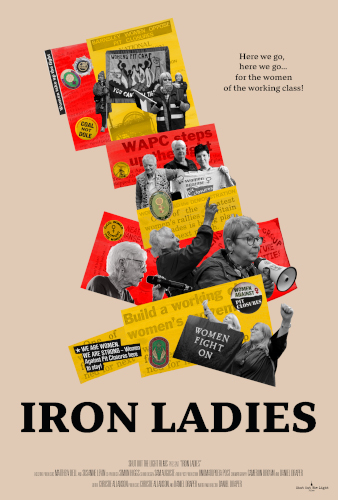
Of course, most of those striking were not violent, and there is ample footage of miners and their supporters being on the receiving end of police violence, though little of this made it onto the news at the time. Daniel Draper’s documentary takes a different look at the strike – from the perspective of the women involved with it. As one of them explains on Thatcher, “She was one iron lady. We were hundreds.”

They were hundreds of women who, when it all began, had no idea what a pivotal moment in history it would become. Draper’s argument is that it wasn’t a simple story of a fight picked in order to break the union movement, though it certainly had the effect. It was also, he suggests, a vital altercation for women, which would change the way they lived and understood themselves forever.
He begins his story in 1972, when miners were campaigning for better wages and better conditions. Women didn’t get involved on that occasion until, briefly, they added their weight to the campaign in 1974. Shortly afterwards, a deal was made, and the conflict and its conclusion were crucial factors in the fall of Edward Heath. Still, some of the miners themselves were unhappy, feeling that the women had overstepped the mark, that they should stay off the picket lines and get back to their kitchens.
To make sense of this, and to understand how out of step it was with a wider society willing to elect a female prime minister, one has perhaps to look a little further back, the Second World War. Mining was, then, a protected occupation. Miners did not get called up, and so their wives did not go into the workplace. Mining culture had, in fact, changed little since the start of the industrial revolution. “When babies came along you knew, if they were boys, they were going to be working at...the colliery,” one woman remembers. Miners’ daughters married miners. Living in isolated villages, many had next to no social contact with anybody else. It was this whole way of life, not just a few hundred theoretically replaceable jobs, that was at stake.
There is plenty to be said about the economic arguments around closing the pits – and, indeed, about the extent to which it might have slowed climate change, though few people were talking about that at the time – but these matters are not Draper’s concern. He’s interested in charting the history of the women who resisted – who stood on picket lines, ran soup kitchens, organised marches, engaged in fundraising efforts and more. We see photographs and film footage from the time, sometimes with direct commentary, along with interviews with quite a number of women in key locations: Durham, South Yorkshire, Staffordshire, Fife, Aylesham, County Durham.
One gets the feeling that most of these women could fill a documentary with fascinating stories all by themselves. Some of them talk about growing up political – about the impossibility of being anything else when experiencing the poverty that mining communities did, never mind recognising the dangers of the pits themselves. One contends that it tempers ran high at times, that might have something to do with it; that there’s a particular sense of horror at being betrayed by a man whom, down there in the darkness, ne might depend on for one’s life.
They speak, for the most part, from modest but nicely kept living rooms, in which one or two have spread out their old banners for the camera. These are very different lives that they are living now, and many have experienced things that they never imagined for themselves; that their female ancestors had. Going into education; leaving abusive marriages; campaigning for women’s rights; even holding political office. Some are in their eighties now but they’re still self assured and always ready to learn. They smile as a young woman explains present day fundraising technology.
Draper shows us still images of the relics that remain where the pits were. Crumbling, purposeless buildings on empty moorland. Great iron structures rusting under the grey sky, inviting speculation by future archaeologists. Pages of clipped newspaper headlines turn over, year by year. “This constant false narrative: ‘the police clashed with the miners’,” one woman recalls, frustrated. “The police attacked the miners. It wasn’t a clash.” Another, who was a girl at the time, recalls threatening a policeman for repeatedly kicking her mother’s legs. The particular cruelty of the Met stands out in memory, and one thinks of what some women have had to say about it more recently.
There is plenty of food for thought here for people getting interested in activism today, though some bits of advice are now out of date. Towards the end, Draper explores the curious relationship between the women and feminism, with many not identifying that way, seeing it as something for the middle classes. One recalls the many arguments, down the years, as to whether or not Thatcher should be seen as a feminist. In light of what they gained from their experiences, most here do not even see her as the victor. Besides, as one puts it, “She’s dead and we’re still ‘ere.”
Reviewed on: 08 Oct 2025



Director: Daniel Draper
Writer: Daniel Draper
Starring: Linda Allbutt, Kate Alvey, Kay Case, Betty Cook, Aggie Currie, Linda Erskine, Kate Flannery, Liz French
Year: 2025
Runtime: 98 minutes
Country: UK
Festivals:
Search database:
