





Eye For Film >> Movies >> Happyend (2024) Film Review



For as long as humans have existed, there have been individuals and organisations work hard to devise the perfect for of tyranny, of control over others. We took take heart from the fact that none have succeeded to date. It is of course fair to argue, as many do, that the risk is growing thanks to the development of military and security technologies, but here, as in other areas related to tech, there is chronic tendency to overlook the social factors. Human beings are complicated and messy. We do things for irrational reasons. We fall in love with inconvenient people and make big sacrifices to be with them. Sometimes we break things just because we can do, without though to the consequences. And, especially when we’re young, many of us feel drawn to creative mischief.
Neo Sora’s Happyend is set in a future not far distant from today. its events take place in a high school, so we observe the world from the perspective of people who are just adapting to it themselves. Yuta (Hayao Kurihara) is popular but rebellious in a playful way, buoyed up by family money which means he’ll never be obliged to take life too seriously. Kou (Yukito Hidaki) is his best friend, a youth who enjoys many of the same pranks but who, due to his Korean ethnicity, has to be a bit more careful. He’s not only vulnerable to casual racism, as is his restaurant-owner mother, but he doesn’t have the same kind of ID card, with attendant privileges, as his friend.
After a high spirited opening sequence in which the two sneak into a gig together and, following a police raid, have a friendly encounter with the DJ, the film focuses on their school lives. They are part of an informal gang, hanging out with pals Tomu (Arazi), Ata-chan (Yuta Hayashi) and Ming (Shina Peng). Most of their exploits centre around music, in which they have a fair bit of skill (Lia Ouyang Rusli’s eclectic score is one of the highlights of the film), but sometimes they try something a little bolder. It’s an incident involving the principal’s car that kicks off the sequence of events on which the film is centred.
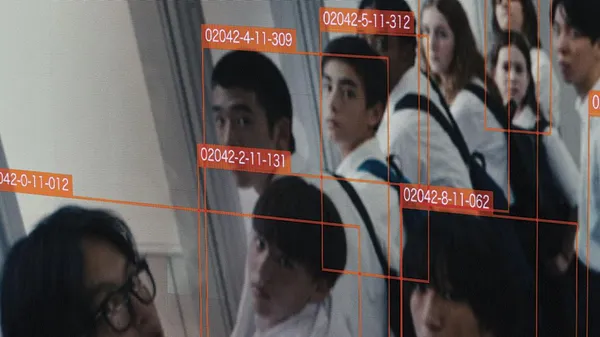
Played by Shiro Sano, the principal is not the monster that some of the kids perceive him as. in the circumstances, he’s extraordinarily patient, and he demonstrates the understanding of and sympathy for young people that are really essential to doing that job well. This does not, however, mean that he’s willing to put up with anything and eveything without taking action. Subsequent to the car incident, the schoolkids find themselves the objects of a new surveillance system which tracks them whenever they’re on the premises, always able to tell who is who, giving them points whenever it identifies an infraction. Too many points means that parents will be summoned, or worse.
The system, of course, can be fooled or exploited, sometimes hilariously. Adults, and even technology company executives, rarely see the weaknesses in such systems as quickly as young people do – they just can’t keep up. Nevertheless, there are consequences, whether it’s young lovers getting in trouble for illicit hugging, or politically active students finding themselves compromised. It’s in this situation that Kou finds himself drawn to the more seriously rebellious Fumi (Inori Kilala), who awakens his political consciousness, making him aware of the world beyond the school in a new way.
The other consequence of seeing the world through young people’s eyes is that we are somewhat sheltered. This enables Sora to dispense with the clichés of dystopian settings. We get hints of the bigger picture through Fumi’s concerns and by way of scenes in which we glimpse protestors running or being arrested in the background, as well as the way that police in that initial club scene identify people with a quick visual swipe of their faces. We can imagine the rest. Over time, Kou’s growing understanding distances him from Yuta, but the latter will ultimately experience an awakening of his own, and the intense affection on which their friendship is built never really fades.
A thoughtful, shrewd examination of the impact of rapidly developing technologies, filtered through a sensitively depicted high school world, Happyend is an impressive piece of cinema and well worth your attention.
Reviewed on: 19 Sep 2025


Director: Neo Sora
Writer: Neo Sora
Starring: Makiko Watanabe, Ayumu Nakajima, Shirô Sano, Yukito Hidaka, Hayato Kurihara, Shina Peng, Kilala Inori, Arazi, Yûta Hayashi, Pushim
Year: 2024
Runtime: 113 minutes
Country: Japan, US
Search database:
