





Eye For Film >> Movies >> Dracula: The Night Around Us (2026) Film Review



One of the qualities of the great novels is that their plots have the potential to be reworked in a multitude of ways without depleting their essence. I maintain that nobody who can’t make Dune work on an empty soundstage should be allowed anywhere near the deserts and costumes and special effects. Dracula is something similar. We have come to expect towering masonry, velvet capes and bats fluttering across the moon, but this is just window dressing. Chris Schwab’s contribution to Frightfest 2026 is a reminder that none of it really matters.
We cruise into his updated version along a lonely road, past a sign which says ‘Borgo Pass – construction ahead – your tax dollars at work’. It’s dark, of course, but it will get darker. At the wheel is Andy, munching on a wafer. He’s about to have an unpleasant encounter – one he could perhaps avoid if he kept his own darkness in check. But that’s the thing about Dracula: it’s not just the story of one bad man, or monster. It’s about the way that he draws out certain traits in those around him, polluting everything he touches, like an infection.

Bram Stoker’s novel is sometimes cited as an early work of medical fiction, being full of medical innovations which would have been exciting to readers when it was published, and Schwab’s film focuses heavily on that aspect of it, taking as its central character the underexplored figure of Dr. John Seward. Played by Eric Toms, he enters the updated narrative just as Renfield (Spencer Weitzel) arrives at the institution where he works. This is a puzzling patient whose early signs of monomania give way to something more complex. A psychiatrist should know better than to interact with him as John does, but perhaps the doctor has a problem with getting closer than he should. A colleague hints at a scandal in his past. We never learn what it is, but it should still make us cautious – and, perhaps, prompt us to observe the ways in which he is cautious about himself.
Another change occurs in Seward’s life when he gets home to find that he has new neighbours: Mina (Marlene Mc’Cohen) and her seven-year-old daughter Lucy (Raelan Mackiewicz). The latter is playful and friendly from the out; the former wary to the point of aggression, but later apologetic to the point of inviting him into her home to eat. She, too, has a past only hinted at. We hear nothing of Jonathan, but do see her take out her anger on a photograph of herself and Lucy standing beside a man. There’s a guardedness about her which suggests a woman on the run, always looking over her shoulder. Though Seward welcomes her presence in his otherwise rather colourless life, there’s a degree to which their friendship is transactional; she wants a man around to watch her back. She also, before long, needs a doctor around, after a disturbing incident in which Lucy, prone to sleepwalking, is assaulted by something whose bizarre appearance she cannot reconcile, and develops a worrying form of anaemia.
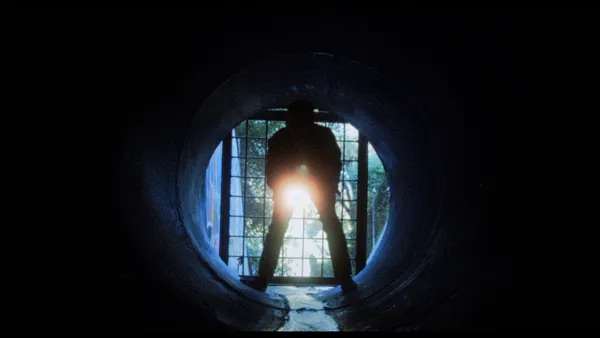
Dracula is not a novel in which it is necessary to greatly outsmart the enemy or to prove one’s mettle through combat. It is much more interested in fear and what it takes to persuade ordinary people to face it. Schwab invests heavily in atmosphere. Here, the title character is the fiend of Stoker’s imagination: not a man but a leathery black creature with claw-like fingernails; an abuser, not a seducer. Against this, the doctor’s familiar tools, his reason, his systematic approach to problem-solving, are useless. He can draw on no lore with which he is familiar. His only hope lies in venturing down into the darkness of the monster’s lair in a sequence so off-kilter as to seem dreamlike. In the process, he must also face the darkness within himself, his fear of what he might be and do and become. He can no longer draw a clear line between his own status and that of Renfield. The very notion of sanity becomes difficult to define.
Lucy in her white dress, looking like Rowan Morrison or any number of anthropomorphised angels, is the image of purity, the bright light against which the darkness is defined, and in her presence, it is impossible to deny its presence. Schwab’s film is deliberately uncomfortable, conjuring a fiend not easily cast out.
Reviewed on: 31 Aug 2026


